−10%
What's Included
- EGP 5,000
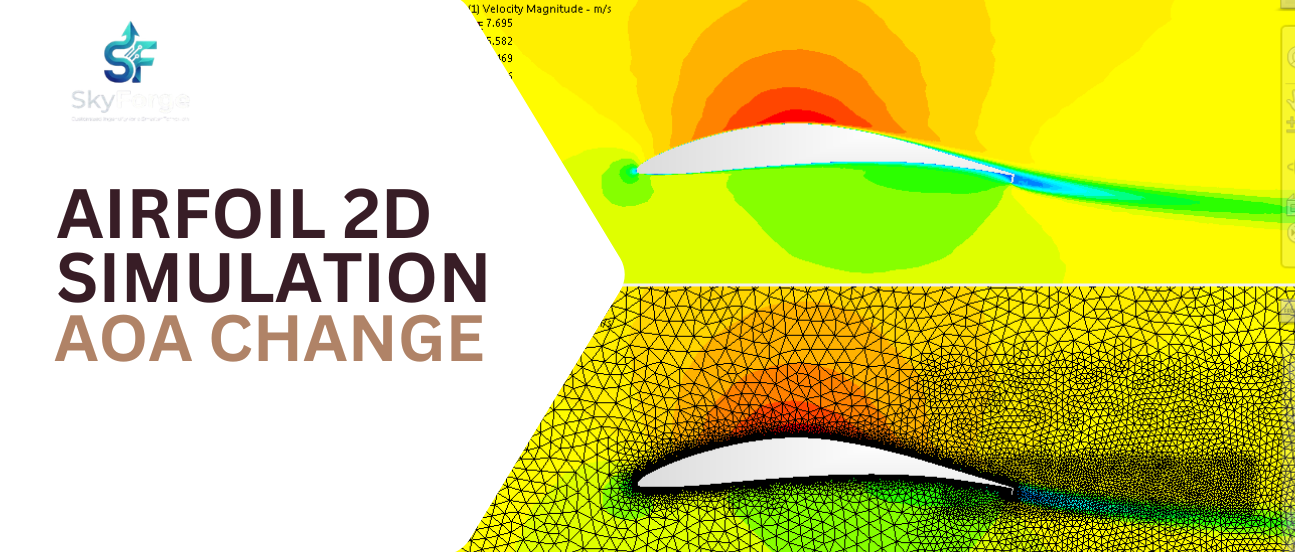 EGP 0ProductAirfoil 2D simulation AOA changeWith 2d airfoil case file, 2d airfoil Data file, parametric case, parametric data
Total valueEGP 5,000
About this bundle
Aerospace CFD Starter Bundle
Your First Step Into Aviation Simulation — Practical, Guided, and Built for Real Engineering
What Is the Aerospace CFD Starter Bundle?
The Aerospace CFD Starter Bundle is the entry point we designed for engineers, students, and simulation enthusiasts who want to move from theory into real aerodynamic simulation without wasting time figuring out where to start. This bundle pairs two resources that were built to work together: a complete structured course module covering aviation and aerospace aerodynamics in ANSYS, and a ready-to-run free simulation project that puts an airfoil in your hands from day one. The moment you access this bundle, you are not reading about lift and drag — you are simulating them. You are not watching someone else set up a CFD case — you are building it yourself, with guidance that takes you through every decision from geometry import to result interpretation. This is the bundle that bridges the gap between knowing what CFD is and actually doing it at a level that reflects real aerospace engineering practice.
The bundle was designed around a single insight that shapes everything we build at Epsilon X Sky: the fastest way to learn simulation is to run a real case on a real geometry while someone who has done it many times explains exactly what is happening and why every choice matters. Abstract tutorials that teach software buttons in isolation produce engineers who can click menus but cannot set up a physically meaningful simulation. The Aerospace CFD Starter Bundle teaches the physics first, connects every software step to an underlying aerodynamic principle, and uses the airfoil — the most fundamental geometry in aviation — as the vehicle for that learning because it is simple enough to understand completely and rich enough to demonstrate every core CFD concept you will use throughout your career.
What Is Included
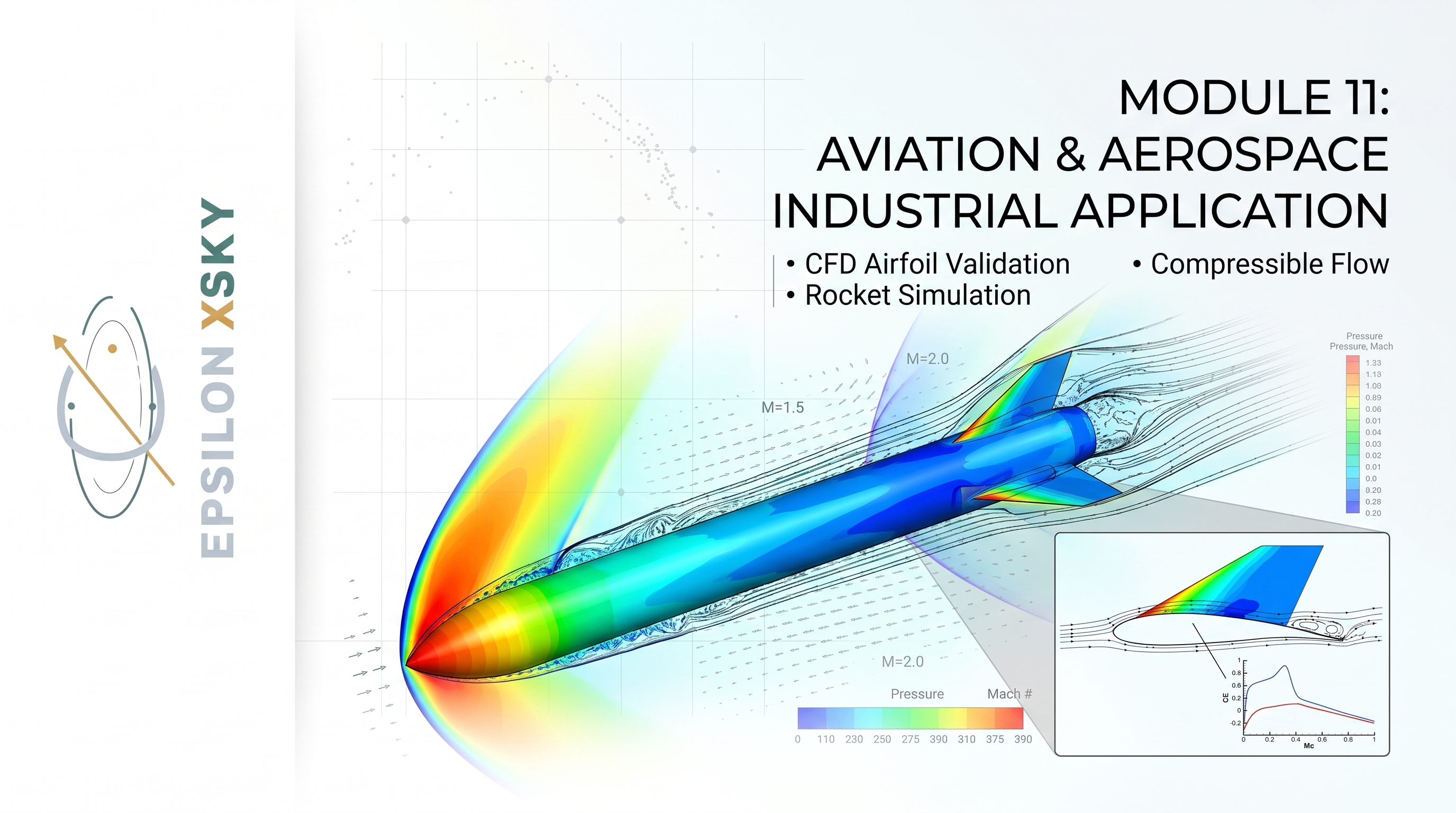
Module 11 — Aviation and Aerospace is a full-length course module built inside the Epsilon X Sky ANSYS training curriculum, covering the aerodynamic theory, simulation methodology, and result validation that define professional aerospace CFD practice. The module opens with the governing equations of compressible and incompressible flow as they apply to aircraft aerodynamics, establishing the physical foundation that every subsequent simulation step depends on. From there it moves into geometry preparation for aviation applications — how to handle airfoil profiles, wing sections, fuselage intersections, and the external flow domains that must be sized and shaped correctly to produce accurate far-field boundary conditions. Mesh strategy for aerospace CFD receives dedicated coverage, including structured C-mesh and O-mesh topologies around lifting surfaces, inflation layer sizing for boundary layer resolution, and the wake refinement zones that capture the trailing edge flow field where lift-induced drag originates.
The Airfoil 2D Simulation — Angle of Attack Change project is a complete, ready-to-run ANSYS Fluent simulation package that you can access and execute immediately upon joining the bundle. The project simulates a standard airfoil profile across a range of angles of attack, capturing the full aerodynamic polar from attached flow at low incidence through to the stall break where the boundary layer separates and lift collapses. The simulation files are pre-structured with a validated mesh and a solver setup that reflects genuine aerospace engineering practice — not a simplified tutorial geometry but a real airfoil case that produces results comparable to published experimental data. Running this project yourself, modifying the angle of attack, observing how the pressure distribution changes, watching the separation point move forward on the suction surface as incidence increases — this is the kind of hands-on experience that makes aerodynamic concepts permanently understood rather than temporarily memorised.
The project is listed as free — meaning your investment in Module 11 gives you immediate, zero-additional-cost access to a practical simulation resource that would cost significant time to build from scratch and significant money to access through commercial training providers. We list it as free because we believe the best way to demonstrate what our simulation resources deliver is to let you experience one before you commit to a full curriculum. Engineers who run the airfoil project consistently report that it changes how they think about CFD — not as a software operation but as a physical investigation conducted in a virtual wind tunnel.
Who This Bundle Is For
This bundle is the right starting point if you are an aerospace or mechanical engineering student who has studied aerodynamics from textbooks and now needs to connect that theoretical knowledge to the simulation tools that industry actually uses. The gap between university aerodynamics coursework and professional CFD practice is real and it costs graduates significant time when they enter employment. This bundle closes that gap directly.
This bundle is right for you if you are a working engineer in a related field — structures, propulsion, systems — who needs to develop aerodynamic CFD capability either because your role is expanding or because you want to move into aerodynamics as a specialism. Module 11 assumes engineering competence and does not waste your time on introductory material that you already know — it moves quickly into the simulation methodology that matters.
This bundle is right for you if you have already worked through introductory CFD training and want to apply that foundation to aviation-specific geometries and flow regimes. The aerodynamics of lifting surfaces, compressibility effects at higher Mach numbers, boundary layer transition, and stall prediction are all aeronautical applications that require domain-specific knowledge beyond general CFD competence, and Module 11 provides exactly that specialisation.
This bundle is right for you if you are building a simulation portfolio and need a validated, professionally structured project that demonstrates real aerodynamic capability. The airfoil simulation with angle of attack sweep is exactly the kind of case that showcases CFD competence to employers and clients — it has a well-known physical answer that validates your methodology, and it demonstrates understanding of lift generation, pressure distribution, and flow separation that goes far beyond generic pipe flow or heat transfer examples.
What You Will Be Able to Do After Completing This Bundle
You will be able to set up a complete external aerodynamic simulation from scratch in ANSYS Fluent — from airfoil geometry import through domain definition, mesh generation with appropriate boundary layer resolution, turbulence model selection, solver configuration, and converged solution extraction. Every step will be grounded in physical understanding rather than procedural instruction, meaning you will be able to adapt the methodology to new geometries and flow conditions rather than only repeating the exact case you practised.
You will be able to generate and interpret the complete aerodynamic polar of a lifting surface — the lift coefficient, drag coefficient, and pitching moment coefficient as functions of angle of attack, including the prediction of stall onset and post-stall behaviour. This is the fundamental output of any airfoil aerodynamic analysis and the baseline from which wing design, aircraft performance analysis, and stability assessment all proceed.
You will understand how mesh topology and resolution choices affect aerodynamic result accuracy, and you will be able to make informed decisions about where to invest mesh resolution — the leading edge, the trailing edge, the boundary layer, the wake — and where coarser cells are acceptable without compromising the physical validity of the results.
You will be able to validate your CFD results against published experimental data, understanding what level of agreement is achievable with RANS turbulence models, where the models are known to underperform (particularly in separated flow regions near stall), and how to communicate the limitations of your results with the technical honesty that professional engineering practice demands.
You will have a completed, documented simulation project in your portfolio — the airfoil angle of attack sweep — that demonstrates genuine aerodynamic CFD capability with a physically validated outcome. This is not a certificate of course completion. It is evidence of engineering work that you can show to employers, clients, and collaborators as proof of what you can do.
Why the Free Airfoil Project Changes Everything
Most simulation training asks you to commit fully before you experience anything. You purchase a course, you work through hours of content, and somewhere much later you run a simulation that may or may not match what you were hoping to learn. The Aerospace CFD Starter Bundle inverts that sequence deliberately. The free airfoil project is your first experience, not your reward for finishing. You run it before you have completed Module 11. You see results — real pressure contours, real velocity fields, real lift and drag coefficients — before you have invested significant time or money. You experience what Epsilon X Sky simulation resources feel like before you decide whether this is the right training environment for you.
The airfoil project also serves as a diagnostic tool for your own knowledge. As you run it, you will encounter questions — why is the mesh structured this way around the leading edge? why is this particular turbulence model selected rather than another? what does this pressure coefficient distribution tell me about where lift is being generated? If you can answer those questions confidently, you are ready to move quickly through Module 11. If those questions reveal gaps in your understanding, Module 11 addresses every one of them systematically. Either way, the project tells you something useful about where you stand and what you need to develop.
The connection between the free project and Module 11 is not accidental. Every topic in the module connects directly to something you encountered when running the airfoil simulation. When Module 11 covers C-mesh topology, you already know why it matters because you saw it in the project mesh. When it covers the Spalart-Allmaras turbulence model, you have already used it in a real case. When it discusses stall prediction limitations of RANS models, you have already seen those limitations in your own results. Learning is always faster when it connects to experience rather than starting from abstraction, and the Aerospace CFD Starter Bundle is structured to exploit that principle at every stage.
Epsilon X Sky — Customized Ingenuity for a Smarter Life