Automotive
Fin & Tube Heat Exchanger H-VAC Unit
2,000 EGP
1 project

1 projects
Automotive


8
Automotive engineering has become one of the most advanced fields leveraging Computational Fluid Dynamics (CFD) to optimize vehicle performance, safety, and efficiency. CFD enables engineers to simulate airflow behavior, thermal systems, and internal fluid flow without relying solely on expensive wind tunnel testing.
In modern vehicle development, CFD is essential for analyzing aerodynamic drag, lift forces, cooling performance, cabin comfort, and energy efficiency, especially with the rapid growth of electric vehicles and sustainability requirements.
At epsilonX CFD Shop, we provide automotive-oriented CFD templates, simulation workflows, industrial courses, and engineering tools designed to replicate real-world automotive development processes.


7
External aerodynamics focuses on airflow around the vehicle body. Engineers aim to reduce drag and control lift to improve stability and fuel efficiency.
Key objectives:
Drag reduction (fuel efficiency / EV range)
Downforce generation (vehicle stability)
Flow separation control
Wake region minimization


7
Thermal CFD is critical for managing heat inside vehicles, especially in electric vehicles (EVs).
Applications include:
Radiator airflow
Battery cooling systems
Electronics cooling
HVAC thermal distribution
Under-hood heat management


5
Internal flow simulations help optimize fluid movement inside vehicle components.
Applications:
Intake manifolds
Exhaust systems
Fuel injection systems
Turbochargers
Cooling ducts


8
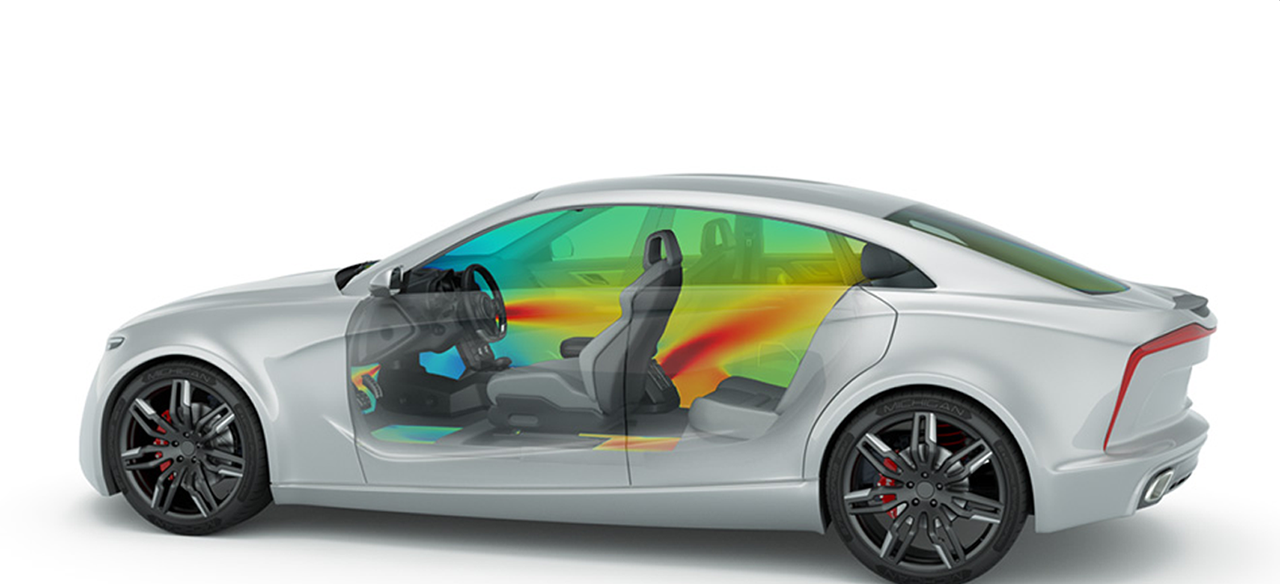
CFD ensures passenger comfort by analyzing airflow and temperature inside the cabin.
Key factors:
Air distribution uniformity
Thermal comfort
Defogging and defrosting
Air quality
To accurately simulate automotive systems, several fundamental equations are used:
D=12ρV2CDAD
Drag is one of the most critical parameters in vehicle design. Reducing drag directly improves fuel efficiency and EV driving range.
Re=ρVLμRe
Determines whether the flow is laminar or turbulent, which strongly affects aerodynamic performance.
Cp=P−P∞12ρV2
Used to analyze pressure distribution across the vehicle body.
L=12ρV2CLAL
Important for vehicle stability and tire grip at high speeds.
h=qA(Ts−T∞)h
Used in cooling system design and thermal performance evaluation.
k-ε model → general-purpose
k-ω SST → high accuracy near walls
LES → high-fidelity simulations
Boundary layer inflation
Refinement near walls
Wake region resolution
Y+ control for accuracy
External flow → turbulent
Internal flow → mixed regimes
High-speed → compressibility effects
Mesh independence study
Experimental comparison
Convergence monitoring
Residual tracking


8
CFD provides major advantages:
Reduces wind tunnel testing cost
Accelerates design iterations
Improves vehicle efficiency
Enhances safety and stability
Enables virtual prototyping
Supports electric vehicle innovation
At epsilonX, we provide a dedicated automotive CFD ecosystem including:
Full vehicle aerodynamics
Cooling system models
Intake & exhaust simulations
HVAC systems
Real project workflows
Industry-standard practices
ANSYS Fluent deep training
Report templates
Post-processing setups
Mesh strategies
Validation guides
At epsilonX, we specialize in delivering high-quality solutions in aerodynamics and aerospace CFD simulation using industry-leading tools, ANSYS Fluent aerodynamics software. Our team is highly experienced in conducting aerodynamic CFD simulations and analysis, advanced modeling of compressible and turbulent flows, and CFD of external aerodynamics and turbomachinery. Whether you’re looking for an ANSYS Fluent aerodynamics tutorial, a complete CFD analysis in aerodynamics, or need assistance with your aerospace CFD projects, we’ve got you covered.
You can explore our portfolio of completed aerodynamics CFD software projects at the top of this page or browse through our ready-made simulations in the CFD SHOP.