Long-Span Bridges — Advanced Wind–Structure Interaction Engineering
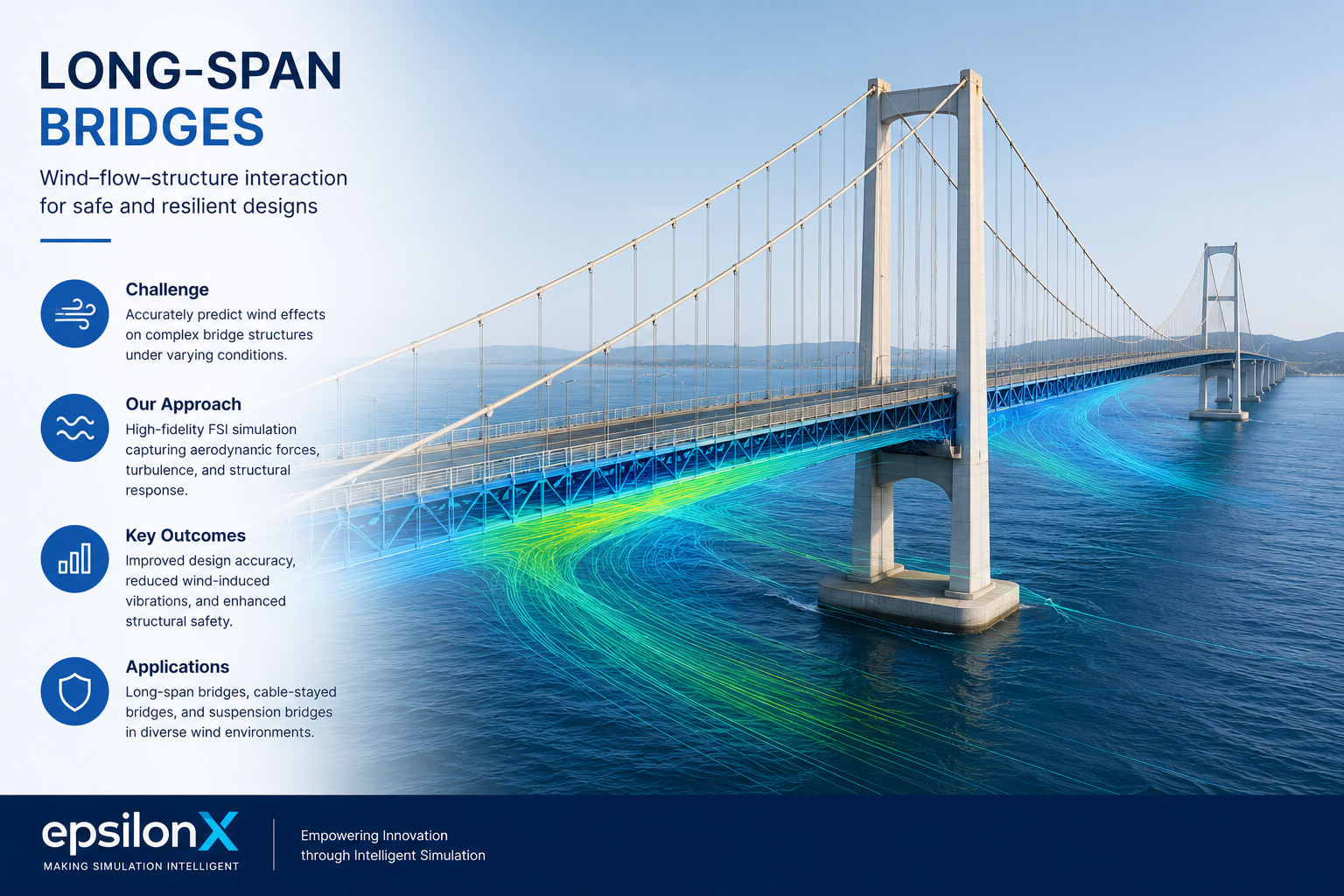
The design of long-span bridges represents one of the most technically demanding fields in modern structural and aerodynamic engineering. As bridge spans continue to increase, the interaction between atmospheric wind flow and structural flexibility becomes a dominant factor governing safety, durability, and operational reliability. Unlike conventional rigid structures, long-span bridges behave as highly flexible dynamic systems where aerodynamic loading continuously interacts with structural deformation, creating complex coupled phenomena that cannot be accurately predicted using traditional static engineering methods alone.
At epsilonX, sponsored by SkyForge, we specialize in advanced multiphysics simulation methodologies dedicated to Fluid–Structure Interaction (FSI) analysis for long-span bridge systems. Our engineering approach combines high-fidelity Computational Fluid Dynamics (CFD), transient structural dynamics, aeroelastic analysis, and bidirectional system coupling to accurately reproduce real operational behavior under realistic environmental conditions.
The primary engineering challenge in long-span bridge design originates from the nonlinear relationship between aerodynamic forces and structural response. Wind flow around bridge decks generates transient pressure distributions, vortex shedding patterns, turbulent wake regions, and fluctuating aerodynamic forces. Simultaneously, the bridge structure itself responds dynamically through displacement, torsion, bending, vibration, and modal interaction. These structural movements then modify the surrounding airflow field, creating a continuously evolving coupled system where both domains directly influence each other throughout the simulation process.
This interaction becomes particularly critical in suspension bridges and cable-stayed bridges where reduced structural stiffness and large unsupported spans significantly amplify aeroelastic sensitivity. Under certain wind conditions, instability mechanisms such as flutter, galloping, buffeting, and vortex-induced vibrations may develop. These aerodynamic instabilities can produce severe structural oscillations, accelerated fatigue accumulation, excessive displacement amplitudes, and in extreme scenarios, catastrophic structural failure.
To accurately capture these phenomena, epsilonX utilizes transient CFD methodologies capable of resolving highly unsteady aerodynamic behavior. Depending on project requirements, the aerodynamic solution may involve Reynolds-Averaged Navier–Stokes (RANS), Unsteady RANS (URANS), Detached Eddy Simulation (DES), or Large Eddy Simulation (LES) techniques. These numerical approaches allow detailed reconstruction of turbulence transport, flow separation, wake interaction, vortex formation, atmospheric boundary layer behavior, and transient gust loading.
The governing fluid mechanics within the aerodynamic domain are represented using the incompressible Navier–Stokes equations:

These equations describe the conservation of momentum within the airflow domain while accounting for transient acceleration, viscous transport, pressure gradients, and external forces acting on the fluid. Accurate resolution of these equations enables prediction of local pressure coefficients, aerodynamic drag, lift generation, turbulence intensity, and fluctuating loading behavior along the bridge structure.
On the structural side, the bridge system is modeled using advanced finite element methodologies incorporating transient structural dynamics, modal superposition, nonlinear deformation analysis, and fatigue assessment. Structural simulations include the bridge deck, suspension cables, pylons, stay cables, cross members, bracing systems, and support interfaces. The structural response is governed by the classical dynamic equilibrium

Within this equation, the mass matrix, damping matrix, and stiffness matrix collectively determine the dynamic characteristics of the bridge system under aerodynamic excitation. The external loading vector originates directly from the transient aerodynamic pressures computed by the CFD solver.
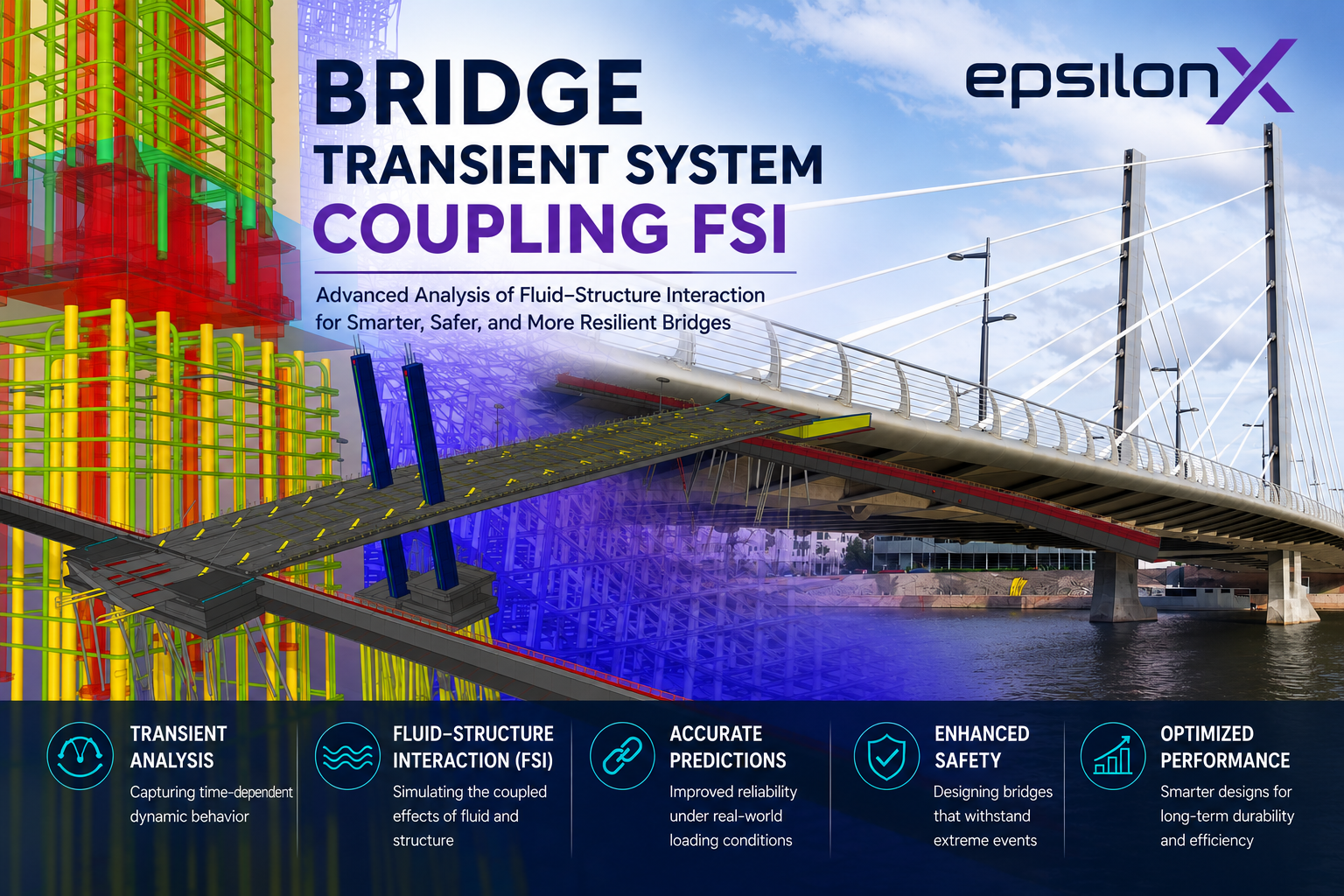
The most critical aspect of the engineering methodology lies within the two-way coupling framework itself. In conventional one-way analyses, aerodynamic forces are transferred to the structural model without allowing structural deformation to influence the airflow field. Such approaches may significantly underestimate aeroelastic effects in highly flexible bridge systems. For this reason, epsilonX applies fully coupled bidirectional FSI methodologies in which aerodynamic forces continuously deform the structure while structural displacement simultaneously updates the computational fluid domain geometry.
This iterative exchange mechanism enables accurate prediction of flutter onset velocity, resonance amplification, transient displacement evolution, and nonlinear aeroelastic instability mechanisms under realistic atmospheric loading conditions.
Our engineering workflow also incorporates atmospheric boundary layer reconstruction to replicate actual wind environments encountered by bridge systems in coastal, urban, offshore, and mountainous regions. Wind profiles are developed according to international engineering standards while accounting for terrain roughness, turbulence scales, gust intensity, and directional variability. This allows the simulation environment to closely replicate operational conditions encountered throughout the bridge lifecycle.
Advanced modal analysis is integrated within the structural workflow to identify critical natural frequencies and mode shapes susceptible to aerodynamic excitation. Particular attention is given to torsional modes, lateral bending modes, cable vibrations, and coupled deck oscillation patterns. Through harmonic response and transient excitation studies, epsilonX evaluates resonance susceptibility and identifies critical operational wind speeds associated with dynamic amplification.
Beyond safety assessment, our simulations are heavily focused on design optimization. Using simulation-driven engineering methodologies, we optimize aerodynamic deck geometry, cable configurations, damping systems, structural stiffness distribution, and material allocation strategies to minimize aerodynamic instability while maximizing structural efficiency. These optimization studies contribute directly to reducing structural weight, lowering construction costs, improving fatigue resistance, and extending operational service life.
The final engineering deliverables include detailed aerodynamic pressure maps, displacement envelopes, stress distribution fields, fatigue hotspot identification, modal participation analysis, vortex shedding characterization, flutter speed prediction, safety factor evaluation, and structural performance recommendations. The resulting datasets provide engineers and infrastructure developers with a comprehensive understanding of bridge behavior under real environmental conditions.
At epsilonX, our philosophy extends beyond conventional simulation practices. We combine industrial-scale numerical methodologies with advanced engineering interpretation to transform simulation into a practical decision-making platform capable of supporting next-generation infrastructure development. Through the integration of CFD, structural mechanics, and intelligent multiphysics coupling, we deliver engineering solutions aligned with the highest international standards of safety, resilience, and innovation.
References
ANSYS System Coupling Technology
ANSYS Fluent CFD Platform
ANSYS Mechanical Structural Analysis
FHWA Bridge Aerodynamics and Wind Engineering