Crashworthiness Simulation in Modern Vehicle Development: The Science Behind Virtual Crash Testing
5 min read
The Science Behind Automotive Crashworthiness Simulation
How Virtual Engineering is Revolutionizing Vehicle Safety
Introduction
Vehicle safety has evolved dramatically over the past few decades. In the early years of automotive engineering, manufacturers relied almost entirely on physical crash testing to evaluate vehicle performance during collisions. While these destructive tests provided valuable insights, they required significant time, financial investment, and multiple prototype vehicles before a final design could be approved.
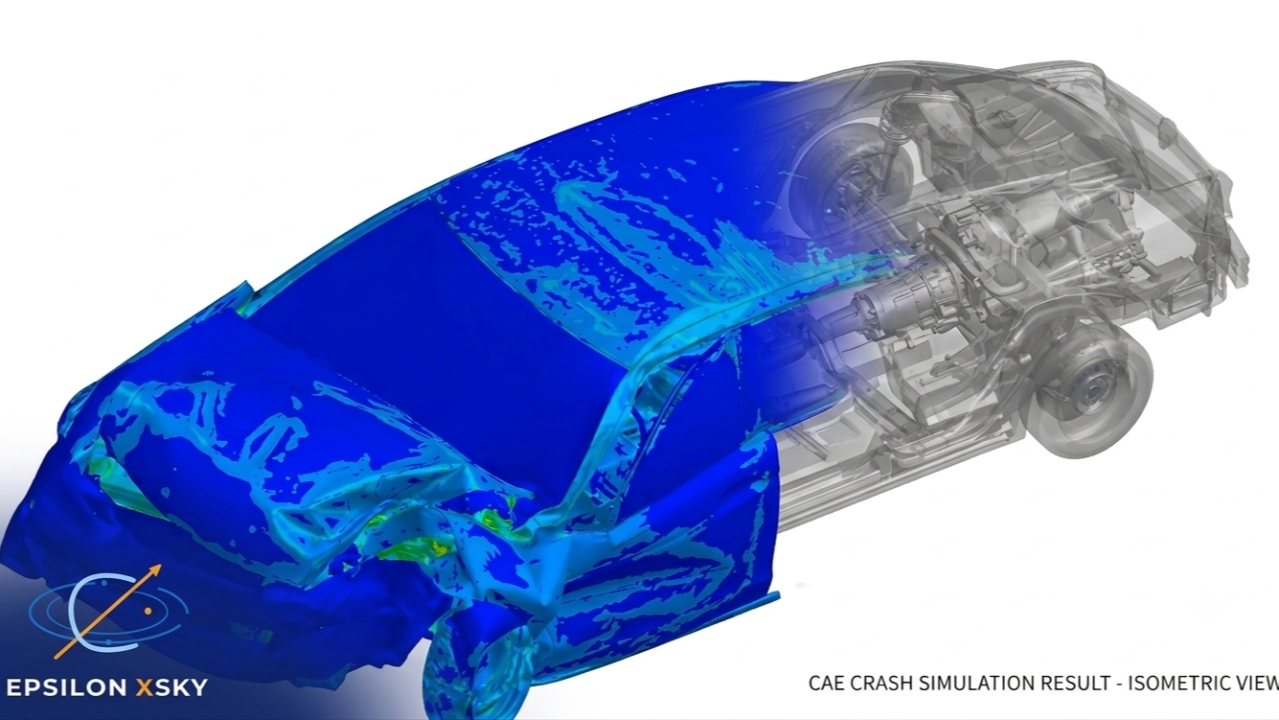
Today, the automotive industry follows a fundamentally different approach. Before a single prototype is built, engineers perform hundreds of high-fidelity virtual crash simulations to predict how a vehicle will respond under various impact scenarios. Using advanced Computer-Aided Engineering (CAE) tools, manufacturers can evaluate structural deformation, energy absorption, occupant safety, and material failure with remarkable accuracy.
This digital development process has transformed vehicle engineering by reducing development costs, shortening design cycles, and enabling safer, lighter, and more efficient vehicles. Leading manufacturers such as BMW, Mercedes-Benz, Tesla, Toyota, Ford, Volvo, and Volkswagen all rely heavily on nonlinear crash simulation throughout the product development process.
Understanding Crashworthiness
Crashworthiness refers to a vehicle's ability to protect its occupants during a collision while minimizing structural damage and reducing injury risk. Contrary to popular belief, the safest vehicle is not necessarily the strongest or most rigid one. Instead, modern vehicle design focuses on controlled energy absorption.
During an impact, specially designed crumple zones deform progressively, converting kinetic energy into plastic deformation while preserving the structural integrity of the passenger compartment. This controlled collapse significantly reduces the forces transmitted to occupants and helps maintain a survivable space inside the vehicle.
Achieving this balance between structural stiffness and controlled deformation is one of the greatest challenges in automotive engineering.
The Physics Behind Vehicle Collisions
Every moving vehicle possesses kinetic energy, defined by the well-known equation:
[
E_k=\frac{1}{2}mv^2
]
where:
m is the vehicle mass
v is the vehicle velocity
Because kinetic energy increases with the square of velocity, even small increases in speed result in significantly greater impact energy. For example, a 1,500 kg passenger vehicle traveling at 64 km/h carries approximately 233 kJ of kinetic energy, all of which must be dissipated within roughly 80–120 milliseconds during a frontal collision.
The objective of crash engineering is not to eliminate this energy but to manage how it is absorbed. Through carefully designed load paths, reinforced passenger compartments, and progressive structural collapse, engineers ensure that the majority of impact energy is absorbed by the vehicle structure rather than transferred to the occupants.
Why Crash Simulation Requires Advanced Numerical Methods
Vehicle crashes involve some of the most complex mechanical phenomena encountered in engineering. During an impact, structural components experience extremely large deformations, rapid plastic yielding, buckling, fracture, and continuous contact with neighboring parts.
Traditional linear finite element analysis cannot accurately capture these highly nonlinear events. Instead, automotive crash simulations employ explicit dynamic finite element methods, which solve the governing equations of motion using extremely small time increments—typically between 10⁻⁷ and 10⁻⁶ seconds.
Although a full crash event lasts only a fraction of a second, millions of computational time steps may be required to accurately predict the vehicle's structural response.
Material Engineering for Crash Safety
Modern vehicles are constructed using a carefully optimized combination of materials, each selected for a specific structural purpose.
High-strength and ultra-high-strength steels are commonly used in the passenger safety cage to maintain structural integrity during severe impacts. Boron steel reinforces critical areas such as A-pillars and B-pillars, providing exceptional resistance to intrusion. Aluminum alloys help reduce vehicle weight while maintaining stiffness, improving both crash performance and fuel efficiency. Composite materials are increasingly employed in high-performance and electric vehicles due to their excellent strength-to-weight ratio.
Accurately predicting the behavior of these materials requires sophisticated constitutive models capable of describing strain-rate sensitivity, plastic deformation, and failure under dynamic loading conditions.
Commercial Software Used in Industry
Automotive manufacturers rely on specialized explicit dynamic solvers capable of modeling highly nonlinear crash events with exceptional accuracy.
Among the most widely used software packages are:
LS-DYNA – Industry standard for full-vehicle crashworthiness, occupant safety, airbags, and structural impact.
Ansys LS-DYNA – Integrates LS-DYNA capabilities within the Ansys ecosystem, enabling multiphysics workflows.
Ansys Autodyn – Designed for blast loading, penetration, ballistic impact, and extreme transient dynamics.
Altair Radioss – Extensively used for vehicle crash certification, side impact, and pedestrian safety analyses.
Abaqus/Explicit – Commonly applied to composite impact, manufacturing processes, and nonlinear dynamic events.
PAM-CRASH – Specialized in occupant protection, restraint systems, and regulatory crash certification.
These tools allow engineers to simulate everything from structural collapse and airbag deployment to battery protection in electric vehicles.
Validation: From Virtual Models to Physical Reality
Despite remarkable advances in computational engineering, simulation alone is never sufficient. Every numerical model must be validated against experimental testing to ensure predictive accuracy.
Validation typically involves material characterization, component impact testing, sled tests, and full-scale crash experiments. Engineers compare simulation results with measured acceleration histories, structural deformation, intrusion levels, and force-time curves to confirm that virtual models accurately represent real-world behavior.
This continuous correlation process builds confidence in simulation results and enables manufacturers to reduce the number of expensive physical prototypes without compromising safety.
The Future of Crashworthiness Simulation
The next generation of automotive safety engineering is being driven by advances in artificial intelligence, high-performance computing, and digital engineering.
Machine learning is beginning to assist engineers in optimizing vehicle structures, while cloud-based computing enables full-vehicle crash analyses to run on thousands of processor cores simultaneously. Digital twins and reduced-order models are also making it possible to evaluate vehicle performance in near real time, accelerating product development and enabling continuous design optimization.
As electric and autonomous vehicles become more common, crash simulation will continue to evolve, addressing new challenges such as battery protection, lightweight composite structures, and advanced occupant safety systems.
Conclusion
Crashworthiness simulation has become one of the most advanced applications of computational engineering. By combining nonlinear finite element analysis, explicit dynamics, material science, contact mechanics, and high-performance computing, engineers can accurately predict how vehicles behave during severe collisions long before physical prototypes exist.
Beyond reducing development costs and shortening design cycles, virtual crash simulation enables manufacturers to build safer, lighter, and more efficient vehicles that meet increasingly demanding international safety regulations.
At epsilonX, we leverage advanced CAE technologies to deliver high-fidelity crashworthiness, structural, and multiphysics simulations that support innovative engineering across the automotive, aerospace, energy, and industrial sectors. By combining engineering expertise with state-of-the-art simulation tools, we help organizations transform complex engineering challenges into reliable, optimized, and cost-effective solutions.
Share this article