Solar Power Plant Design and Performance Optimization Using ANSYS: CFD, FEA, Thermal Analysis, and Engineering Best Practices

Introduction
Solar energy has become one of the fastest-growing renewable energy technologies, transforming how electricity is generated across the world. Governments, utility companies, and private industries are investing heavily in large-scale solar power plants to reduce carbon emissions, improve energy security, and meet ambitious sustainability targets. As photovoltaic technology continues to evolve, maximizing the efficiency and reliability of solar installations has become an essential engineering objective. Every percentage increase in energy production can translate into significant financial returns over the lifetime of a solar power plant, making simulation-driven optimization a critical component of modern solar engineering.
Unlike conventional power stations, solar farms operate continuously under changing environmental conditions. Solar irradiance, wind speed, ambient temperature, humidity, dust accumulation, and structural loading all influence the performance of photovoltaic panels. High operating temperatures reduce electrical efficiency, strong winds create structural stresses on mounting systems, and poor panel arrangements can generate aerodynamic interference that affects cooling performance. Designing an efficient solar power plant therefore requires the integration of multiple engineering disciplines rather than considering electrical performance alone.
Modern engineering simulation enables designers to evaluate these complex interactions before construction begins. Instead of relying solely on field testing, engineers can predict airflow around solar arrays, analyze structural loading, evaluate thermal behavior, investigate wind-induced vibrations, and optimize plant layouts using advanced numerical methods. This significantly reduces project risk while improving long-term energy production and reducing maintenance costs.
At Epsilon X Sky, we utilize the complete ANSYS simulation environment—including ANSYS Fluent, ANSYS Mechanical, and multiphysics workflows—to optimize every aspect of solar power plant performance. Our engineering approach combines Computational Fluid Dynamics (CFD), Finite Element Analysis (FEA), thermal analysis, and optimization techniques to improve cooling, increase energy efficiency, enhance structural reliability, and maximize return on investment.

One of the greatest advantages of simulation-driven engineering is the ability to evaluate multiple design alternatives without constructing expensive physical prototypes. Engineers can investigate different panel spacing, tilt angles, mounting structures, cooling airflow patterns, wind loading conditions, and support frame configurations in a virtual environment. This allows engineering decisions to be based on physics rather than assumptions, leading to more reliable and economically efficient solar power plants.
Solar installations are also expected to operate for more than twenty-five years under continuously changing environmental conditions. Throughout this lifespan, mounting structures must withstand wind storms, thermal expansion, cyclic loading, corrosion, and material fatigue while maintaining accurate panel alignment. Consequently, structural integrity is just as important as electrical efficiency. Advanced simulation provides valuable insight into these long-term performance challenges before the first support structure is fabricated.
Another critical consideration is thermal management. Although photovoltaic panels convert sunlight into electrical energy, a considerable portion of incoming solar radiation is transformed into heat. Elevated operating temperatures reduce panel efficiency and accelerate material degradation. Engineers therefore use CFD to analyze natural and forced convection around solar panels, optimizing airflow and improving passive cooling. Even small reductions in operating temperature can produce measurable improvements in annual energy production.
Modern utility-scale solar farms also require careful layout optimization. Panel spacing influences both aerodynamic behavior and shading losses. Closely spaced rows maximize land utilization but may reduce airflow and increase operating temperatures. Wider spacing improves cooling but increases installation costs and land requirements. Numerical optimization enables engineers to identify the arrangement that delivers the highest overall energy yield while maintaining practical construction costs.
As renewable energy continues to expand worldwide, engineering simulation is becoming indispensable for designing reliable, efficient, and sustainable solar power systems. Through advanced ANSYS technologies, Epsilon X Sky helps developers, EPC contractors, and renewable energy companies optimize every stage of solar power plant development—from conceptual design to structural validation and operational performance enhancement.
This article explores the complete engineering workflow used to analyze and optimize solar power plants using ANSYS, covering CFD airflow simulations, structural analysis, thermal management, optimization strategies, and future engineering trends that are shaping the renewable energy industry.
Fundamentals of Solar Power Plant Engineering and the Role of ANSYS Simulation

Solar power plants convert solar radiation into electrical energy through photovoltaic (PV) modules that generate electricity when exposed to sunlight. Although the physical principle behind photovoltaic conversion is relatively straightforward, designing a highly efficient solar power plant involves solving numerous engineering challenges. Electrical performance depends not only on the efficiency of the solar cells themselves but also on structural stability, thermal behavior, aerodynamic cooling, environmental loading, and overall system integration.
The performance of a photovoltaic module is strongly influenced by its operating temperature. As the temperature of a solar cell increases, its electrical conversion efficiency decreases. Under intense solar radiation, panel temperatures can rise significantly above ambient conditions, particularly in regions with high solar irradiance and limited natural airflow. Engineers therefore devote considerable attention to cooling strategies that maintain lower operating temperatures throughout the day.
Natural convection serves as the primary cooling mechanism for most fixed photovoltaic installations. Air flowing beneath and around the panels removes heat generated by solar absorption, lowering cell temperatures and improving electrical output. However, the effectiveness of this cooling process depends heavily on panel spacing, tilt angle, support structure geometry, wind direction, and local atmospheric conditions. These complex interactions cannot be evaluated accurately using simplified analytical equations alone.
Computational Fluid Dynamics provides engineers with detailed insight into airflow behavior around photovoltaic arrays. Using ANSYS Fluent, engineers simulate wind movement across the solar farm, investigate velocity distributions beneath the panels, evaluate turbulence generation, and identify regions of poor airflow where excessive heat accumulation may occur. Optimizing airflow around photovoltaic panels is one of the most effective methods for increasing long-term electrical efficiency without modifying the panels themselves.
Structural reliability represents another critical aspect of solar power plant engineering. Solar panel mounting systems must withstand continuous exposure to wind, rain, thermal expansion, snow loads in colder climates, and occasional extreme weather events. Wind loading can produce significant uplift forces on photovoltaic panels, particularly near array edges where pressure distributions become highly non-uniform. These aerodynamic loads are transferred directly to support structures, foundations, and mechanical fasteners.
Finite Element Analysis using ANSYS Mechanical enables engineers to predict structural stresses, deformation, safety factors, and fatigue behavior under realistic environmental conditions. Engineers investigate support frame stiffness, connection integrity, foundation loading, and structural resonance to ensure long-term reliability throughout the service life of the installation. Structural optimization often reduces material usage while maintaining or even improving mechanical performance.
Thermal expansion introduces another important engineering consideration. Daily temperature fluctuations cause repeated expansion and contraction of support structures, mounting rails, and fasteners. Although these movements may appear relatively small, they accumulate over thousands of thermal cycles during the operational lifetime of the solar plant. Engineers therefore evaluate thermal stresses alongside mechanical loading to ensure that structural components remain reliable over decades of service.
Solar farms are also exposed to highly variable wind conditions throughout the year. Wind not only cools photovoltaic panels but also generates aerodynamic forces that influence structural stability. CFD simulations allow engineers to predict pressure coefficients across panel surfaces, identify regions of high uplift, and determine the most appropriate support configurations for different geographical locations.
At Epsilon X Sky, solar power plant engineering combines CFD, structural analysis, thermal simulations, and optimization within a unified simulation workflow. Rather than analyzing airflow, structural loading, and thermal behavior separately, our multidisciplinary engineering approach evaluates the complete physical interaction between these phenomena. This integrated simulation methodology produces more accurate engineering decisions while significantly reducing project development risks.
CFD Airflow Analysis, Thermal Performance, and Solar Farm Optimization Using ANSYS Fluent

One of the most significant advantages of using ANSYS Fluent in solar power plant engineering is the ability to predict airflow behavior across an entire photovoltaic field before construction begins. Although photovoltaic panels appear to be simple structures, the airflow surrounding them is highly complex. Wind direction, panel inclination, row spacing, terrain roughness, atmospheric turbulence, and surrounding structures all influence cooling performance and structural loading. Understanding these aerodynamic interactions is essential for maximizing energy production while ensuring long-term structural reliability.
As photovoltaic panels absorb solar radiation, only a portion of the incoming energy is converted into electricity. The remaining energy becomes heat, causing the panel temperature to rise significantly during operation. Elevated temperatures reduce electrical conversion efficiency because semiconductor materials become less effective as temperature increases. Even a moderate increase in panel temperature can noticeably reduce annual energy production across a utility-scale solar farm. Consequently, maintaining effective airflow around photovoltaic modules is one of the most economical methods for improving plant performance.
At Epsilon X Sky, CFD simulations begin by constructing a realistic computational domain representing the solar array and its surrounding environment. Engineers include panel geometry, mounting structures, terrain characteristics, atmospheric boundary layers, and prevailing wind directions to ensure that the simulation accurately reflects real operating conditions. Depending on project requirements, simulations may represent individual panel rows or entire sections of a solar farm.
The computational mesh is carefully refined around photovoltaic panels where velocity gradients and turbulence are highest. Inflation layers are generated along panel surfaces to accurately resolve the boundary layer responsible for convective heat transfer. Mesh quality is one of the most critical factors affecting CFD accuracy because it directly influences predictions of airflow, temperature distribution, and pressure loading.
After the computational model has been prepared, engineers define realistic environmental conditions within ANSYS Fluent. Wind velocity profiles are introduced according to local meteorological data, while ambient temperature, solar radiation, and atmospheric turbulence intensity are specified based on site-specific operating conditions. These boundary conditions allow the simulation to reproduce realistic weather scenarios experienced throughout the year.
As airflow enters the solar farm, it accelerates around the leading edges of photovoltaic panels before separating and forming complex wake structures downstream. These wakes interact with neighboring panel rows, creating highly three-dimensional flow patterns that strongly influence cooling performance. Velocity contour plots reveal how airflow moves beneath and above the panels, highlighting regions where cooling is effective and areas where stagnant air causes excessive heat accumulation.
One of the primary engineering objectives is identifying regions of low airflow beneath the photovoltaic modules. Poor ventilation reduces convective heat transfer, allowing panel temperatures to increase and electrical efficiency to decrease. CFD simulations enable engineers to modify panel spacing, mounting height, and tilt angle to improve airflow while minimizing additional land requirements. Optimized airflow directly contributes to lower operating temperatures and increased electrical power generation.
Temperature contour plots provide valuable insight into the thermal behavior of the solar installation. Engineers examine surface temperatures across every panel to identify hot spots that may reduce electrical efficiency or accelerate material degradation. Uniform temperature distributions generally indicate effective cooling, while localized high-temperature regions suggest insufficient airflow or poor thermal management.
ANSYS Fluent also calculates local heat transfer coefficients across panel surfaces. These results help engineers quantify cooling effectiveness and evaluate how design modifications influence convective heat removal. Higher local heat transfer coefficients correspond to stronger cooling and lower operating temperatures, ultimately improving photovoltaic efficiency.
Pressure contour analysis represents another essential aspect of solar farm CFD simulations. Wind flowing around photovoltaic panels creates pressure differences that generate uplift forces on the support structures. Engineers carefully evaluate pressure distributions to determine structural loading conditions under various wind directions and wind speeds. Accurate pressure predictions are essential for designing safe and reliable mounting systems capable of withstanding extreme weather events.
Streamline visualization reveals the complex aerodynamic behavior occurring throughout the solar array. Flow separation, vortex formation, wake interaction, and recirculation zones become clearly visible, allowing engineers to understand how neighboring panel rows influence one another. These flow structures not only affect cooling performance but also determine the aerodynamic forces acting on each support structure.
The spacing between photovoltaic rows plays a particularly important role in solar farm performance. Closely spaced rows maximize land utilization but often restrict airflow and increase thermal accumulation. Conversely, excessively wide spacing improves cooling but increases installation costs and land usage. CFD simulations enable engineers to identify the optimum compromise that delivers maximum annual energy production while maintaining economic feasibility.
Wind direction further influences cooling effectiveness. Because prevailing winds vary seasonally, engineers frequently simulate multiple wind directions to evaluate plant performance under different environmental conditions. Some panel arrangements perform exceptionally well for one wind direction but poorly for another. By evaluating multiple operating scenarios, designers develop layouts that remain efficient throughout the entire year.
Large utility-scale solar farms frequently include hundreds or thousands of photovoltaic rows. Although individual panels behave similarly, the cumulative aerodynamic interaction across the entire installation becomes increasingly complex. Wake development from upstream rows influences downstream cooling performance, making full-farm CFD simulations particularly valuable for optimizing large renewable energy projects.

Thermal management becomes even more important in desert environments where ambient temperatures and solar irradiance remain extremely high. Under these conditions, CFD analysis helps engineers investigate natural ventilation, optimize support frame geometry, and maximize passive cooling without increasing operational energy consumption. Passive cooling strategies improve efficiency without requiring additional electrical power, making them highly attractive for sustainable energy systems.
CFD simulations are also used to investigate dust transport and particle deposition within solar farms. In arid climates, airborne dust accumulation significantly reduces photovoltaic efficiency by blocking incoming solar radiation. Airflow simulations help engineers understand how wind patterns influence dust deposition, allowing maintenance schedules and cleaning strategies to be optimized.
At Epsilon X Sky, airflow analysis extends beyond simple visualization. Engineers extract quantitative performance indicators including average panel temperature, heat transfer coefficient, velocity magnitude, turbulence intensity, pressure coefficient, wind loading, and cooling effectiveness. These engineering metrics provide objective data that support design optimization and investment decisions.
The combination of aerodynamic analysis and thermal simulation enables developers to improve electrical efficiency, reduce structural loading, increase equipment reliability, and maximize long-term energy production. Simulation-driven optimization ensures that every aspect of the solar farm contributes to higher performance before construction begins.
Through advanced CFD methodologies and engineering expertise, Epsilon X Sky helps renewable energy developers create solar power plants that achieve greater efficiency, lower operational costs, and improved long-term sustainability by fully understanding the interaction between airflow, heat transfer, and photovoltaic performance.
Structural Analysis (FEA), Wind Loading, and Mechanical Reliability Using ANSYS Mechanical

While maximizing energy production is a primary objective in solar power plant design, structural integrity is equally critical. A photovoltaic installation is expected to operate continuously for more than twenty-five years while being exposed to wind, rain, thermal expansion, seismic activity, corrosion, and cyclic environmental loading. Every support frame, foundation, mounting rail, and fastener must remain reliable throughout decades of operation. A structurally optimized solar power plant not only protects valuable equipment but also minimizes maintenance costs and extends the operational lifespan of the entire installation.
At Epsilon X Sky, structural analysis is performed using ANSYS Mechanical, where engineers evaluate stresses, deformation, vibration characteristics, fatigue life, and safety factors under realistic operating conditions. These simulations enable designers to verify that every structural component satisfies engineering standards before fabrication begins.
The structural workflow begins by importing the complete three-dimensional CAD model of the photovoltaic support system. This model includes solar panel frames, support rails, vertical columns, cross members, connection brackets, anchor bolts, and foundation interfaces. Although some manufacturing details may be simplified for computational efficiency, all load-bearing components are represented accurately to ensure reliable stress predictions.
Material properties are then assigned according to the selected construction materials. Structural steel, galvanized steel, aluminum alloys, stainless steel, and composite materials each possess unique elastic properties, yield strengths, thermal expansion coefficients, and fatigue characteristics. Accurate material modeling is essential because structural performance depends directly on these mechanical properties.
The first major loading condition considered is dead load, which represents the self-weight of the photovoltaic panels and supporting structures. Gravity acts continuously throughout the service life of the installation, producing permanent stresses that combine with environmental loads. Engineers verify that these static stresses remain well below allowable material limits while maintaining acceptable structural stiffness.
Wind loading is one of the most important design considerations for solar power plants. During strong wind events, photovoltaic panels behave similarly to aerodynamic surfaces, generating uplift forces, drag forces, and overturning moments that can place substantial loads on the support system. Extreme wind conditions often govern the structural design of utility-scale solar installations.
To improve accuracy, pressure distributions obtained from ANSYS Fluent CFD simulations are frequently transferred directly into ANSYS Mechanical. This one-way CFD-to-FEA workflow allows realistic aerodynamic pressures to be applied across the panel surfaces instead of relying on simplified uniform pressure assumptions. The resulting structural predictions more accurately represent actual operating conditions.
Stress analysis reveals how mechanical loads are distributed throughout the support structure. Engineers carefully examine Von Mises stress contours to identify highly loaded regions where yielding or structural failure could occur. Areas surrounding bolt holes, welded joints, support brackets, and geometric transitions typically experience elevated stresses because of stress concentration effects.
These stress concentrations require careful engineering evaluation. Although the average stress throughout the structure may remain relatively low, localized peaks can initiate fatigue cracks after repeated loading cycles. Engineers therefore investigate not only the maximum stress values but also their location and potential influence on long-term structural durability.
Deformation analysis provides another critical measure of structural performance. Even if stresses remain below allowable limits, excessive structural deflection may alter panel orientation, reduce energy production, or create maintenance challenges. Engineers evaluate total displacement under multiple loading conditions to ensure that the support structure maintains adequate stiffness throughout its operational life.
Panel alignment is especially important because photovoltaic modules must remain correctly oriented toward the sun to maximize electrical output. Excessive deformation caused by wind or thermal loading may reduce solar exposure, lowering annual energy production. Structural stiffness directly contributes to maintaining optimal photovoltaic performance.
Thermal expansion introduces another important loading condition. Solar support structures experience daily and seasonal temperature variations that produce repeated expansion and contraction of structural members. These thermal movements generate additional stresses, particularly in constrained assemblies where differential expansion occurs between connected components.
ANSYS Mechanical enables engineers to simulate thermal loading by applying realistic temperature distributions obtained from thermal analysis or environmental data. The resulting thermal stresses are combined with mechanical loads to evaluate the complete structural response under operating conditions. This multiphysics approach provides a more realistic representation of actual service behavior.
Fatigue analysis is particularly valuable for installations located in regions with frequent wind loading. Although individual wind events may not produce stresses exceeding the material yield strength, repeated cyclic loading over many years can gradually initiate microscopic cracks that eventually propagate into structural failures. Fatigue simulations estimate component life based on expected loading histories, enabling engineers to reinforce critical regions before construction.
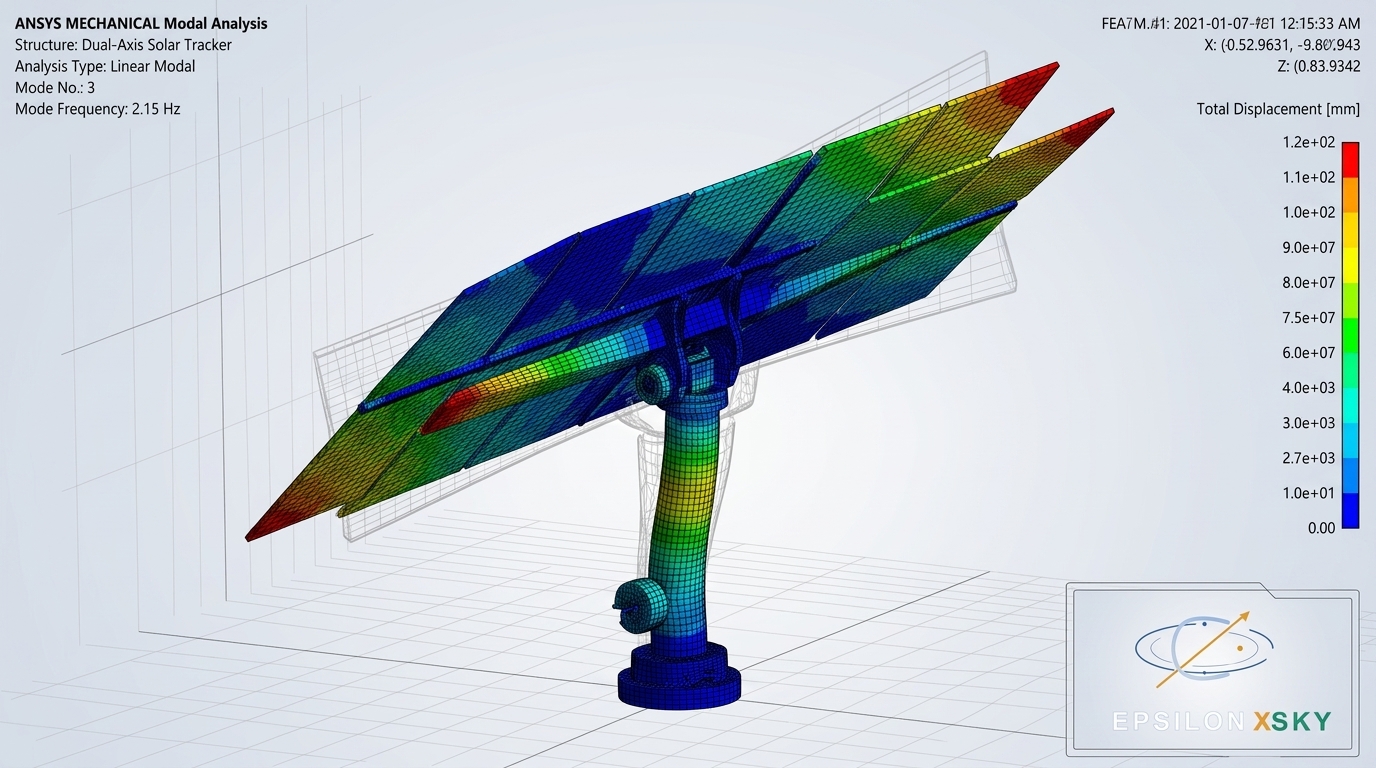
Modal analysis represents another essential component of structural evaluation. Every structure possesses natural frequencies at which vibration amplitudes increase dramatically if external excitation occurs near those frequencies. Engineers calculate the natural frequencies and mode shapes of photovoltaic support structures to ensure that resonance does not occur under expected wind-induced excitation or seismic loading.
Resonance can significantly amplify structural deformation and accelerate fatigue damage. By modifying member dimensions, support spacing, or connection stiffness, engineers shift the natural frequencies away from excitation frequencies, improving structural stability and reliability.
Seismic analysis may also be required for solar farms located in earthquake-prone regions. Engineers evaluate the dynamic response of support structures under prescribed ground accelerations, verifying that foundations, anchors, and structural members remain capable of resisting seismic forces without collapse or excessive deformation.
Foundation analysis completes the structural evaluation. Loads generated by wind, gravity, and thermal expansion are transferred through the support structure into concrete foundations or driven piles. Engineers assess foundation reactions, soil pressures, and anchor bolt forces to ensure that the supporting ground remains stable under all anticipated operating conditions.

Optimization plays an increasingly important role during structural design. Rather than simply increasing member sizes to improve safety, engineers use simulation to remove unnecessary material while maintaining structural performance. This reduces fabrication costs, transportation requirements, and installation time while preserving adequate safety margins.
At Epsilon X Sky, structural optimization is integrated directly into the engineering workflow. Multiple support frame configurations are evaluated using ANSYS Mechanical, comparing stress distributions, deformation, material usage, and safety factors. The final design represents the optimal balance between structural reliability, manufacturability, and economic efficiency.
Validation remains a key aspect of professional structural engineering. Simulation results are compared with international design standards, manufacturer specifications, and, where possible, experimental measurements. Mesh independence studies and sensitivity analyses ensure that numerical predictions accurately reflect physical behavior rather than computational artifacts.
By combining CFD-derived wind loading with advanced Finite Element Analysis, Epsilon X Sky delivers highly reliable structural designs that maximize safety, minimize material consumption, and ensure decades of dependable solar power generation.
Solar Power Plant Optimization, Digital Engineering, and Industrial Applications Using ANSYS

Modern solar power plants are no longer designed using conventional engineering calculations alone. Increasing demand for higher energy production, reduced construction costs, and improved operational reliability has transformed optimization into one of the most important stages of renewable energy engineering. Every engineering decision—from panel orientation and structural layout to airflow management and thermal performance—directly affects the long-term profitability of a solar installation. Optimization ensures that every component contributes to maximum energy generation while minimizing cost and environmental impact.
At Epsilon X Sky, optimization begins after CFD and structural simulations have been validated. Rather than accepting the first successful design, our engineers evaluate multiple design alternatives using ANSYS DesignXplorer and advanced simulation workflows. This iterative approach enables developers to identify the most efficient configuration before construction begins, reducing both technical risk and project costs.
One of the primary optimization objectives is determining the optimal tilt angle of photovoltaic panels. The inclination of the panels directly influences annual solar irradiation, self-cleaning capability, wind loading, and natural cooling. A small change in tilt angle can significantly affect annual electrical production depending on geographical location and seasonal solar movement.
ANSYS simulations allow engineers to evaluate multiple tilt angles while simultaneously considering airflow, thermal performance, and structural loading. Instead of optimizing energy production alone, the entire engineering system is optimized as a whole. The most efficient solar power plant is one that balances energy generation, cooling performance, structural safety, and economic feasibility.
Another important optimization parameter is row spacing. Closely spaced solar panels increase land utilization and reduce installation costs but may create shading effects and restrict airflow beneath the modules. Reduced ventilation increases panel temperature, decreasing photovoltaic efficiency over time.
Conversely, wider spacing improves airflow and reduces thermal accumulation but requires larger installation areas and higher infrastructure costs. Using CFD simulations, engineers investigate numerous spacing configurations to identify the arrangement that delivers the highest annual energy output while minimizing land usage.
Wind direction also influences optimization decisions. Solar farms experience seasonal variations in prevailing wind conditions, affecting both cooling efficiency and structural loading. Engineers simulate multiple wind scenarios to ensure that the chosen layout performs efficiently throughout the year rather than under only one operating condition.
Terrain characteristics further complicate optimization. Hills, surrounding buildings, vegetation, and nearby infrastructure all modify local airflow patterns. CFD simulations capture these environmental influences, enabling engineers to position photovoltaic arrays where natural ventilation is strongest and aerodynamic loading remains acceptable.
Thermal optimization represents another major engineering objective. Since photovoltaic efficiency decreases as operating temperature rises, engineers continuously seek methods to improve passive cooling without increasing energy consumption. Natural airflow beneath the panels, optimized mounting heights, and intelligent row arrangements all contribute to improved heat dissipation.
Even a modest reduction in average panel temperature can produce measurable improvements in annual electrical energy generation and significantly increase the lifetime return on investment.
Optimization also extends to structural design. Support frames must remain sufficiently stiff to resist wind loading while minimizing material usage and fabrication costs. Using ANSYS Mechanical, engineers perform topology optimization and parametric studies to remove unnecessary material without compromising structural safety.
Material selection represents another critical optimization opportunity. Galvanized steel, aluminum alloys, stainless steel, and composite materials each offer different combinations of strength, corrosion resistance, weight, and cost. Engineers compare multiple material options through structural simulations to identify the most appropriate solution for the intended operating environment.
Foundation optimization becomes increasingly important for utility-scale solar farms. By accurately predicting structural reactions under wind and gravity loading, engineers avoid excessive foundation sizes while maintaining adequate safety margins. This reduces concrete consumption, excavation requirements, and overall construction costs.
Electrical cable routing may also benefit from simulation-driven optimization. Although ANSYS primarily focuses on physical engineering analysis, optimized plant layouts frequently reduce cable lengths, lowering electrical losses and installation expenses.
Modern optimization increasingly incorporates sustainability metrics. Engineers evaluate not only technical performance but also carbon footprint, material consumption, recyclability, maintenance requirements, and lifecycle costs. Engineering optimization today is measured not only by efficiency but also by long-term environmental sustainability.
Artificial Intelligence is rapidly becoming an important component of engineering optimization. Machine learning algorithms analyze thousands of simulation results to identify design trends and recommend improved configurations. Rather than replacing engineering judgment, AI accelerates the optimization process by identifying high-performing solutions more efficiently than manual iteration.
Digital Twin technology represents another significant advancement in renewable energy engineering. A Digital Twin combines real-time operational data with high-fidelity simulation models, allowing engineers to monitor plant performance continuously after construction. Environmental measurements, wind conditions, panel temperatures, and electrical output can all be compared against numerical predictions to identify maintenance requirements and performance degradation.
At Epsilon X Sky, Digital Engineering forms the foundation of our renewable energy workflow. CFD, structural analysis, thermal simulation, optimization, and performance monitoring are integrated into a unified engineering process that supports decision-making throughout the entire lifecycle of the solar power plant.
Industrial applications of ANSYS optimization extend far beyond conventional photovoltaic farms. Floating solar installations require CFD analysis to evaluate wave-induced motion and cooling performance. Building-integrated photovoltaics demand combined thermal and structural analysis to ensure façade safety. Desert solar farms require advanced airflow simulations to investigate dust accumulation and thermal management under extreme environmental conditions.
Hybrid renewable energy systems also benefit from simulation-driven optimization. Solar installations integrated with wind turbines, battery storage systems, hydrogen production facilities, and concentrated solar power technologies all require multidisciplinary engineering approaches that combine CFD, FEA, thermal analysis, and system-level optimization.
At Epsilon X Sky, every optimization project is driven by one objective: delivering measurable engineering improvements that increase efficiency, reduce operational costs, and maximize long-term system reliability. Rather than relying on assumptions, our engineers use physics-based simulation to evaluate every critical design decision before construction begins.
Through advanced ANSYS technologies, simulation-driven engineering enables renewable energy developers to build smarter, safer, and more efficient solar power plants capable of meeting the growing global demand for sustainable electricity generation.
Future Trends, Engineering Best Practices, Conclusion.
As renewable energy technologies continue to evolve, solar power plants are becoming increasingly sophisticated engineering systems rather than simple collections of photovoltaic panels. Modern solar installations must deliver higher efficiency, lower operational costs, greater reliability, and improved sustainability while operating under increasingly demanding environmental conditions. To meet these expectations, the future of solar engineering will rely heavily on advanced simulation technologies, artificial intelligence, digital twins, and multiphysics optimization. Engineering simulation is no longer an optional design tool—it has become a strategic requirement for developing competitive renewable energy projects.
One of the most significant trends shaping the future of solar power plants is the integration of Artificial Intelligence (AI) with simulation-driven engineering. AI algorithms can analyze thousands of CFD and structural simulation results, identifying design patterns that would be difficult to detect through traditional engineering methods. By combining machine learning with ANSYS simulations, engineers can rapidly evaluate multiple panel arrangements, support structures, cooling strategies, and environmental scenarios, significantly accelerating the optimization process.
Digital Twin technology is also transforming how solar farms are designed and operated. A Digital Twin is a virtual representation of the physical power plant that continuously updates using real-time operational data. Environmental conditions, panel temperatures, electrical output, wind speeds, and structural responses can be compared directly with simulation predictions. This enables engineers to identify performance degradation early, optimize maintenance schedules, and improve future designs based on actual operating experience.
The use of High-Performance Computing (HPC) continues to expand simulation capabilities. Solar farms covering hundreds of hectares generate highly complex airflow patterns that require substantial computational resources to model accurately. Modern HPC platforms allow engineers to perform large-scale CFD analyses, transient simulations, and optimization studies within practical timeframes, enabling more detailed engineering investigations than ever before.
Floating solar farms represent another rapidly growing area of renewable energy development. These systems introduce additional engineering challenges because photovoltaic arrays must interact with water surfaces, waves, currents, and changing environmental conditions. CFD and structural simulations become essential tools for evaluating hydrodynamic loading, cooling performance, and structural stability in these unique environments.
Building-Integrated Photovoltaics (BIPV) are also becoming increasingly important. Instead of installing solar panels on separate structures, photovoltaic elements are incorporated directly into building facades, roofs, and architectural components. This integration requires detailed thermal, structural, and airflow analysis to ensure both energy production and building performance remain optimized.
As climate conditions become more extreme in many regions, resilience engineering is gaining importance. Solar power plants must withstand stronger storms, higher temperatures, increased dust accumulation, and more severe environmental loading. Simulation allows engineers to evaluate these extreme conditions before construction begins, reducing risk and improving long-term reliability.
At Epsilon X Sky, engineering best practices form the foundation of every solar power plant project. The first principle is always validation. Numerical simulations must be verified through mesh independence studies, sensitivity analyses, benchmark comparisons, and whenever possible, experimental data. Reliable engineering decisions depend on reliable simulation results.
The second principle is multidisciplinary analysis. Solar farms should not be optimized from only one engineering perspective. Electrical performance, thermal management, structural integrity, aerodynamic behavior, maintenance requirements, and economic feasibility must all be considered simultaneously. True optimization occurs when all engineering disciplines work together rather than independently.
The third principle is lifecycle thinking. Solar installations are expected to operate for decades. Therefore, design decisions should consider not only initial performance but also maintenance requirements, fatigue life, corrosion resistance, thermal cycling, and long-term reliability. Engineering simulation provides valuable insight into these lifecycle considerations before construction begins.
The fourth principle is sustainability. Every engineering improvement should contribute to reduced energy consumption, lower material usage, improved efficiency, and reduced environmental impact. Simulation-driven engineering supports sustainability by enabling smarter designs that achieve higher performance with fewer resources.
At Epsilon X Sky, we combine CFD, FEA, thermal analysis, optimization, and engineering expertise to help clients develop high-performance solar power plants capable of meeting future energy demands. Our simulation-driven workflow reduces uncertainty, improves efficiency, lowers costs, and accelerates project development from concept to operation.
Conclusion
Solar power plants are among the most important technologies driving the global transition toward sustainable energy. However, achieving maximum performance requires more than simply installing photovoltaic panels. Airflow management, thermal performance, structural reliability, wind loading, and plant layout optimization all play critical roles in determining long-term efficiency and profitability.
Using ANSYS Fluent, engineers can analyze airflow behavior, optimize cooling performance, evaluate pressure distributions, and improve photovoltaic efficiency through advanced CFD simulations. Using ANSYS Mechanical, structural integrity can be verified under wind, thermal, and seismic loading conditions, ensuring safe and reliable operation throughout the plant lifecycle.
Simulation-driven engineering allows developers to make informed decisions before construction begins, reducing costs, minimizing risks, and maximizing energy production.
At Epsilon X Sky, we utilize advanced ANSYS technologies to deliver comprehensive engineering solutions for renewable energy projects. Through CFD analysis, structural simulation, thermal optimization, and multidisciplinary engineering workflows, we help clients design smarter, safer, and more efficient solar power plants capable of achieving long-term operational success.
The future of renewable energy belongs to organizations that combine innovation, engineering expertise, and simulation-driven decision-making—and Epsilon X Sky is committed to helping clients lead that future.
Share this article