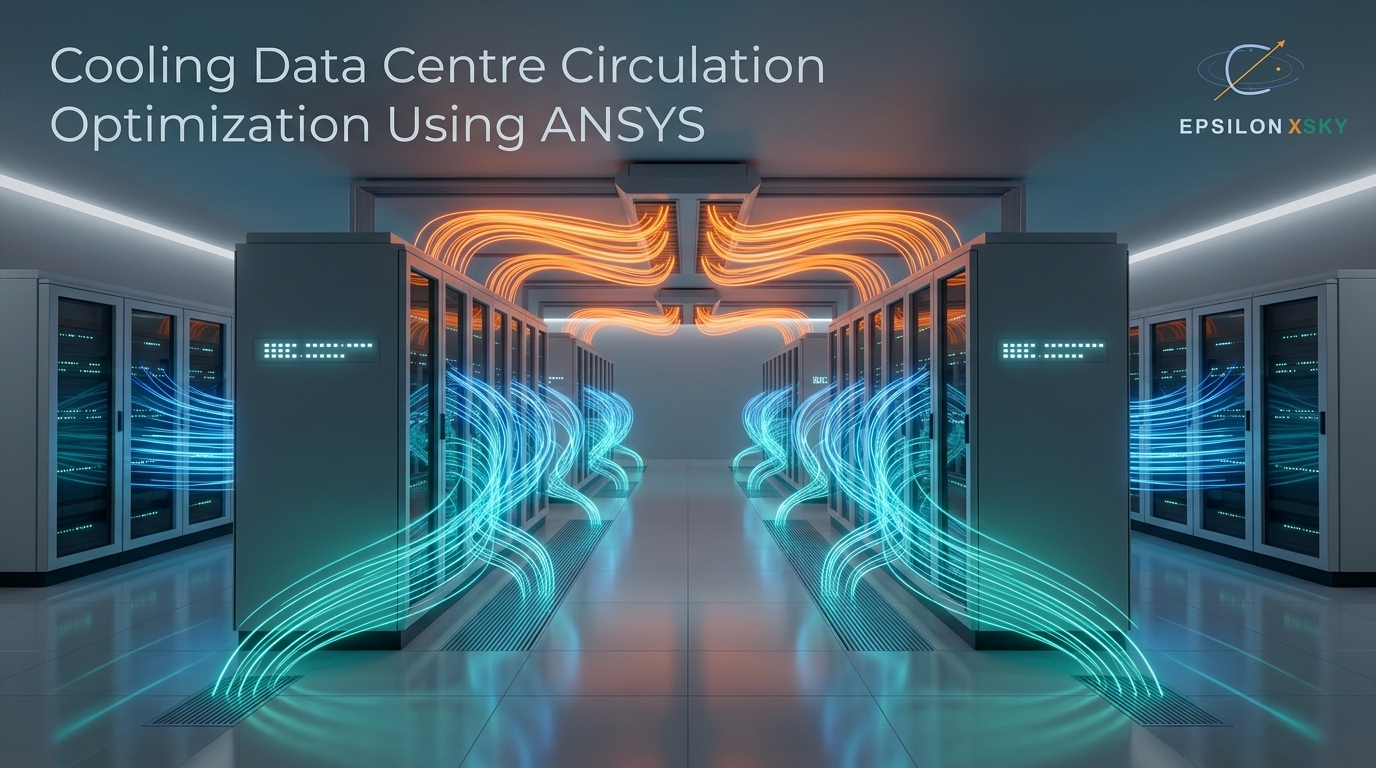
Cooling Data Centre Circulation Optimization Using ANSYS | Epsilon X Sky

Introduction to Data Centre Cooling Optimization Using CFD
Modern data centres are the backbone of today's digital economy, powering cloud computing, artificial intelligence, financial systems, healthcare infrastructure, telecommunications, and enterprise applications. As computing power continues to increase, so does the heat generated by servers, storage systems, networking equipment, and power electronics. Efficient cooling has become one of the most critical engineering challenges in data centre design because thermal management directly affects equipment reliability, operational costs, and energy efficiency.
At Epsilon X Sky, we use ANSYS Fluent Computational Fluid Dynamics (CFD) to optimize airflow circulation, cooling efficiency, and thermal performance within data centres. Instead of relying solely on empirical rules or expensive physical testing, CFD enables engineers to visualize airflow behavior, identify hot spots, and optimize cooling strategies before installation.
A typical data centre contains hundreds or even thousands of servers installed within racks arranged in hot and cold aisles. Cooling systems—including Computer Room Air Conditioning (CRAC) units, Computer Room Air Handlers (CRAH), raised floors, overhead ducts, containment systems, and ventilation pathways—must work together to maintain safe operating temperatures across every rack.
Poor airflow distribution often creates hot spots, where local temperatures exceed equipment design limits. These hot spots reduce hardware reliability, shorten component lifespan, increase cooling energy consumption, and may even trigger unexpected server shutdowns.
One of the most common causes of inefficient cooling is airflow recirculation. Instead of delivering cool air directly to server intakes, warm exhaust air can mix with incoming cold air, significantly reducing cooling effectiveness. CFD simulations reveal these invisible airflow patterns and allow engineers to eliminate inefficient circulation before the facility becomes operational.
Another challenge is bypass airflow. In many facilities, cooled air returns to cooling units without passing through server racks, wasting cooling capacity and increasing operating costs. Similarly, air leakage beneath raised floors, through cable openings, or around poorly sealed racks reduces cooling efficiency throughout the entire data hall.
At Epsilon X Sky, CFD simulations accurately model the interaction between server heat generation, cooling equipment, airflow circulation, pressure distribution, and room geometry. Engineers evaluate how air moves throughout the facility under various operating conditions, enabling optimization of every component involved in thermal management.
The simulation process begins with creating a detailed three-dimensional model of the data centre. This includes server racks, CRAC or CRAH units, raised floors, perforated tiles, ducts, cable trays, ceilings, containment walls, return air pathways, and all structural elements that influence airflow.
High-quality computational meshes are generated to accurately capture velocity gradients near server racks, cooling vents, containment barriers, and ventilation openings. Local mesh refinement ensures precise prediction of airflow and temperature while maintaining computational efficiency.
Boundary conditions represent realistic operating conditions, including server heat loads, cooling unit performance, supply air temperature, airflow rates, return conditions, and environmental operating parameters. Multiple operating scenarios can then be simulated to evaluate system performance under varying IT loads.
ANSYS Fluent solves the coupled equations governing fluid flow, turbulence, heat transfer, and air circulation throughout the facility. The resulting simulations provide detailed velocity contours, temperature distributions, pressure maps, streamline visualizations, and airflow patterns that would be impossible to observe directly in an operating data centre.
One of the greatest strengths of CFD is its ability to compare multiple cooling strategies before implementation. Engineers can evaluate different rack arrangements, cooling unit locations, aisle containment systems, perforated floor tile layouts, supply airflow rates, and ventilation configurations without making expensive physical modifications.
At Epsilon X Sky, our objective is not simply to reduce temperatures but to optimize the entire cooling system for maximum energy efficiency, equipment reliability, and long-term operational performance. By replacing engineering assumptions with physics-based simulations, CFD enables data centres to achieve lower Power Usage Effectiveness (PUE), reduced energy consumption, improved thermal stability, and significant operational cost savings.
Simulation-driven cooling optimization ensures that every cubic meter of conditioned air contributes effectively to cooling IT equipment while minimizing wasted energy and maximizing infrastructure performance.
CFD Modeling of Airflow Circulation and Thermal Performance Using ANSYS Fluent

Efficient cooling in a modern data centre depends on much more than installing powerful air conditioning units. The interaction between airflow distribution, server heat generation, room geometry, rack arrangement, and cooling equipment determines whether the facility operates efficiently or suffers from excessive energy consumption and thermal instability. At Epsilon X Sky, we use ANSYS Fluent Computational Fluid Dynamics (CFD) to accurately simulate these complex interactions and optimize cooling performance before deployment.
The simulation process begins by creating a highly detailed three-dimensional model of the entire data centre. Every engineering feature that influences airflow is included, such as server racks, CRAC (Computer Room Air Conditioning) units, CRAH (Computer Room Air Handler) units, raised floors, perforated floor tiles, overhead ducts, return air plenums, containment systems, cable trays, and structural obstacles.
Accurate geometry is essential because even relatively small physical changes—such as relocating a cooling unit, changing rack spacing, or modifying perforated tile placement—can dramatically influence airflow circulation throughout the data hall.
Once the geometry is complete, a computational mesh is generated. Millions of computational cells divide the airflow domain into small control volumes where the governing equations are solved. Mesh refinement is concentrated around server racks, cooling outlets, return air pathways, containment barriers, and regions expected to exhibit high velocity gradients or turbulent mixing.
Boundary conditions are then assigned using actual operating parameters. Engineers define server heat output, cooling unit airflow rates, supply air temperature, return pressure, room humidity (when required), and environmental operating conditions. Multiple operating scenarios—including full IT load, partial load, equipment failure, and maintenance conditions—can be analyzed without interrupting facility operation.
ANSYS Fluent simultaneously solves fluid flow, heat transfer, turbulence, and energy equations, providing a complete picture of airflow movement throughout the data centre.
One of the most valuable simulation outputs is airflow velocity distribution. Velocity contour plots reveal whether conditioned air reaches every server inlet uniformly or whether airflow bypasses critical equipment. Engineers immediately identify low-velocity regions where insufficient cooling may cause elevated temperatures.
Temperature contour analysis provides another critical engineering insight. CFD predicts temperature throughout the room as well as at the inlet and outlet of every server rack. Hot spots that cannot easily be detected through conventional measurements become clearly visible through thermal contour visualization.
Pressure distribution is equally important. Differences in pressure beneath raised floors influence how much conditioned air exits each perforated tile. CFD helps engineers balance underfloor pressure, ensuring that airflow is distributed evenly across all server rows instead of concentrating in only a few locations.
Streamline visualization provides a powerful understanding of airflow behavior. Engineers can observe how cold air travels from cooling units through raised floors or overhead ducts toward server racks and how warm exhaust air returns to cooling equipment. These visualizations reveal undesirable recirculation patterns where hot exhaust air mixes with incoming cold air, reducing overall cooling efficiency.
Turbulence modeling further improves simulation accuracy. Airflow inside data centres is highly turbulent due to multiple fans, obstacles, equipment arrangements, and ventilation systems. Appropriate turbulence models—such as k-ε, k-ω SST, or Reynolds Stress Models (RSM)—allow ANSYS Fluent to accurately predict complex airflow behavior while maintaining computational efficiency.

Server racks themselves are represented using porous media models or detailed fan simulations depending on the required level of engineering accuracy. These models account for airflow resistance generated by servers while accurately representing heat generation inside the equipment.
Heat transfer simulation extends beyond simple airflow analysis. ANSYS Fluent predicts convective heat transfer between air and server surfaces, allowing engineers to evaluate whether cooling capacity is sufficient to maintain equipment within manufacturer-recommended operating temperatures.
Transient simulations provide additional engineering value. Rather than analyzing only steady-state conditions, engineers can simulate changing thermal loads throughout the day, server startup sequences, cooling unit failures, maintenance operations, or unexpected increases in computational demand. These time-dependent analyses ensure that cooling systems remain stable under realistic operating conditions.
Containment systems are another major area of optimization. Hot aisle containment and cold aisle containment significantly influence airflow circulation. CFD enables engineers to compare different containment configurations and determine which design provides the best balance between cooling efficiency and construction cost.
Cooling equipment placement is also optimized through simulation. Instead of relying on empirical guidelines, ANSYS Fluent evaluates multiple CRAC or CRAH locations, supply airflow rates, diffuser arrangements, and return air pathways until the optimal configuration is achieved.
These detailed results provide engineers with quantitative information for making informed design decisions. Rather than relying on assumptions, every modification is supported by physics-based simulation, significantly reducing engineering uncertainty while improving thermal performance.
By accurately modeling airflow circulation and heat transfer using ANSYS Fluent, Epsilon X Sky helps clients design highly efficient data centres that maximize cooling performance, reduce operating costs, improve equipment reliability, and achieve long-term energy savings.
Optimizing Cooling Circulation, Eliminating Hot Spots, and Improving Energy Efficiency Using CFD

One of the primary goals of every modern data centre is to maintain stable operating temperatures while minimizing energy consumption. Cooling systems account for a significant portion of total facility power usage, making airflow optimization one of the most effective methods for reducing operating costs. At Epsilon X Sky, ANSYS Fluent CFD enables engineers to optimize cooling circulation, eliminate thermal hot spots, and maximize cooling efficiency before construction or system upgrades are implemented.
The optimization process begins by identifying airflow inefficiencies within the data hall. Even facilities equipped with high-capacity cooling systems may experience poor thermal performance if conditioned air is not distributed effectively. CFD simulations reveal exactly where cooling air travels, where it bypasses server racks, and where warm exhaust air recirculates back into equipment intakes.
One of the most common issues identified during CFD analysis is the formation of hot spots. These localized high-temperature regions occur when server racks receive insufficient cooling airflow or when warm exhaust air mixes with incoming cold air. Even a few hot spots can reduce equipment reliability, increase cooling demand, shorten hardware lifespan, and increase the risk of unexpected downtime.
Using ANSYS Fluent, engineers generate detailed temperature contour maps that identify every hot spot within the facility. Once identified, multiple engineering solutions can be evaluated without modifying the physical infrastructure.
Rack arrangement plays a major role in airflow performance. Improper rack spacing or inconsistent equipment placement often disrupts airflow circulation. CFD allows engineers to investigate alternative rack layouts that improve airflow uniformity while maintaining efficient use of available floor space.
Cold aisle and hot aisle containment systems are among the most effective methods for improving cooling efficiency. By physically separating cold supply air from warm exhaust air, containment systems reduce air mixing and increase the effectiveness of cooling equipment. CFD simulations allow engineers to compare different containment configurations and determine which design provides the highest cooling performance with the lowest energy consumption.
Raised floor optimization is another important engineering application. Conditioned air delivered beneath raised floors exits through perforated tiles positioned in front of server racks. Incorrect tile placement often causes uneven airflow distribution, resulting in excessive cooling in some areas and insufficient cooling in others.
ANSYS Fluent predicts underfloor pressure distribution and airflow through every perforated tile. Engineers can optimize tile location, opening percentage, and airflow rate to ensure each rack receives the required cooling air.
Cooling unit placement also influences overall performance. CRAC and CRAH units positioned incorrectly may create airflow short-circuiting, where conditioned air returns directly to cooling equipment without passing through server racks. CFD identifies these inefficient circulation patterns and evaluates alternative equipment locations that maximize cooling effectiveness.
Server inlet temperatures are continuously monitored throughout the simulation. Rather than relying on average room temperature, engineers analyze the temperature entering each individual rack. This detailed information ensures every server operates within manufacturer-recommended thermal limits regardless of equipment location.
Air recirculation analysis is another critical component of optimization. Warm exhaust air naturally rises and may be drawn back into nearby server intakes if airflow management is poor. Streamline visualization clearly illustrates these recirculation paths, allowing engineers to introduce containment systems, airflow barriers, or revised ventilation layouts that eliminate thermal mixing.
Bypass airflow represents another major source of inefficiency. In many facilities, conditioned air travels around server racks rather than through them, reducing effective cooling while increasing energy consumption. CFD quantifies bypass airflow and enables engineers to redesign airflow pathways that maximize useful cooling.
Variable IT loads require equally flexible cooling strategies. During periods of low computational demand, cooling requirements decrease significantly. CFD simulations evaluate partial-load operating conditions to ensure airflow remains balanced even when only part of the facility is operating at maximum capacity.
Optimization also extends to fan performance. Server fans, CRAC fans, and ventilation systems consume significant electrical power. Engineers evaluate fan speed, airflow distribution, and operating efficiency to identify opportunities for reducing power consumption without compromising thermal performance.

Another important performance metric is Power Usage Effectiveness (PUE). Lower PUE values indicate more efficient data centre operation by reducing the proportion of energy consumed by cooling and supporting infrastructure. CFD-driven airflow optimization directly contributes to improved PUE by reducing unnecessary cooling energy while maintaining stable operating temperatures.
Sensitivity studies further enhance optimization. Engineers systematically vary supply air temperature, airflow rate, rack power density, containment configuration, and cooling unit operation to identify the combination that delivers the best overall performance.
At Epsilon X Sky, optimization studies often compare multiple design alternatives simultaneously. Engineers evaluate different rack layouts, cooling unit capacities, airflow management systems, raised floor configurations, ceiling return systems, and containment strategies before selecting the optimal solution.
By combining advanced CFD analysis with engineering optimization, Epsilon X Sky helps organizations build data centres that are cooler, more energy-efficient, more reliable, and significantly less expensive to operate over their entire lifecycle.
Validation, Sustainable Cooling Strategies, and Future Data Centre Optimization Using ANSYS
Modern data centres must operate continuously while maintaining maximum reliability and minimum energy consumption. As computing densities continue to increase due to artificial intelligence, cloud computing, and high-performance computing (HPC), cooling systems are becoming more complex than ever before. At Epsilon X Sky, ANSYS Fluent enables engineers to validate cooling performance, optimize energy efficiency, and develop sustainable thermal management strategies before deployment.

Validation is one of the most important stages of every CFD project. Accurate simulation results depend on realistic operating conditions and proper numerical modeling. Before optimization recommendations are implemented, engineers verify that the computational model accurately represents the physical behavior of the data centre.
The validation process begins with confirming the geometric model. Every server rack, cooling unit, raised floor, containment barrier, duct, cable tray, and airflow obstruction must be accurately represented because even minor geometric differences can influence airflow distribution throughout the facility.
Mesh quality is then verified through mesh independence studies. Engineers compare multiple mesh densities to ensure that airflow velocity, temperature distribution, and pressure predictions remain consistent regardless of mesh resolution. This process guarantees that engineering conclusions are based on physical behavior rather than numerical artifacts.
Boundary conditions are carefully selected using actual operating data whenever available. Server heat loads, cooling unit performance curves, supply air temperature, airflow volume, return conditions, and environmental parameters are incorporated into the CFD model to reproduce realistic operating conditions.
This comparison increases confidence in simulation accuracy while allowing engineers to refine numerical models if necessary.
One of the greatest advantages of CFD is its ability to evaluate failure scenarios without placing the actual facility at risk. Engineers simulate unexpected CRAC or CRAH shutdowns, blocked airflow paths, fan failures, increased IT loads, or equipment maintenance conditions to determine whether sufficient cooling redundancy exists.
Redundancy analysis is particularly important for mission-critical facilities. N+1 and N+2 cooling strategies can be evaluated using CFD to ensure that acceptable operating temperatures are maintained even when one or more cooling units become unavailable.
Sustainability has become a major objective in modern data centre engineering. Cooling systems often account for 30–50% of total facility energy consumption, making airflow optimization one of the most effective methods for reducing carbon emissions.
CFD supports sustainable design by identifying opportunities to:
-Reduce cooling energy consumption
-Improve airflow efficiency
-Lower fan power requirements
-Optimize supply air temperature
-Minimize overcooling
-Improve cooling unit utilization
-Increase overall Power Usage Effectiveness (PUE)
Rather than simply increasing cooling capacity, engineers use CFD to maximize the effectiveness of every unit of conditioned air delivered into the data hall.
Free cooling technologies represent another growing area of optimization. In suitable climates, outside air or indirect evaporative cooling can significantly reduce compressor operation. CFD helps engineers evaluate airflow circulation and temperature distribution when integrating these sustainable cooling technologies into existing facilities.
Liquid cooling is also becoming increasingly important for high-density computing applications such as AI servers and GPU clusters. Hybrid cooling systems combining traditional air cooling with direct liquid cooling require careful engineering to maintain balanced thermal conditions throughout the facility. CFD allows engineers to optimize these mixed cooling strategies while ensuring uniform thermal performance.
Artificial Intelligence is beginning to transform cooling management. Machine learning algorithms combined with CFD-generated datasets allow intelligent building management systems to automatically adjust cooling operation according to changing computational loads, environmental conditions, and equipment utilization.
Digital Twin technology represents another major advancement. By integrating real-time sensor data with CFD models, operators continuously monitor airflow, temperature, humidity, and cooling performance throughout the facility. This predictive approach enables maintenance teams to identify thermal problems before they impact equipment reliability.
Our engineering reports provide clear visualizations, quantitative performance metrics, and practical design recommendations that help clients maximize both operational reliability and long-term energy efficiency.
By combining advanced ANSYS Fluent simulations with engineering expertise, Epsilon X Sky delivers cooling systems that provide superior thermal performance, reduced operating costs, enhanced sustainability, and exceptional reliability for mission-critical data centres.
Conclusion
As digital transformation accelerates, data centres are becoming larger, denser, and more energy-intensive. Artificial Intelligence, cloud computing, edge computing, machine learning, and high-performance computing (HPC) continue to increase rack power densities, making advanced thermal management more important than ever. Traditional cooling design methods are no longer sufficient for modern facilities. Physics-based simulation using ANSYS Fluent has become an essential engineering tool for designing efficient, reliable, and sustainable cooling systems.
At Epsilon X Sky, we believe simulation-driven engineering is transforming data centre design by allowing engineers to predict thermal performance before construction begins. Instead of relying on trial-and-error approaches or expensive physical testing, CFD enables rapid evaluation of multiple cooling strategies while reducing engineering risk and improving operational efficiency.
One of the most significant developments is the adoption of Digital Twin technology. Digital Twins combine real-time operational data with CFD simulations, allowing facility managers to continuously monitor airflow, temperature distribution, cooling efficiency, and equipment performance. This predictive capability enables proactive maintenance, minimizes downtime, and improves long-term operational reliability.
Artificial Intelligence is also reshaping thermal management. Machine learning algorithms can analyze thousands of CFD simulations to automatically recommend optimal rack layouts, cooling unit settings, airflow distribution, and operating parameters. This integration of AI with CFD significantly shortens engineering design cycles while maximizing cooling efficiency and reducing energy consumption.
Another important trend is the transition toward high-density liquid cooling systems. As AI servers and GPU clusters generate significantly higher heat loads than conventional servers, direct liquid cooling, immersion cooling, and hybrid cooling solutions are becoming increasingly common. CFD provides engineers with the ability to evaluate these advanced cooling technologies before implementation, ensuring stable operation under extreme thermal loads.
Sustainability remains a key driver in data centre engineering. Governments and organizations worldwide are working to reduce carbon emissions while increasing computational capacity. Optimizing airflow circulation, minimizing cooling energy, and improving Power Usage Effectiveness (PUE) directly contribute to lower operating costs and reduced environmental impact.
ANSYS Fluent also supports renewable energy integration by helping engineers optimize cooling systems powered by solar, wind, or hybrid energy sources. These simulations allow designers to evaluate thermal performance under varying environmental conditions while maintaining consistent server temperatures.
Each project concludes with a comprehensive engineering report containing airflow velocity contours, temperature maps, pressure distributions, streamline visualizations, turbulence intensity, cooling performance metrics, and practical optimization recommendations.
These reports allow engineers, consultants, architects, and facility operators to make informed design decisions before construction or renovation begins, reducing project costs while improving long-term operational reliability.
Simulation-driven engineering replaces uncertainty with measurable performance. Instead of overdesigning cooling systems to compensate for unknown airflow behavior, CFD enables engineers to deliver precisely optimized solutions that balance cooling performance, capital cost, and operational efficiency.
Data centres represent some of the most thermally demanding engineering facilities in the modern world. Efficient cooling directly influences equipment reliability, operational continuity, energy consumption, and overall business performance.
Using ANSYS Fluent Computational Fluid Dynamics (CFD), engineers can accurately predict airflow circulation, identify hot spots, optimize cooling unit placement, improve rack cooling, reduce bypass airflow, eliminate recirculation, and significantly enhance thermal management throughout the facility.
At Epsilon X Sky, we combine advanced CFD simulation, engineering expertise, and optimization methodologies to deliver highly efficient cooling solutions for modern data centres. Every design decision is supported by physics-based analysis, enabling our clients to reduce energy costs, improve reliability, increase sustainability, and confidently prepare for future expansion.
Whether designing a new hyperscale data centre or optimizing an existing facility, Epsilon X Sky provides advanced engineering solutions powered by ANSYS Fluent to maximize cooling performance and operational excellence.
Share this article