Complex Plumbing System Optimization with Hydrogen Mole Fraction Analysis Using ANSYS | Epsilon X Sky

Introduction to Hydrogen Transport in Complex Plumbing Systems
As the global energy sector moves toward cleaner and more sustainable solutions, hydrogen has emerged as one of the most promising energy carriers. From hydrogen fueling stations and industrial processing plants to power generation systems and green hydrogen infrastructure, complex piping and plumbing networks are becoming increasingly important. However, transporting hydrogen safely through intricate piping systems requires much more than conventional fluid flow calculations. Small changes in hydrogen concentration can significantly influence pressure distribution, flow stability, mixing behavior, and overall system safety.
At Epsilon X Sky, we use ANSYS Fluent Computational Fluid Dynamics (CFD) to simulate hydrogen transport inside complex plumbing systems, enabling engineers to optimize hydrogen mole fraction distribution while avoiding localized pressure peaks and other critical operating conditions.
Unlike conventional gases, hydrogen possesses unique physical characteristics. It has a very low molecular weight, high diffusivity, low density, and high compressibility. These properties make hydrogen behave differently from natural gas or air when flowing through pipes, manifolds, valves, bends, and distribution networks. Accurately predicting hydrogen behavior requires advanced multiphysics simulation rather than simplified engineering assumptions.
In hydrogen distribution systems, maintaining an appropriate hydrogen mole fraction throughout the network is essential for operational efficiency and safety. Non-uniform hydrogen concentrations may produce localized pressure fluctuations, unstable mixing, undesirable recirculation zones, and increased mechanical loading on system components.
Complex plumbing systems often include numerous elbows, tees, reducers, valves, compressors, pressure regulators, manifolds, storage vessels, and branching pipelines. Every geometric feature influences fluid momentum, turbulence generation, and species transport. Even relatively small geometric modifications can significantly alter hydrogen distribution throughout the system.
Pressure management is another major engineering challenge. Sudden pressure increases can accelerate component fatigue, increase leakage risk, reduce equipment lifetime, and create unsafe operating conditions. CFD enables engineers to predict these pressure variations before physical installation, allowing optimized piping layouts that maintain stable operating conditions.
At Epsilon X Sky, CFD simulations are performed using ANSYS Fluent, where fluid flow, turbulence, pressure distribution, hydrogen species transport, and concentration fields are solved simultaneously. This provides a comprehensive understanding of system behavior under realistic operating conditions.
The engineering workflow begins with creating an accurate three-dimensional CAD model representing the complete plumbing system. The model includes every pipe section, valve, elbow, manifold, junction, inlet, outlet, and flow-control device that influences hydrogen transport.
After geometry preparation, high-quality computational meshes are generated. Mesh refinement focuses on regions where strong velocity gradients, rapid mixing, pressure changes, or complex turbulence are expected. This ensures accurate prediction of hydrogen concentration while maintaining computational efficiency.
Boundary conditions are then applied to reproduce actual operating scenarios. These include inlet pressure, flow rate, hydrogen mole fraction, operating temperature, outlet conditions, and turbulence characteristics. Multiple operating cases can be simulated to evaluate system performance under varying load conditions.
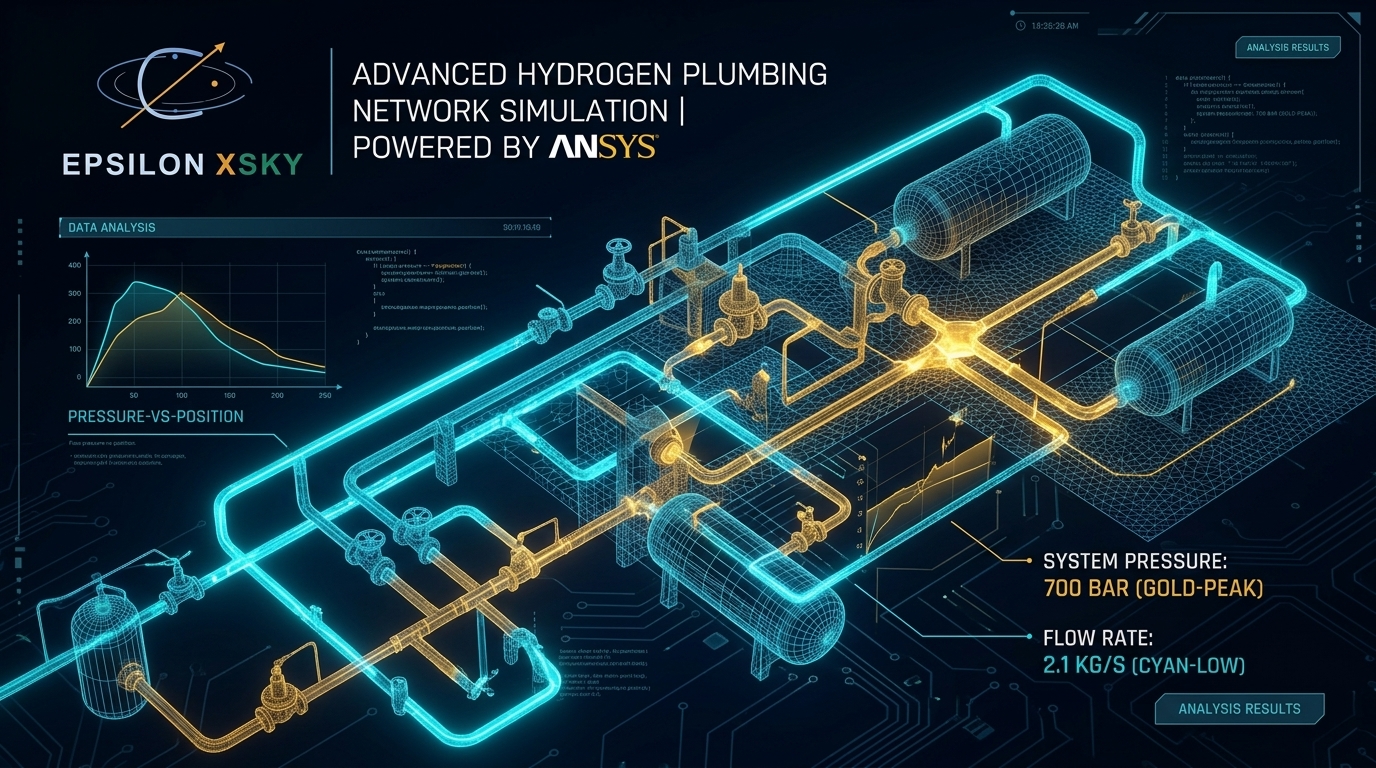
One of the greatest strengths of CFD lies in its visualization capabilities. Engineers can observe hydrogen concentration fields, pressure contours, velocity vectors, turbulence intensity, streamline patterns, and mixing behavior throughout the entire plumbing network. Instead of relying solely on average values, CFD reveals exactly where pressure peaks develop, where hydrogen accumulates, and how system geometry influences overall performance.
Species transport modeling represents one of the most valuable features of hydrogen simulations. ANSYS Fluent calculates hydrogen mole fraction throughout every region of the system, allowing engineers to identify concentration gradients, poor mixing zones, and regions where hydrogen enrichment could influence safety or operational stability.
Transient simulations further enhance engineering understanding by capturing system behavior during startup, shutdown, valve operation, compressor cycling, and changing operating conditions. These analyses reveal dynamic pressure fluctuations and concentration changes that steady-state simulations cannot capture.
At Epsilon X Sky, our objective is not only to predict hydrogen flow but also to optimize system performance. Multiple plumbing layouts, manifold designs, valve configurations, and operating conditions can be evaluated rapidly without constructing expensive physical prototypes.
By combining advanced CFD analysis with engineering optimization, hydrogen plumbing systems become safer, more efficient, and more reliable while reducing development time and minimizing engineering uncertainty.
CFD Modeling of Hydrogen Mole Fraction and Pressure Distribution Using ANSYS Fluent

Designing a safe and efficient hydrogen plumbing system requires much more than selecting appropriate pipe diameters. Hydrogen transport involves complex interactions between fluid flow, turbulence, pressure gradients, species diffusion, and mixing behavior. Even small variations in hydrogen mole fraction can influence pressure stability, flow distribution, and overall system performance. At Epsilon X Sky, we utilize ANSYS Fluent to model these complex physical processes with high accuracy before construction or system modification.
The simulation process begins by creating a detailed three-dimensional model of the entire plumbing network. This includes straight pipe sections, elbows, tees, reducers, valves, pressure regulators, compressors, manifolds, branch connections, and storage vessels. Every geometric feature influences hydrogen transport and therefore must be accurately represented within the computational model.
After geometry preparation, a high-quality computational mesh is generated. Mesh quality directly affects simulation accuracy, especially in regions where strong pressure gradients or rapid hydrogen mixing occur. At Epsilon X Sky, local mesh refinement is applied near valves, junctions, sharp bends, flow restrictions, and mixing regions where velocity and concentration gradients are highest.
Boundary conditions are then assigned based on realistic operating data. Engineers specify inlet pressure, mass flow rate, hydrogen mole fraction, operating temperature, outlet pressure, and turbulence characteristics. Multiple operating scenarios—including peak demand, startup conditions, partial load operation, and emergency shutdown sequences—can be evaluated to ensure reliable system performance under all expected conditions.
One of the most important capabilities of ANSYS Fluent is species transport simulation. Hydrogen is modeled as an individual species within the gas mixture, allowing the solver to calculate its local mole fraction throughout every section of the plumbing system. This enables engineers to observe exactly how hydrogen mixes, diffuses, and distributes across the network.
Hydrogen mole fraction contours provide one of the most valuable engineering outputs. These contour plots reveal concentration gradients, localized hydrogen enrichment, incomplete mixing regions, and flow separation zones that may otherwise remain undetected using conventional design methods.
Velocity contour analysis complements species transport results. Engineers evaluate how fluid velocity changes throughout the network, particularly around elbows, junctions, valves, and manifold connections. High-velocity jets may increase turbulence and improve mixing, while low-velocity regions can encourage concentration non-uniformity and pressure instability.
Pressure contour plots are equally critical. Hydrogen systems often operate under elevated pressures, making accurate pressure prediction essential for safe design. CFD identifies localized pressure peaks caused by sudden contractions, flow restrictions, rapid directional changes, or improper component placement. By identifying these pressure concentrations early, engineers can redesign the system before manufacturing or installation begins.

Pressure drop analysis is another key design objective. Every fitting, valve, and bend introduces hydraulic resistance that contributes to total pressure loss. Excessive pressure drop increases compressor power requirements, reduces overall system efficiency, and may prevent downstream equipment from operating within its design range. CFD quantifies these losses and helps optimize component arrangement to minimize unnecessary energy consumption.
Turbulence modeling plays an essential role in hydrogen simulations. Because hydrogen has a very low density and high diffusivity, turbulent mixing strongly influences concentration distribution. At Epsilon X Sky, turbulence models such as k-ε, k-ω SST, or Reynolds Stress Models (RSM) are selected according to system complexity and flow characteristics to ensure accurate prediction of both pressure and species transport.
Streamline visualization provides another powerful engineering tool. Streamlines trace the actual flow paths of the gas mixture throughout the plumbing network. Engineers can immediately identify recirculation regions, flow separation, dead zones, and inefficient routing that may influence hydrogen concentration or increase pressure losses.
Transient CFD simulations extend analysis beyond steady-state operation. During compressor startup, valve switching, rapid flow changes, or emergency shutdown procedures, hydrogen concentration and pressure can fluctuate significantly. Transient simulations capture these time-dependent behaviors, allowing engineers to evaluate system stability under dynamic operating conditions.
Temperature effects may also be incorporated into the simulation. Hydrogen properties vary with temperature, affecting density, viscosity, diffusion rate, and pressure distribution. Coupled thermal-fluid simulations provide a more realistic representation of operating conditions, particularly for high-pressure hydrogen storage and transfer systems.
For systems involving hydrogen blending with natural gas or other gases, CFD predicts mixture composition throughout the network. Engineers evaluate blending efficiency, concentration uniformity, and downstream mole fraction stability to ensure consistent fuel quality while avoiding localized composition variations.
At Epsilon X Sky, every CFD project includes detailed engineering reports featuring hydrogen mole fraction contours, velocity fields, pressure distributions, streamline plots, turbulence intensity maps, pressure drop calculations, and component performance evaluations. These quantitative results allow clients to make informed engineering decisions with confidence.
By replacing empirical design methods with physics-based CFD simulations, hydrogen plumbing systems can be optimized for safety, efficiency, reliability, and long-term operational performance. Every design modification is validated numerically before implementation, significantly reducing engineering risk and development costs.
Optimizing Hydrogen Mole Fraction and Preventing Critical Pressure Conditions Using CFD

Maintaining a stable hydrogen mole fraction throughout a complex plumbing system is one of the most important engineering challenges in hydrogen infrastructure. Uneven hydrogen distribution can lead to localized pressure increases, unstable flow behavior, inefficient mixing, and excessive mechanical loading on system components. At Epsilon X Sky, ANSYS Fluent CFD is used not only to predict these behaviors but also to optimize the entire plumbing network to ensure safe, efficient, and reliable hydrogen transport.
One of the first objectives during optimization is achieving a uniform hydrogen concentration throughout the system. In complex piping networks containing numerous branches, elbows, manifolds, and valves, hydrogen may not distribute evenly. Certain regions may experience hydrogen enrichment, while others receive lower concentrations than intended. These concentration variations directly influence gas density, pressure distribution, and flow stability.
Species transport simulations performed in ANSYS Fluent calculate hydrogen mole fraction throughout every section of the plumbing system. Engineers analyze concentration contour plots to identify areas where hydrogen accumulates or where poor mixing occurs. Once these regions are identified, multiple design modifications can be evaluated to improve overall species distribution.
Pipe routing plays a significant role in hydrogen transport. Sharp bends, sudden contractions, and complex junctions often generate flow separation and recirculation zones that disrupt uniform mixing. CFD allows engineers to investigate alternative routing strategies that minimize unnecessary turbulence while maintaining efficient hydrogen transport.
Manifold design is another critical optimization parameter. Improper manifold geometry may distribute hydrogen unevenly between multiple outlet branches, creating pressure imbalance across the system. Through CFD analysis, engineers optimize manifold dimensions, branching angles, and flow passages to achieve balanced hydrogen delivery under all operating conditions.
Valve positioning and sizing also influence hydrogen concentration. Excessive throttling creates localized pressure losses and accelerates turbulent mixing, while oversized valves may reduce flow control accuracy. ANSYS Fluent enables engineers to compare multiple valve configurations and identify designs that maintain both stable pressure and consistent hydrogen mole fraction.
Pressure management is equally important during optimization. High-pressure hydrogen systems require careful control to prevent localized pressure peaks that may compromise mechanical integrity or reduce operational safety. Pressure contour analysis reveals regions where sudden pressure increases occur due to flow restrictions, abrupt geometry changes, or poor component placement.
CFD simulations allow engineers to redesign these regions by introducing smoother transitions, increasing bend radii, modifying pipe diameters, or relocating valves. These relatively simple geometric changes often produce significant reductions in pressure loss while improving overall hydraulic performance.
Flow velocity optimization further enhances system efficiency. Excessively high velocities increase pressure losses, mechanical erosion, vibration, and turbulence, whereas extremely low velocities may produce poor species mixing and non-uniform hydrogen concentration. CFD identifies the optimal velocity range that balances efficient transport with stable hydrogen distribution.
One of the most valuable optimization tools available in ANSYS Fluent is Design Point Analysis. Multiple design alternatives can be simulated automatically, allowing engineers to compare different pipe layouts, manifold geometries, valve arrangements, and operating conditions without constructing physical prototypes. This significantly accelerates engineering development while reducing project costs.
Parametric optimization enables engineers to evaluate hundreds of design combinations. Variables such as pipe diameter, branch angle, manifold length, valve opening, inlet pressure, and hydrogen mole fraction can be systematically adjusted until the optimal solution is achieved.
Hydrogen diffusion characteristics must also be considered. Because hydrogen diffuses much faster than heavier gases, concentration gradients evolve rapidly throughout the plumbing system. Species transport models accurately capture molecular diffusion together with turbulent mixing, providing realistic predictions of concentration stability during both steady-state and transient operation.
Transient CFD simulations become particularly valuable during startup and shutdown procedures. Rapid valve movements, compressor activation, or sudden demand changes can temporarily alter hydrogen concentration and pressure throughout the system. Engineers evaluate these dynamic events to ensure pressure always remains below allowable design limits.
Safety remains the primary objective throughout the optimization process. Localized pressure spikes, unstable flow oscillations, and concentration imbalances can all contribute to operational risks. CFD allows these issues to be identified virtually, long before the system is manufactured or commissioned, dramatically reducing engineering uncertainty and improving overall system reliability.
At Epsilon X Sky, optimization studies combine hydrogen mole fraction analysis, pressure distribution, turbulence modeling, velocity evaluation, and species transport into a unified engineering workflow. Every design recommendation is supported by quantitative CFD results rather than empirical assumptions, ensuring the highest level of confidence in final system performance.
The result is a plumbing system that delivers uniform hydrogen distribution, minimized pressure losses, stable operating conditions, improved energy efficiency, and enhanced long-term reliability. By optimizing every aspect of hydrogen transport using ANSYS Fluent, Epsilon X Sky helps clients develop hydrogen infrastructure that is safer, more efficient, and ready to support the growing hydrogen economy.
Safety, Engineering Validation, and Performance Optimization of Hydrogen Plumbing Systems Using ANSYS

Hydrogen is rapidly becoming one of the most important energy carriers in the transition toward sustainable energy systems. However, because of its unique physical properties, hydrogen requires a much higher level of engineering analysis than conventional gases. Its low molecular weight, high diffusivity, wide flammability range, and ability to rapidly propagate through complex piping systems make safety the highest priority during system design. At Epsilon X Sky, we use ANSYS Fluent to evaluate hydrogen transport, pressure stability, and system performance long before physical construction begins.
One of the primary objectives of CFD validation is ensuring that the plumbing network operates safely under every expected operating condition. Engineers must verify that pressure remains within allowable design limits, hydrogen concentration remains uniformly distributed, and no unstable flow conditions develop throughout the system.
Pressure fluctuations are particularly important in hydrogen infrastructure. Sudden valve closure, compressor startup, rapid flow acceleration, or changes in operating demand may generate localized pressure surges that cannot easily be predicted using traditional calculations. Transient CFD simulations capture these dynamic events, allowing engineers to verify that every component remains within its allowable pressure rating.
ANSYS Fluent enables engineers to simulate multiple operating scenarios, including:
-Full-load operation
-Partial-load conditions
-Compressor startup and shutdown
-Emergency isolation procedures
-Valve opening and closing sequences
-Variable hydrogen supply conditions
-Multiple inlet and outlet operating combinations

Each scenario provides valuable insight into pressure stability, hydrogen distribution, and overall system reliability.
Hydrogen mole fraction validation is equally critical. The species transport model predicts concentration throughout the plumbing system, ensuring that hydrogen remains evenly distributed across every branch and manifold. Engineers verify that no localized concentration peaks develop that could influence downstream equipment performance or create undesirable operating conditions.
Flow stability is another essential aspect of validation. Complex plumbing systems often experience secondary flow structures, vortices, recirculation regions, and turbulence generated by elbows, reducers, and branching junctions. These phenomena influence both pressure losses and hydrogen mixing efficiency.
Using streamline visualization and turbulence intensity maps, engineers evaluate whether flow remains stable throughout the network. Regions exhibiting excessive turbulence or flow separation are redesigned through geometric optimization until smooth and balanced flow is achieved.
Mechanical reliability also benefits significantly from CFD analysis. Large pressure gradients and turbulent fluctuations generate dynamic forces acting on valves, supports, manifolds, and piping structures. Although detailed structural integrity is generally analyzed using ANSYS Mechanical, CFD provides the accurate pressure loading required for subsequent structural analysis.
Thermal behavior may also influence hydrogen transport. During compression, expansion, or rapid pressure reduction, gas temperature changes affect hydrogen density and pressure distribution. Coupled thermal-fluid simulations allow engineers to evaluate these temperature effects while optimizing system performance under realistic operating conditions.
Energy efficiency represents another important optimization objective. Every unnecessary pressure loss increases compressor power requirements and operating costs. CFD identifies inefficient flow regions where energy is dissipated because of poor geometry, excessive turbulence, or flow restrictions.
By redesigning pipe layouts, optimizing valve locations, increasing bend radii, or improving manifold geometry, engineers reduce overall pressure loss while maintaining stable hydrogen transport. These improvements lower energy consumption and reduce long-term operating expenses without compromising system safety.
Whenever experimental or plant operating data are available, CFD predictions are compared against measured values to verify model accuracy. This validation process increases confidence in simulation results and ensures reliable engineering recommendations.
Optimization is performed iteratively. Multiple plumbing configurations are evaluated until the final design achieves balanced hydrogen distribution, minimized pressure loss, stable flow behavior, and maximum operational safety. Because every design alternative exists only virtually, expensive prototype fabrication and field modifications are dramatically reduced.
For hydrogen production facilities, fueling stations, chemical processing plants, fuel cell infrastructure, and energy distribution systems, this simulation-driven workflow significantly shortens project development time while improving system reliability.
By integrating hydrogen species transport, pressure analysis, turbulence modeling, transient simulations, and engineering optimization into one unified CFD workflow, Epsilon X Sky delivers plumbing systems that meet the highest standards of performance, safety, and efficiency.
The combination of advanced ANSYS Fluent simulations and experienced engineering expertise enables clients to confidently develop hydrogen infrastructure capable of supporting the rapidly growing clean-energy economy.
Future Trends, Conclusion
The rapid growth of the hydrogen economy is driving the development of increasingly sophisticated piping and distribution systems. As hydrogen becomes a major energy carrier for transportation, power generation, industrial processing, and energy storage, engineering design must evolve to meet higher standards of efficiency, reliability, and safety. Computational Fluid Dynamics (CFD) has become one of the most valuable engineering tools for designing these next-generation hydrogen systems before physical implementation.
At Epsilon X Sky, we believe simulation-driven engineering is transforming how hydrogen infrastructure is developed. Instead of relying on simplified calculations or expensive prototype testing, engineers can evaluate hundreds of operating conditions virtually, optimize every design parameter, and confidently validate system performance before installation.
One of the most significant future developments is the adoption of Digital Twin technology. A Digital Twin combines real-time sensor data with high-fidelity CFD simulations to continuously monitor hydrogen plumbing systems during operation. Pressure, temperature, flow rate, and hydrogen concentration measurements are continuously compared with numerical predictions, allowing operators to detect abnormal conditions before they develop into operational problems.
Artificial Intelligence (AI) is also reshaping engineering optimization. Machine learning algorithms can analyze thousands of CFD simulations to automatically determine the optimal pipe routing, manifold configuration, valve placement, and hydrogen distribution strategy. This dramatically shortens engineering design cycles while improving overall system performance and reducing development costs.
Hydrogen blending with natural gas is another rapidly growing application. Many countries are evaluating blended hydrogen networks as an intermediate step toward full hydrogen infrastructure. CFD plays a critical role in predicting mixing efficiency, hydrogen mole fraction distribution, pressure behavior, and combustion characteristics within these blended systems.
As hydrogen infrastructure expands, regulatory requirements will become increasingly stringent. Engineers must demonstrate safe operation under both normal and abnormal conditions while ensuring compliance with international standards for pressure systems, hydrogen transport, and industrial safety. Advanced CFD analysis provides the detailed engineering evidence needed to support these safety assessments.
At Epsilon X Sky, every hydrogen CFD project follows a structured engineering methodology based on international best practices. The first step is accurate geometric representation of the complete plumbing network, ensuring every pipe, fitting, valve, manifold, and flow-control device is included in the computational model.
The second step focuses on high-quality mesh generation. Proper mesh refinement near valves, elbows, branch connections, and flow restrictions allows accurate prediction of hydrogen concentration gradients, pressure losses, and turbulent flow structures while maintaining computational efficiency.
Selecting the appropriate physical models is equally important. Hydrogen simulations often require coupled fluid flow, turbulence, species transport, heat transfer, and compressible flow analysis. Using the correct numerical models ensures reliable prediction of hydrogen behavior under both steady-state and transient operating conditions.
Boundary condition validation represents another essential engineering practice. Simulation accuracy depends directly on realistic operating inputs, including inlet pressure, hydrogen mole fraction, temperature, flow rate, compressor performance, and downstream operating conditions.
Whenever experimental measurements or operational data are available, CFD predictions are validated against real-world observations. This verification process confirms that the computational model accurately represents actual system behavior, providing greater confidence in engineering recommendations.
At Epsilon X Sky, comprehensive engineering reports include pressure contours, hydrogen mole fraction maps, streamline visualizations, velocity distributions, turbulence intensity, pressure-drop analysis, and practical design recommendations. These detailed reports enable clients to make informed engineering decisions based on quantitative simulation data rather than engineering assumptions.
Simulation-driven hydrogen engineering significantly reduces technical risk while improving performance, lowering operating costs, and accelerating project development. By optimizing every aspect of hydrogen transport before construction, organizations can develop safer and more efficient infrastructure capable of supporting the expanding hydrogen economy.
Conclusion
Hydrogen represents one of the most promising clean-energy solutions for the future, but its successful implementation depends on highly optimized engineering systems. Complex plumbing networks must maintain stable pressure, uniform hydrogen mole fraction, efficient flow distribution, and safe operating conditions across a wide range of operating scenarios.
Using ANSYS Fluent, engineers can simulate fluid flow, pressure distribution, turbulence, hydrogen species transport, and transient operating conditions with exceptional accuracy. These simulations identify potential problems early in the design process and enable optimization before physical construction begins.
At Epsilon X Sky, we combine advanced Computational Fluid Dynamics (CFD) with engineering expertise to optimize hydrogen plumbing systems for maximum efficiency, operational safety, and long-term reliability. Every engineering decision is supported by physics-based simulation, delivering smarter designs, reduced development costs, and confidence in system performance.
As hydrogen infrastructure continues to grow worldwide, simulation-driven engineering will remain a cornerstone of safe, efficient, and sustainable energy systems.
Share this article