Lagoon CFD Analysis for Optimizing Water Circulation and Eliminating Dead Zones Using ANSYS | Epsilon X Sky

Introduction to Lagoon Hydrodynamics and the Importance of CFD Analysis
Modern lagoons play a critical role in numerous industries, including wastewater treatment plants, aquaculture farms, mining operations, desalination facilities, cooling ponds, and recreational water systems. Regardless of their application, the efficiency of a lagoon depends largely on how water circulates throughout the basin. Poor circulation creates stagnant regions, commonly referred to as dead zones, where water movement becomes minimal. These dead zones reduce treatment efficiency, promote sediment accumulation, lower dissolved oxygen levels, and create conditions favorable for algae growth and poor water quality.
At Epsilon X Sky, we utilize ANSYS Fluent Computational Fluid Dynamics (CFD) to simulate lagoon hydrodynamics and optimize water circulation before construction or modification. Instead of relying on expensive field trials or empirical assumptions, CFD provides engineers with a detailed understanding of water movement, allowing informed decisions that improve hydraulic performance and reduce operational costs.
In wastewater treatment lagoons, dead zones reduce the effective treatment volume. Water may short-circuit from the inlet directly to the outlet without spending sufficient time inside the lagoon for biological treatment. As a result, contaminants remain insufficiently treated, reducing plant performance and potentially violating environmental discharge regulations.
In aquaculture lagoons, inadequate circulation can produce oxygen-deficient regions where fish and aquatic organisms experience stress. Uneven distribution of nutrients and oxygen also creates non-uniform environmental conditions that negatively affect production efficiency and overall ecosystem health.
Industrial cooling lagoons face similar challenges. Poor circulation causes localized thermal stratification where certain regions become significantly warmer than others. This temperature imbalance reduces cooling efficiency and increases thermal loading on downstream equipment.
Sediment transport represents another major concern. Low-velocity regions allow suspended particles to settle rapidly, gradually reducing lagoon capacity. Over time, sediment accumulation increases maintenance requirements and dredging costs while decreasing overall hydraulic performance.
The geometry of a lagoon significantly influences circulation behavior. Inlet and outlet locations, basin shape, depth variations, internal baffles, islands, aerators, and flow control structures all affect how water moves throughout the system. Even small geometric modifications can dramatically improve circulation patterns and eliminate stagnant regions.
Traditional hydraulic design methods often assume simplified flow behavior that cannot accurately capture complex recirculation zones, vortices, or transient mixing processes. Computational Fluid Dynamics overcomes these limitations by solving the governing equations of fluid motion throughout the entire lagoon domain.
Using ANSYS Fluent, engineers simulate water velocity, pressure distribution, turbulence intensity, residence time, mixing efficiency, and contaminant transport under realistic operating conditions. These simulations provide comprehensive insight into hydraulic behavior long before physical construction begins.
The CFD workflow begins with developing a detailed three-dimensional model of the lagoon. Engineers include all critical hydraulic features such as inlet channels, outlet structures, baffles, aeration systems, embankments, and internal obstacles. High-quality computational meshes are generated to capture flow details while maintaining computational efficiency.
Boundary conditions accurately represent operating conditions including inlet flow rate, water level, outlet pressure, environmental conditions, and turbulence parameters. Depending on project objectives, transient simulations may also include varying inflow rates, seasonal operating conditions, wind effects, or changing water elevations.
One of the greatest advantages of CFD is visualization. Engineers can observe water movement throughout the lagoon using velocity contours, streamlines, pathlines, turbulence maps, and residence time distributions. Instead of simply measuring average flow rates, CFD reveals exactly where dead zones form, why they develop, and how they can be eliminated.
At Epsilon X Sky, simulation results support both new lagoon design and optimization of existing facilities. Multiple inlet configurations, outlet locations, baffle arrangements, and hydraulic modifications can be evaluated rapidly without expensive physical prototypes.
This simulation-driven approach reduces engineering uncertainty while maximizing hydraulic efficiency. Improved circulation leads to better treatment performance, reduced sediment accumulation, lower maintenance costs, and enhanced long-term operational reliability.
By combining ANSYS Fluent CFD with advanced hydraulic engineering expertise, Epsilon X Sky delivers optimized lagoon designs that maximize circulation efficiency, eliminate dead zones, and improve overall system performance.
CFD Modeling of Lagoon Hydrodynamics Using ANSYS Fluent

Designing an efficient lagoon requires much more than selecting the correct dimensions. The way water enters, circulates, mixes, and exits the lagoon directly determines hydraulic efficiency, treatment performance, sediment transport, and long-term operational reliability. Computational Fluid Dynamics (CFD) enables engineers to understand these complex flow behaviors before construction, reducing uncertainty and improving overall system performance.
At Epsilon X Sky, we utilize ANSYS Fluent to perform detailed hydrodynamic simulations of lagoons under realistic operating conditions. Our CFD workflow provides engineers with quantitative data on velocity distribution, pressure fields, turbulence intensity, residence time, mixing efficiency, and dead zone formation, allowing optimized hydraulic designs that maximize circulation and water quality.
The simulation process begins by creating an accurate three-dimensional CAD model of the lagoon. This model includes every hydraulic feature that influences water movement, including inlet channels, outlet structures, internal baffles, embankments, islands, aerators, pumping systems, and varying bottom elevations. Even relatively small geometric features can significantly influence circulation patterns and therefore must be represented accurately.
After geometry preparation, a high-quality computational mesh is generated. Mesh quality is critical because it determines numerical accuracy and solution stability. At Epsilon X Sky, mesh refinement is concentrated around inlet jets, outlet regions, baffle edges, corners, and areas where strong velocity gradients or recirculation are expected. Mesh independence studies are performed to verify that simulation results remain consistent regardless of mesh density.
Boundary conditions are then applied to reproduce actual operating conditions. Inlet flow rates are specified according to design capacity or measured field data. Outlet boundaries are typically modeled using pressure outlet conditions that allow water to leave the computational domain naturally. Water surface behavior may be modeled as a free-slip surface or through more advanced free-surface techniques depending on project requirements.
One of the major advantages of ANSYS Fluent is its ability to accurately simulate turbulence. Lagoon flow rarely remains perfectly smooth. As water enters through inlet structures, interacts with walls, flows around obstacles, and mixes with existing water, turbulence develops naturally. Appropriate turbulence models such as k-ε, k-ω SST, or Reynolds Stress Models (RSM) are selected depending on lagoon geometry and flow complexity.
Transient simulations provide even greater insight into lagoon behavior. Instead of assuming steady operating conditions, transient CFD captures the evolution of flow over time, allowing engineers to observe how circulation develops after startup, how recirculation regions evolve, and how mixing changes during varying operating conditions.
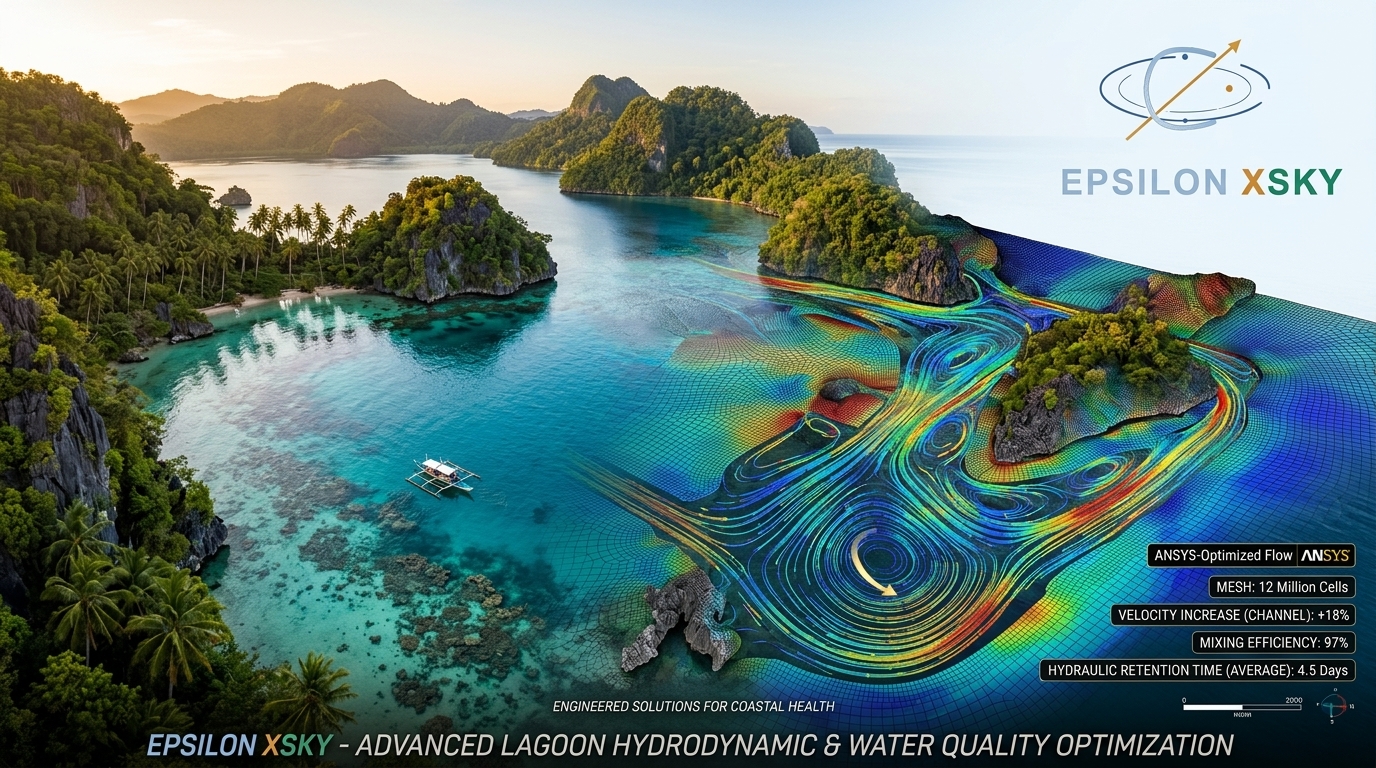
Velocity contour plots represent one of the most valuable simulation outputs. These contours clearly identify high-velocity inlet jets, moderate circulation zones, and extremely low-velocity regions where dead zones begin to form. Dead zones are typically characterized by velocities approaching zero, allowing sediments to settle and reducing effective hydraulic volume.
Streamline visualizations provide another powerful engineering tool. Streamlines trace the path followed by water particles as they move throughout the lagoon. Engineers can immediately observe whether flow reaches every region of the basin or bypasses certain areas entirely. Recirculation loops, short-circuiting, and isolated stagnant regions become visually apparent.
Pressure distributions also provide valuable design information. Although lagoons generally operate at relatively low pressures, pressure gradients influence flow distribution between different regions of the basin. Understanding these pressure variations helps optimize inlet geometry, outlet placement, and internal hydraulic structures.
Residence Time Distribution (RTD) analysis represents one of the most important performance metrics in lagoon engineering. Ideally, water should remain inside the lagoon long enough to achieve effective treatment before exiting. Short-circuiting causes some water to travel directly from inlet to outlet, reducing treatment efficiency. CFD-based RTD analysis allows engineers to quantify hydraulic retention time and evaluate how design modifications improve overall performance.
Tracer studies are frequently incorporated into CFD simulations. A virtual tracer is injected into the inlet flow, and its movement throughout the lagoon is monitored over time. These simulations reveal mixing characteristics, identify stagnant regions, and determine how effectively the lagoon distributes incoming water.
Sediment transport analysis can also be integrated into lagoon simulations. Suspended particles carried by flowing water gradually settle when local velocities become sufficiently low. CFD predicts where sediment deposition is most likely to occur, enabling engineers to redesign flow patterns that minimize accumulation and reduce future dredging requirements.
For lagoons equipped with mechanical aerators or mixers, CFD evaluates their hydraulic effectiveness. Engineers investigate how equipment placement, rotational speed, and operating schedules influence circulation throughout the basin. Instead of adding unnecessary equipment, simulation identifies the optimal number and positioning required to eliminate stagnant regions efficiently.
Wind-induced circulation can also be incorporated into large lagoon simulations. Surface winds generate additional water movement that may either improve mixing or create undesirable circulation patterns depending on lagoon geometry. ANSYS Fluent allows engineers to include environmental wind loading as part of comprehensive hydrodynamic analysis.
At Epsilon X Sky, every CFD project includes detailed engineering reports featuring velocity contours, streamline plots, pressure maps, turbulence intensity distributions, residence time analysis, tracer studies, and dead zone identification. These results provide practical recommendations for improving lagoon geometry and hydraulic performance before construction begins.
Simulation transforms lagoon design from empirical estimation into a precise engineering process. Instead of reacting to hydraulic problems after construction, engineers can optimize circulation, eliminate dead zones, and maximize treatment efficiency through data-driven CFD analysis.
By combining advanced ANSYS Fluent CFD with hydraulic engineering expertise, Epsilon X Sky helps clients develop lagoon systems that achieve superior circulation, improved water quality, reduced maintenance requirements, and enhanced long-term operational performance.
Eliminating Dead Zones Through CFD-Based Design Optimization Using ANSYS

Dead zones are among the most significant hydraulic problems affecting lagoon performance. These stagnant regions develop where water velocity becomes extremely low, preventing effective circulation and reducing the useful volume of the lagoon. Although dead zones may occupy only a portion of the basin, they can significantly decrease treatment efficiency, increase maintenance costs, and accelerate environmental degradation. At Epsilon X Sky, we use ANSYS Fluent CFD to identify, analyze, and eliminate these problematic regions before construction or during the optimization of existing lagoon systems.
Dead zones commonly develop because of poor hydraulic design. Inlet flow may enter the lagoon with excessive momentum and travel directly toward the outlet, bypassing large portions of the basin. This hydraulic short-circuiting leaves certain areas almost motionless while other regions experience relatively high velocities. As a result, water retention time becomes uneven, reducing the effectiveness of treatment processes.
Complex lagoon geometries can further contribute to stagnation. Sharp corners, irregular shorelines, deep recesses, islands, and internal structures often interrupt natural circulation patterns. Water entering these regions loses momentum rapidly, producing isolated pockets of slow-moving water where contaminants and sediments accumulate over time.
One of the primary objectives of CFD analysis is to visualize these circulation deficiencies before physical construction begins. Using ANSYS Fluent, engineers generate detailed velocity contour maps that clearly distinguish between active circulation zones and stagnant regions. Areas exhibiting near-zero velocity become immediately visible, allowing engineers to investigate their causes and develop targeted design improvements.
Streamline analysis provides additional insight into lagoon circulation. Instead of viewing only velocity magnitude, engineers observe the complete flow paths followed by water throughout the basin. These streamline visualizations reveal whether water successfully reaches every portion of the lagoon or whether large regions remain hydraulically isolated.
Residence Time Distribution (RTD) analysis further quantifies hydraulic performance. Water entering the lagoon should ideally remain inside long enough to achieve effective mixing or treatment before exiting. Dead zones increase residence time excessively in some areas while short-circuiting decreases residence time elsewhere. CFD enables engineers to optimize these hydraulic characteristics until flow distribution becomes significantly more uniform.
At Epsilon X Sky, several optimization strategies are investigated during every lagoon design project. One of the most effective approaches involves relocating inlet structures. Even relatively small changes in inlet position or orientation can dramatically improve circulation by redirecting the primary flow toward previously stagnant regions.
Outlet positioning is equally important. Improperly located outlets encourage short-circuiting by drawing water directly from the inlet. CFD allows engineers to evaluate multiple outlet configurations and determine which arrangement maximizes hydraulic retention while minimizing stagnant zones.
Internal baffles are frequently introduced to guide flow throughout the lagoon. Properly designed baffles interrupt direct flow paths, forcing water to travel longer distances before reaching the outlet. This increases effective residence time while ensuring that nearly the entire lagoon volume participates in circulation. ANSYS simulations evaluate various baffle lengths, heights, orientations, and spacing until the optimal hydraulic configuration is identified.
For lagoons equipped with mechanical aerators or circulation pumps, CFD determines the ideal equipment placement. Rather than installing additional equipment unnecessarily, simulation identifies the locations where mixing devices produce the greatest improvement in overall circulation efficiency. Engineers can compare multiple operating scenarios while minimizing both capital investment and long-term operating costs.
Flow deflectors also provide an effective method for eliminating localized stagnation. By redirecting high-momentum inlet jets toward poorly circulated regions, these hydraulic structures distribute energy more evenly throughout the lagoon. CFD allows engineers to optimize deflector geometry and orientation before installation.
Another important aspect of lagoon optimization involves depth variation. Deep pockets often experience weaker circulation than shallow regions, promoting sediment accumulation and oxygen depletion. Simulation helps engineers evaluate whether modifying bottom elevations or introducing gradual slopes can improve hydraulic performance without increasing construction costs.
Wind effects become increasingly important for large lagoons. Surface winds generate secondary circulation patterns that may either enhance or disrupt natural mixing. ANSYS Fluent incorporates environmental wind loading into transient simulations, allowing engineers to understand seasonal circulation behavior under realistic operating conditions.
Tracer transport simulations provide one of the most convincing demonstrations of optimization success. After hydraulic modifications are introduced, engineers compare tracer dispersion before and after optimization. Well-designed lagoons exhibit uniform tracer distribution with minimal stagnant regions, confirming that circulation has been significantly improved.
Sediment transport simulations often accompany circulation analysis. Once dead zones are eliminated, suspended particles remain in motion for longer periods instead of settling immediately. This reduces long-term sediment accumulation, extends lagoon service life, and lowers maintenance requirements associated with dredging operations.
Water quality also improves as circulation becomes more uniform. Better mixing distributes dissolved oxygen more evenly throughout the lagoon while reducing localized nutrient accumulation that encourages algae growth. For wastewater treatment facilities, improved circulation directly enhances biological treatment efficiency and overall process reliability.
At Epsilon X Sky, optimization is not based on intuition or empirical rules. Every design modification is validated through quantitative CFD analysis, comparing velocity distributions, turbulence intensity, residence time, tracer transport, sediment behavior, and overall hydraulic efficiency. This simulation-driven approach ensures that every engineering recommendation delivers measurable performance improvements.
By eliminating dead zones through advanced CFD analysis, lagoon systems become more efficient, more reliable, and significantly easier to operate and maintain. Optimized circulation improves treatment performance, reduces operational costs, enhances environmental sustainability, and maximizes the long-term value of hydraulic infrastructure.
Water Quality Improvement, Environmental Performance, and Lagoon Optimization Using CFD

Water circulation is one of the most important factors influencing lagoon water quality. Even if a lagoon has sufficient capacity, poor hydraulic performance can reduce its effectiveness dramatically. Stagnant water creates ideal conditions for sediment deposition, algae growth, oxygen depletion, and pollutant accumulation, ultimately reducing the overall performance of the lagoon. At Epsilon X Sky, we use ANSYS Fluent CFD to optimize water circulation and create hydraulic conditions that support superior water quality and long-term environmental sustainability.
One of the first consequences of poor circulation is the formation of oxygen-deficient regions. In stagnant areas, dissolved oxygen is consumed by biological activity faster than it can be replenished through natural mixing. Low oxygen concentrations negatively affect aquatic ecosystems, reduce biological treatment efficiency, and encourage anaerobic conditions that generate unpleasant odors and harmful gases.
CFD simulations allow engineers to identify these potential low-oxygen regions before construction. By analyzing water velocity, turbulence intensity, and mixing efficiency, engineers can redesign hydraulic systems that maintain continuous circulation throughout the lagoon and improve oxygen distribution.
Algae blooms represent another major operational challenge. Areas with limited circulation often experience elevated temperatures and nutrient accumulation, creating favorable conditions for excessive algae growth. Once algae populations increase, water clarity decreases, dissolved oxygen fluctuates, and maintenance requirements become significantly higher.
Using ANSYS Fluent, engineers evaluate how different circulation patterns influence nutrient transport and residence time. Improved mixing prevents localized nutrient accumulation, reducing the environmental conditions that promote algae growth and maintaining healthier water quality throughout the lagoon.
Sediment accumulation is another critical issue addressed through CFD analysis. Suspended solids naturally settle whenever local water velocity becomes sufficiently low. Over months or years, these deposits reduce the effective storage volume of the lagoon, increase dredging requirements, and alter hydraulic behavior.
Velocity contour maps generated by CFD clearly indicate regions where sediment deposition is likely to occur. Engineers then modify inlet geometry, outlet placement, internal baffles, or circulation devices to maintain sufficient flow velocities that keep particles suspended until they reach intended collection or treatment areas.
Water age analysis provides another valuable design tool. Water age represents the amount of time individual water parcels remain inside different regions of the lagoon. Extremely old water typically indicates stagnant circulation and poor hydraulic performance. CFD calculates water age throughout the entire lagoon, enabling engineers to eliminate isolated regions where water remains trapped for excessive periods.
Tracer transport simulations complement water age analysis by visualizing how dissolved substances move through the lagoon. Engineers introduce a virtual tracer into the inlet flow and monitor its dispersion over time. Uniform tracer distribution indicates efficient mixing, while isolated high-concentration regions reveal poor circulation that requires further optimization.
In wastewater treatment lagoons, hydraulic optimization directly improves treatment performance. Better circulation increases contact between microorganisms and pollutants, enhancing biological degradation while reducing the likelihood of untreated water bypassing the treatment process. This leads to more consistent effluent quality and improved compliance with environmental discharge regulations.
For aquaculture applications, uniform circulation helps distribute dissolved oxygen, nutrients, and temperature evenly throughout the lagoon. Fish and aquatic organisms experience more stable environmental conditions, resulting in healthier populations, improved growth rates, and reduced biological stress.
Cooling lagoons used in power plants and industrial facilities also benefit from CFD optimization. Efficient circulation prevents localized thermal hotspots and promotes uniform temperature distribution across the basin. This improves heat rejection efficiency while reducing thermal loading on downstream cooling equipment.
Wind-driven circulation represents another important environmental factor. Large lagoons often experience significant surface flow generated by prevailing winds. Depending on lagoon geometry, wind may either improve circulation or create additional stagnant regions. ANSYS Fluent incorporates wind loading into transient simulations, allowing engineers to evaluate seasonal environmental effects and optimize hydraulic design accordingly.
Mechanical aeration systems are frequently used to supplement natural mixing. CFD determines the optimal placement, orientation, and operating conditions of aerators to maximize circulation while minimizing energy consumption. Rather than installing additional equipment unnecessarily, simulation identifies the most efficient configuration based on quantitative hydraulic analysis.
Environmental sustainability is becoming increasingly important for modern infrastructure projects. Optimized lagoons require less maintenance, consume less energy, reduce dredging frequency, improve water quality, and minimize environmental impacts. CFD supports these objectives by enabling engineers to develop highly efficient hydraulic systems before construction begins.
At Epsilon X Sky, every lagoon optimization project includes comprehensive analyses of velocity distribution, turbulence, residence time, tracer transport, sediment deposition, water age, and mixing efficiency. These engineering studies provide clients with practical recommendations that improve both operational performance and environmental compliance.
Simulation-driven lagoon design transforms water quality management from reactive maintenance into proactive engineering. Instead of correcting circulation problems after construction, CFD enables engineers to eliminate their root causes during the design stage.
By combining ANSYS Fluent CFD with advanced hydraulic engineering expertise, Epsilon X Sky delivers lagoon solutions that improve water quality, maximize circulation efficiency, reduce operational costs, and support long-term environmental sustainability.
Future Trends, Engineering Best Practices, Conclusion, and FAQs

As hydraulic engineering continues to evolve, Computational Fluid Dynamics is becoming an essential part of lagoon design and optimization. Traditional hydraulic calculations remain valuable during preliminary design, but they cannot accurately predict the complex flow behavior that occurs inside real lagoons. CFD has transformed lagoon engineering by allowing designers to visualize, quantify, and optimize water circulation before construction begins, significantly reducing project risk and improving long-term operational performance.
At Epsilon X Sky, we integrate ANSYS Fluent CFD into every stage of lagoon development—from conceptual design and hydraulic optimization to troubleshooting existing facilities. By replacing assumptions with engineering simulation, our clients gain confidence that their lagoon systems will perform efficiently under real operating conditions.
One of the most significant future trends is the use of Digital Twins for water infrastructure. A Digital Twin combines CFD simulation with real-time operational data collected from sensors installed throughout the lagoon. Flow rates, water levels, dissolved oxygen, temperature, and weather conditions are continuously monitored and compared with numerical predictions. This allows operators to identify hydraulic problems before they affect water quality and optimize system performance throughout the lagoon's lifetime.
Artificial Intelligence is also beginning to transform hydraulic optimization. Machine learning algorithms can evaluate thousands of CFD simulation results to identify the best inlet geometry, outlet configuration, baffle arrangement, and circulation strategy for specific operating conditions. Instead of manually comparing design alternatives, AI-assisted optimization accelerates engineering decisions while improving overall hydraulic efficiency.
Environmental regulations are becoming increasingly strict worldwide. Future lagoon systems must meet higher standards for water quality, nutrient removal, sediment management, and environmental protection. CFD enables engineers to evaluate these requirements during the design phase, ensuring compliance before construction begins while minimizing future operational costs.
Renewable energy integration represents another emerging trend. Solar-powered circulation pumps, aeration systems, and intelligent flow control devices are increasingly being incorporated into lagoon infrastructure. CFD simulations help engineers evaluate how these sustainable technologies influence circulation patterns while minimizing energy consumption.
At Epsilon X Sky, every lagoon CFD project follows a structured engineering methodology based on internationally recognized best practices. The first step is accurate geometric modeling. Every inlet, outlet, embankment, baffle, aerator, and structural feature is represented precisely because even small geometric details can significantly influence circulation behavior.
The second principle is mesh quality verification. High-quality computational meshes ensure numerical stability while accurately resolving velocity gradients, recirculation regions, and turbulence structures. Mesh independence studies are performed to confirm that engineering conclusions remain consistent regardless of mesh density.
The third principle is selecting the appropriate turbulence model. Different lagoon configurations require different turbulence approaches depending on flow complexity, inlet velocity, and recirculation behavior. Choosing the correct turbulence model improves simulation accuracy while maintaining computational efficiency.
The fourth principle is realistic boundary conditions. Simulation accuracy depends directly on the quality of input data. Measured flow rates, water levels, environmental conditions, seasonal operating scenarios, and equipment performance must accurately represent actual lagoon operation.
Validation is equally important. Whenever field measurements are available, CFD predictions are compared against observed flow behavior, tracer studies, or hydraulic monitoring data. This validation process ensures that numerical simulations accurately represent real-world lagoon performance.
Optimization should never focus solely on circulation. Engineers must simultaneously consider water quality, sediment transport, hydraulic retention time, dissolved oxygen distribution, energy consumption, maintenance requirements, and long-term operational costs. This multidisciplinary approach delivers the greatest overall value to lagoon owners and operators.
At Epsilon X Sky, engineering reports include detailed velocity contours, streamline visualizations, turbulence intensity maps, residence time distributions, tracer analyses, dead zone identification, sediment transport predictions, and practical design recommendations. These reports provide decision-makers with clear, quantitative information that supports confident engineering decisions.
The ability to simulate multiple design alternatives before construction significantly reduces project costs. Instead of modifying physical infrastructure after hydraulic problems appear, engineers optimize circulation virtually until the best-performing design is achieved. This simulation-driven workflow minimizes construction risks while maximizing operational efficiency.
Conclusion
Efficient water circulation is the foundation of every successful lagoon system. Poor hydraulic performance creates dead zones, increases sediment accumulation, reduces treatment efficiency, lowers dissolved oxygen levels, and raises long-term maintenance costs. Advanced CFD analysis eliminates these uncertainties by providing a complete understanding of water movement before construction begins.
Using ANSYS Fluent, engineers can simulate velocity fields, turbulence, residence time, tracer transport, sediment behavior, and hydraulic efficiency under realistic operating conditions. These simulations identify stagnant regions, evaluate alternative designs, and optimize circulation through improved inlet placement, outlet configuration, baffle design, and flow management strategies.
At Epsilon X Sky, we combine Computational Fluid Dynamics, hydraulic engineering, and advanced optimization techniques to develop lagoon systems that maximize circulation efficiency, eliminate dead zones, improve water quality, reduce maintenance requirements, and support long-term environmental sustainability.
Simulation-driven engineering transforms lagoon design from empirical estimation into precise, data-driven optimization—delivering safer, more efficient, and more sustainable hydraulic infrastructure.
Share this article