eVTOL CFD Development at Epsilon X Sky: Meshing Challenges, Simulation Modeling, and Engineering Best Practices

Introduction
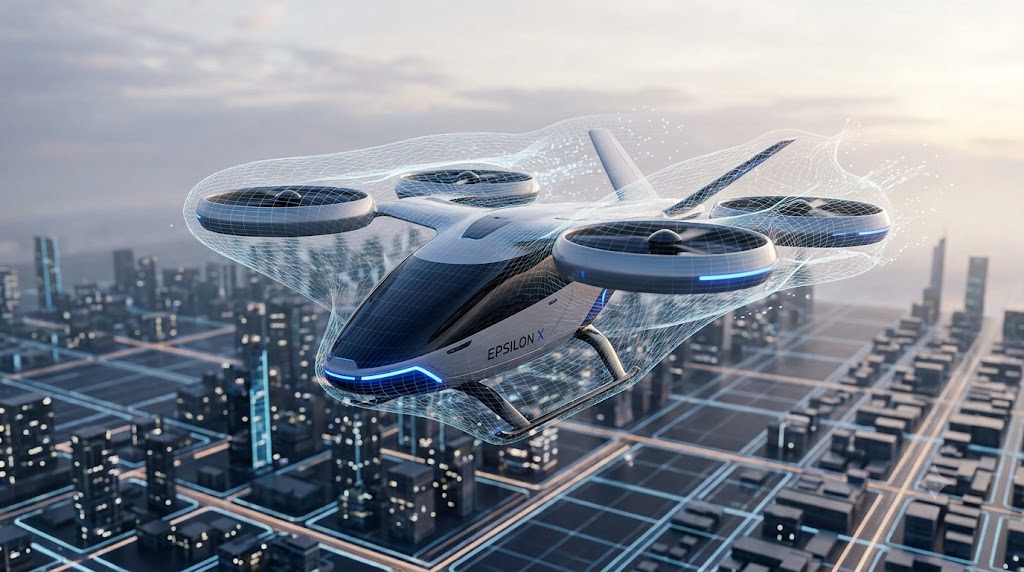
Electric Vertical Take-Off and Landing (eVTOL) aircraft are transforming the future of urban air mobility by combining the flexibility of helicopters with the efficiency of fixed-wing aircraft. Unlike conventional aircraft, eVTOL systems integrate multiple propulsion units, rotating propellers, lightweight composite structures, batteries, and sophisticated flight control systems into a compact design. These characteristics make aerodynamic performance one of the most critical aspects of the development process. Even small changes in geometry or airflow can significantly affect lift, drag, stability, power consumption, noise generation, and overall flight efficiency.
At Epsilon X Sky, Computational Fluid Dynamics (CFD) plays a central role in evaluating and optimizing eVTOL designs before physical prototypes are manufactured. Using ANSYS Fluent, our engineering team performs detailed aerodynamic analyses to understand airflow behavior around the aircraft during different flight conditions, including vertical take-off, hovering, transition, and forward flight. Through advanced numerical simulation, we help reduce development time, lower manufacturing costs, and improve overall vehicle performance while minimizing the need for expensive experimental testing.
Developing an accurate CFD model for an eVTOL is considerably more challenging than simulating a conventional aircraft. The presence of multiple rotors, complex fuselage geometries, wing interactions, and highly turbulent flow fields requires careful attention to geometry preparation, mesh generation, numerical methods, turbulence modeling, and solution validation. Every stage of the CFD workflow directly influences the accuracy of the final engineering results.
This article explains how Epsilon X Sky approaches eVTOL CFD development using ANSYS Fluent, highlighting the engineering challenges associated with meshing, simulation modeling, and the best practices that ensure reliable and accurate aerodynamic predictions.
Understanding eVTOL Aerodynamics and Simulation Objectives

The aerodynamic environment surrounding an eVTOL aircraft is significantly more complex than that of conventional fixed-wing aircraft. Traditional airplanes primarily generate lift through stationary wings while relying on one or two propulsion systems to provide thrust. An eVTOL, however, typically contains several electric propellers distributed across the aircraft, producing highly interactive flow fields that continuously change during different phases of flight.
During vertical take-off and landing, the propellers generate strong downward jets that interact with the aircraft structure, landing gear, wings, and even the ground surface. These interactions create highly turbulent regions where velocity gradients, vortices, and pressure fluctuations become extremely difficult to predict without advanced CFD analysis. As the aircraft transitions into forward flight, aerodynamic conditions change dramatically. Wing-generated lift gradually replaces rotor-generated lift, while complex interactions develop between the propeller wake and surrounding aerodynamic surfaces.
At Epsilon X Sky, the first stage of every eVTOL CFD project involves defining clear simulation objectives before any geometry preparation begins. Engineers determine exactly which aerodynamic quantities need to be evaluated, including lift coefficient, drag coefficient, pressure distribution, propeller performance, wake development, flow separation, downwash characteristics, and aerodynamic efficiency.
Different flight conditions require entirely different simulation strategies. Hover simulations focus on rotor-induced flow and vertical momentum transfer, while cruise simulations prioritize aerodynamic efficiency and drag reduction. Transition flight represents the most challenging operating condition because multiple aerodynamic mechanisms occur simultaneously, making it necessary to carefully select numerical methods capable of accurately capturing transient flow behavior.
Another important objective involves identifying regions of flow separation. Flow separation occurs when the boundary layer detaches from the aircraft surface, producing increased drag, reduced lift, and potential stability issues. By visualizing streamline behavior and pressure distributions, CFD allows engineers to modify surface geometry before manufacturing begins.
Rotor wake interaction is another critical consideration. The rotating propellers continuously generate helical vortices that interact with the wings, fuselage, neighboring propellers, and tail surfaces. These interactions directly influence vehicle stability, control effectiveness, structural loading, and acoustic performance. Without accurate simulation, predicting these effects becomes extremely difficult.
Noise generation also plays an increasingly important role in eVTOL development. Since these aircraft are intended for urban transportation, reducing aeroacoustic emissions has become one of the major engineering priorities. Although aerodynamic performance remains the primary objective, understanding flow structures responsible for noise generation allows engineers to optimize blade geometry and operating conditions for quieter flight.
Clearly defining simulation objectives before geometry preparation ensures that computational resources are focused on solving the engineering problems that matter most.
At Epsilon X Sky, every CFD project begins with a detailed engineering assessment to establish performance targets, select appropriate numerical models, define realistic operating conditions, and develop an efficient simulation strategy. This structured approach ensures that each simulation produces meaningful engineering insights rather than simply generating numerical results.
Engineering simulation is most valuable when it answers specific design questions with measurable, data-driven results.
Geometry Preparation and Meshing Challenges in eVTOL CFD

Once the engineering objectives have been clearly established, the next stage of eVTOL development involves preparing the aircraft geometry for Computational Fluid Dynamics (CFD) simulation. This phase is often underestimated, yet it is one of the most critical steps in the entire simulation workflow. Even the most advanced numerical solver cannot produce reliable results if the computational model is based on poor-quality geometry. At Epsilon X Sky, geometry preparation is treated as a dedicated engineering process rather than a simple CAD cleanup task. The quality of the geometry directly influences mesh generation, numerical stability, convergence behavior, and ultimately the accuracy of the aerodynamic predictions.
Unlike manufacturing models, which are designed for production, assembly, and fabrication, simulation models must be optimized for numerical analysis. Manufacturing CAD files often contain extremely small features such as bolts, screws, fillets, embossed logos, cable routing clips, drainage holes, chamfers, cosmetic grooves, and detailed mechanical components that have little or no influence on external aerodynamics. Including every manufacturing detail dramatically increases mesh size while providing minimal engineering value. Consequently, one of the first tasks performed by our engineers is identifying which geometric details are physically important and which should be simplified or removed.
The objective of simulation modeling is not to reproduce every manufacturing detail, but to capture the physics that governs the engineering problem accurately and efficiently.
Geometry simplification requires engineering judgment. Removing an important aerodynamic feature can significantly alter the flow field, while retaining unnecessary details increases computational cost without improving accuracy. Every simplification decision must therefore be supported by an understanding of the expected flow physics. For example, leading-edge curvature, wingtip geometry, propeller blade profiles, inlet ducts, cooling passages, and rotor hubs often have a direct influence on airflow and must remain accurately represented. Conversely, internal brackets, fasteners, and decorative surface details rarely affect external aerodynamics and can usually be omitted.
One of the greatest challenges encountered during eVTOL modeling is the complexity of the aircraft configuration itself. Modern eVTOL vehicles frequently employ distributed electric propulsion systems with six, eight, or even more rotors positioned around the fuselage and wings. Each rotor introduces additional geometric complexity, while the interaction between multiple rotor wakes creates highly three-dimensional flow structures that demand careful numerical treatment. Every blade profile, blade twist distribution, and hub geometry contributes to the aerodynamic behavior of the entire aircraft.
Preparing rotor geometry for CFD requires particular attention because rotating components introduce moving reference frames, sliding mesh interfaces, or overset mesh techniques depending on the selected simulation approach. Small imperfections in rotor geometry can generate poor-quality mesh cells that later produce convergence problems or inaccurate pressure predictions. At Epsilon X Sky, each rotating assembly is inspected thoroughly before mesh generation begins to ensure that all surfaces are watertight, properly connected, and free from geometric defects.
Another significant challenge involves defining the computational domain surrounding the aircraft. The surrounding air volume must be sufficiently large to prevent artificial boundary effects from influencing the solution. If the computational domain is too small, pressure reflections and velocity disturbances may interfere with the aerodynamic behavior of the aircraft. Engineers therefore determine appropriate distances between the aircraft and the inlet, outlet, top, side, and far-field boundaries based on expected wake development and flight conditions.
After geometry preparation has been completed, the project moves to one of the most technically demanding stages of CFD development: mesh generation. The mesh converts continuous geometry into millions of discrete computational control volumes where the governing fluid equations are solved numerically. The quality of these computational cells has a direct influence on solution stability, numerical accuracy, and computational efficiency.

A CFD simulation is only as accurate as the mesh that supports it.
For eVTOL simulations, hybrid meshing strategies are commonly employed because different regions of the aircraft require different cell types. Near-wall regions typically utilize prism or inflation layers to accurately resolve boundary layer development. These layers capture velocity gradients adjacent to the aircraft surface, enabling accurate prediction of wall shear stress, skin friction, and flow separation. Outside the boundary layer, tetrahedral or polyhedral cells are often used to efficiently discretize complex three-dimensional geometries while maintaining acceptable computational cost.
Particular attention is given to regions surrounding the propellers. Rotor wakes contain strong velocity gradients, vortex structures, and turbulence that require significantly finer mesh resolution than other parts of the computational domain. Insufficient refinement in these areas can cause excessive numerical diffusion, weakening vortex structures and producing inaccurate aerodynamic forces. Consequently, localized mesh refinement zones are introduced around rotor disks, blade tips, and wake trajectories to preserve important flow features throughout the simulation.
Mesh quality metrics are continuously monitored during generation. Engineers evaluate skewness, orthogonal quality, aspect ratio, and element growth rates to ensure numerical stability. Poor-quality cells often become the primary source of convergence difficulties, residual oscillations, or unrealistic pressure distributions. Rather than increasing mesh density indiscriminately, Epsilon X Sky focuses on generating high-quality elements that balance numerical accuracy with computational efficiency.
Mesh independence studies represent another essential component of the validation process. Multiple meshes with increasing resolution are generated and simulated until key engineering outputs—such as lift, drag, and pressure distribution—remain nearly unchanged. This process confirms that the simulation results depend on the underlying physics rather than the numerical discretization. Mesh independence provides confidence that additional refinement would not significantly alter the engineering conclusions.
Large eVTOL simulations often contain tens or even hundreds of millions of computational cells. Managing simulations of this scale requires careful planning to ensure efficient use of computational resources while maintaining practical solution times. Intelligent mesh refinement, adaptive sizing techniques, and localized resolution strategies allow engineers to maximize simulation accuracy without creating unnecessarily large computational models.
At Epsilon X Sky, geometry preparation and mesh generation are viewed as engineering disciplines in their own right. These stages establish the foundation upon which every subsequent CFD calculation depends. By investing significant effort in developing high-quality simulation models, our engineers ensure that the aerodynamic predictions produced by ANSYS Fluent accurately represent the real-world behavior of advanced eVTOL aircraft.
High-quality simulation begins long before the solver starts—it begins with intelligent geometry preparation and carefully engineered mesh generation.
CFD Setup, Physical Models, and Numerical Methods for eVTOL Simulation

Once the geometry has been prepared and a high-quality computational mesh has been generated, the next phase involves configuring the Computational Fluid Dynamics (CFD) simulation. This stage determines how accurately the mathematical model represents real aerodynamic behavior. At Epsilon X Sky, CFD setup is never treated as a routine software procedure. Instead, it is approached as a scientific engineering process where every numerical parameter, physical model, and solver setting is selected according to the physics of the problem being investigated.
A successful CFD simulation requires much more than importing a CAD model and pressing the solve button. The numerical solution depends on the correct selection of governing equations, turbulence models, boundary conditions, rotating reference frame techniques, discretization schemes, convergence criteria, and monitoring parameters. Every decision made during the setup phase directly influences the reliability of the engineering conclusions.
One of the first decisions concerns whether the simulation should be performed as a steady-state or transient analysis. For some cruise-flight conditions where aerodynamic forces remain relatively constant, a steady-state solution may provide sufficiently accurate predictions while minimizing computational cost. However, many eVTOL operating conditions involve rapidly changing aerodynamic interactions that cannot be represented by a steady solution. Hovering, vertical take-off, landing, transition flight, and rotor wake interactions all produce time-dependent flow structures that require transient simulation techniques.
Transient CFD captures the evolution of airflow over time, allowing engineers to visualize vortex formation, wake propagation, rotor interactions, and fluctuating aerodynamic loads. Although transient simulations require considerably greater computational resources, they provide a much more realistic representation of eVTOL aerodynamics, especially during critical flight maneuvers.
Selecting the appropriate turbulence model represents another essential step. Most practical aerospace CFD simulations rely on Reynolds-Averaged Navier-Stokes (RANS) equations because they offer an excellent balance between computational efficiency and engineering accuracy. Within this framework, turbulence models such as k-ω SST are widely adopted for aerodynamic applications because they accurately predict adverse pressure gradients, boundary-layer separation, and near-wall flow behavior.
For projects requiring even greater fidelity, advanced approaches such as Detached Eddy Simulation (DES), Scale-Adaptive Simulation (SAS), or Large Eddy Simulation (LES) may be employed. These methods resolve a much larger portion of the turbulent flow structures, making them especially useful for studying rotor wakes, vortex interactions, and aeroacoustic phenomena. However, they also require substantially finer meshes and significantly higher computational power.

At Epsilon X Sky, the turbulence model is selected according to the engineering objective rather than personal preference. If the goal is aerodynamic optimization during conceptual design, an efficient RANS approach may provide all the necessary engineering insight. If the objective involves detailed wake prediction or noise analysis, more advanced turbulence modeling techniques may be justified.
Boundary conditions form another critical component of CFD setup. These conditions define how the external environment interacts with the computational domain. In forward-flight simulations, engineers typically prescribe a free-stream velocity corresponding to the aircraft's operating speed, together with atmospheric pressure and ambient temperature. For hover analyses, different boundary conditions are required because the surrounding airflow is generated almost entirely by the rotating propellers rather than external wind.
Correctly representing rotating propellers presents one of the greatest challenges in eVTOL CFD. Several numerical techniques are available depending on the level of accuracy required. The Moving Reference Frame (MRF) approach offers an efficient steady approximation by solving the governing equations within a rotating coordinate system. This method significantly reduces computational cost while providing accurate average aerodynamic forces.
For highly transient analyses involving blade passage effects, engineers often employ Sliding Mesh techniques. In this approach, the computational mesh physically rotates during the simulation, allowing direct modeling of blade movement relative to the surrounding stationary components. Although computationally expensive, sliding mesh methods produce extremely accurate predictions of unsteady aerodynamic interactions.
Overset mesh methods provide another powerful solution for complex rotating systems. Independent meshes surrounding the propellers overlap with the stationary computational domain, allowing complex moving geometries without excessive remeshing. This technique has become increasingly valuable in advanced eVTOL simulations involving multiple independent rotors.
Accurate near-wall treatment is equally important. The thin boundary layer developing along the aircraft surface strongly influences drag, heat transfer, and flow separation. Inflation layers generated during mesh creation must be combined with appropriate wall functions or low-Reynolds-number formulations depending on the selected turbulence model. Engineers carefully evaluate dimensionless wall distance (y⁺) to ensure compatibility between the mesh and turbulence model.
Numerical discretization schemes determine how the governing equations are solved throughout the computational mesh. First-order methods often provide stable initial convergence but suffer from excessive numerical diffusion, reducing solution accuracy. Consequently, higher-order discretization schemes are generally adopted after the initial solution stabilizes. These methods improve prediction of pressure gradients, velocity distributions, and vortex structures while minimizing artificial numerical errors.
Convergence monitoring extends far beyond observing residual values. Although residual reduction provides an indication of numerical stability, engineering quantities such as lift coefficient, drag coefficient, rotor thrust, torque, pressure distributions, and mass flow rates must also stabilize before a solution is considered converged. A simulation with low residuals but unstable engineering outputs cannot be considered physically reliable.

Throughout the solution process, engineers continuously monitor aerodynamic forces acting on each component of the aircraft. Rotor thrust, fuselage drag, wing lift, pressure recovery, wake velocity profiles, and moment coefficients are evaluated to verify both numerical stability and physical consistency. Any unexpected behavior triggers further investigation into mesh quality, boundary conditions, solver settings, or turbulence modeling assumptions.
Visualization tools integrated within ANSYS Fluent provide additional insight into the evolving flow field. Velocity contours, pressure distributions, streamline patterns, turbulence intensity, vorticity magnitude, and vortex identification techniques allow engineers to understand complex aerodynamic interactions that cannot be observed through numerical values alone. These visualizations often reveal design opportunities that would remain hidden using traditional engineering calculations.
At Epsilon X Sky, every CFD setup undergoes multiple engineering reviews before large computational resources are committed to production simulations. Solver settings, mesh quality, physical models, and boundary conditions are systematically verified to ensure that the numerical model accurately represents the intended flight condition.
Successful CFD simulation is not determined by software alone—it is determined by selecting the correct physical models, numerical methods, and engineering assumptions that faithfully reproduce real aerodynamic behavior.
By combining advanced ANSYS Fluent capabilities with rigorous engineering methodology, Epsilon X Sky delivers simulation results that designers can confidently use to optimize performance, improve efficiency, and reduce development risks throughout the eVTOL design process.
Validation, Aerodynamic Performance Analysis, and Engineering Optimization
Completing a CFD simulation does not mark the end of the engineering process. In reality, obtaining numerical results is only the beginning of a much deeper analysis. At Epsilon X Sky, every simulation undergoes a comprehensive validation and performance assessment before any engineering recommendations are made. Engineering decisions should never rely solely on colorful contour plots or numerical outputs—they must be supported by validated, physically consistent results. Validation ensures that the simulation accurately represents the behavior of the real aircraft and provides the confidence necessary for design optimization.
The first stage of validation involves verifying numerical convergence. Engineers examine the residual histories of the governing equations to ensure that continuity, momentum, turbulence, and energy equations have stabilized throughout the solution process. However, convergence cannot be judged solely by residual reduction. Lift, drag, thrust, torque, pressure coefficients, and aerodynamic moments must also become stable over time. If these engineering parameters continue to fluctuate while residuals appear acceptable, additional iterations or adjustments to the numerical setup may be required.
Another essential validation step is checking mass conservation throughout the computational domain. Air entering the domain should match the mass exiting the domain within an acceptable numerical tolerance. Significant mass imbalance often indicates issues with mesh quality, boundary conditions, or solver stability that must be corrected before interpreting the results. At Epsilon X Sky, conservation checks are performed routinely as part of every quality assurance workflow.
Mesh independence verification also plays a vital role in establishing confidence in the solution. Although a mesh independence study begins during mesh generation, it is confirmed again after obtaining the final simulation results. Engineers compare aerodynamic coefficients obtained from coarse, medium, and fine meshes to ensure that additional refinement does not significantly change the engineering conclusions. A validated CFD model should produce nearly identical aerodynamic predictions regardless of further mesh refinement. This process confirms that the numerical solution reflects the underlying physics rather than discretization errors.
Whenever possible, simulation results are also compared with available experimental measurements, wind tunnel data, published literature, or previous engineering studies. Although full-scale experimental data for emerging eVTOL concepts may be limited, validation against smaller-scale experiments or benchmark aerodynamic cases provides additional confidence in the computational methodology. This comparison helps identify potential discrepancies early and improves the reliability of future simulations.
Once the numerical model has been validated, engineers begin evaluating the aerodynamic performance of the aircraft. One of the primary objectives is determining the distribution of pressure across the aircraft surfaces. Pressure contour visualization reveals how aerodynamic loading is distributed over the wings, fuselage, rotor blades, and control surfaces. High-pressure regions typically develop on leading surfaces facing the incoming airflow, while low-pressure zones contribute to lift generation. Understanding these distributions enables engineers to identify areas where geometry modifications may improve aerodynamic efficiency.
Velocity contours provide another powerful visualization tool. They reveal acceleration zones, recirculation regions, separated flow, and wake development around the aircraft. Engineers carefully examine these patterns to determine whether airflow remains attached to critical surfaces or whether undesirable separation occurs during different flight conditions. Flow separation often leads to increased drag, reduced lift, and degraded stability, making its identification one of the primary goals of aerodynamic analysis.
Streamline visualization offers additional insight into airflow behavior. Streamlines illustrate the paths followed by fluid particles as they move around the aircraft, making vortex formation and rotor wake interactions easier to understand. For eVTOL configurations with distributed propulsion systems, streamline analysis is particularly valuable because it reveals how the wake from one propeller interacts with neighboring propellers, wings, and the fuselage. These interactions can significantly influence vehicle stability, efficiency, and control authority during both hover and forward flight.
Rotor performance analysis represents another major component of the engineering evaluation. Engineers calculate thrust, torque, power consumption, and propulsive efficiency for each rotor independently. Balanced rotor loading is essential for maintaining stable flight and minimizing unnecessary power consumption. If one rotor consistently produces different aerodynamic characteristics than the others, adjustments to blade geometry, rotational speed, or positioning may be required.
Transition flight receives particular attention because it represents one of the most demanding operating conditions for an eVTOL aircraft. During this phase, the aircraft gradually shifts from rotor-supported vertical flight to wing-supported forward flight. Aerodynamic loads continuously change throughout the transition, making accurate simulation essential for ensuring flight stability. Engineers evaluate lift distribution, pitching moments, wake interactions, and control surface effectiveness across multiple transition conditions to identify potential aerodynamic challenges before prototype testing begins.
Beyond evaluating aerodynamic performance, simulation results also guide engineering optimization. Rather than relying on intuition or trial-and-error design changes, CFD enables engineers to improve the aircraft systematically through data-driven decision-making. Geometry modifications may include refining wing profiles, adjusting rotor spacing, optimizing propeller blade twist, redesigning fuselage contours, or modifying inlet and outlet configurations. Each design iteration is simulated and compared against previous versions to quantify performance improvements objectively.
Optimization frequently targets multiple objectives simultaneously. Engineers seek to maximize lift while minimizing drag, improve propulsive efficiency while reducing power consumption, enhance stability while lowering structural loads, and increase aerodynamic performance while reducing noise generation. Because these objectives often conflict with one another, achieving the optimal design requires careful engineering trade-offs supported by reliable simulation data.
Parametric studies provide another valuable optimization strategy. By automatically varying geometric dimensions, operating conditions, or design parameters across multiple simulations, engineers can identify relationships between design variables and aerodynamic performance. Modern optimization algorithms integrated with ANSYS enable hundreds of design variations to be evaluated efficiently, significantly accelerating product development while reducing engineering risk.
At Epsilon X Sky, simulation results are not simply delivered as numerical reports. Every project concludes with a comprehensive engineering assessment that explains the physical meaning behind the data, identifies design opportunities, and provides practical recommendations for improving aircraft performance. This engineering interpretation transforms raw CFD outputs into actionable design guidance that supports informed decision-making throughout the product development process.
The true value of CFD lies not in producing simulation results, but in using validated engineering data to create better, safer, and more efficient aircraft.
Through rigorous validation procedures, detailed aerodynamic analysis, and systematic optimization methodologies, Epsilon X Sky helps manufacturers transform innovative eVTOL concepts into high-performance aerospace solutions capable of meeting the demanding requirements of next-generation urban air mobility.
Simulation Best Practices, Manufacturing Considerations, and the Future of eVTOL Development at Epsilon X Sky
As the aerospace industry continues to accelerate the development of electric Vertical Take-Off and Landing (eVTOL) aircraft, engineering teams face increasing pressure to shorten development cycles while maintaining the highest standards of safety, efficiency, and performance. Computational Fluid Dynamics has become one of the most powerful engineering tools available to achieve these objectives, but its effectiveness depends entirely on how it is implemented. At Epsilon X Sky, every CFD project follows a structured engineering methodology based on proven best practices, rigorous validation, and continuous optimization. Simulation is not simply about obtaining results—it is about generating reliable engineering knowledge that supports confident design decisions.
One of the most important lessons learned from advanced eVTOL development is that successful simulations begin long before the solver starts running. Engineering success depends on defining clear objectives, understanding the underlying physics, selecting appropriate numerical models, and preparing high-quality computational geometry. Skipping or rushing these early stages often leads to inaccurate predictions, unstable numerical behavior, and unnecessary computational expense.
Throughout every project, our engineering team emphasizes the importance of developing simulation-ready models rather than manufacturing-ready models. Although both originate from the same aircraft concept, their purposes are fundamentally different. Manufacturing CAD models are created to guide fabrication, machining, assembly, and production. They include every bolt, weld, bracket, cable support, chamfer, and fastening detail required for manufacturing. These details are essential for production but often have little influence on external aerodynamic performance.
Simulation models, however, are designed to solve engineering physics efficiently. Engineers intentionally simplify unnecessary geometric features while preserving the surfaces that directly influence airflow, pressure distribution, turbulence generation, and aerodynamic loading. An effective CFD model represents the physical behavior of the aircraft—not every manufacturing feature contained within the original CAD assembly.
This distinction significantly reduces computational requirements without sacrificing engineering accuracy. By removing unnecessary complexity, engineers obtain faster convergence, improved numerical stability, and shorter solution times while maintaining highly accurate aerodynamic predictions. At Epsilon X Sky, every simulation model undergoes careful engineering review to ensure that simplification never compromises the validity of the physical results.
Another critical best practice involves maintaining high mesh quality throughout the computational domain. Increasing mesh density alone does not automatically improve simulation accuracy. Poorly shaped elements, excessive skewness, abrupt cell transitions, and insufficient boundary-layer resolution can introduce numerical errors regardless of mesh size. Consequently, our engineers focus on producing efficient meshes that combine excellent element quality with intelligent local refinement in regions of complex flow behavior.
Equally important is the careful selection of physical models. No turbulence model or numerical method is universally suitable for every engineering problem. Hover simulations, transition flight, cruise conditions, and rotor wake interactions each present unique aerodynamic characteristics that require different modeling strategies. Choosing the appropriate turbulence model, time-stepping approach, and rotor representation is therefore essential for producing reliable engineering predictions.
Validation remains one of the cornerstones of our engineering philosophy. Every major CFD project includes systematic verification of mesh independence, solution convergence, conservation principles, and engineering consistency. Whenever possible, numerical predictions are compared with experimental measurements, published benchmark studies, or previous validated simulations. Engineering confidence is achieved through validation—not through software alone.
Modern eVTOL development increasingly involves multidisciplinary engineering rather than isolated aerodynamic analysis. In practice, aerodynamic loads obtained from CFD simulations are frequently transferred into structural finite element analyses to evaluate stresses, deformations, vibration characteristics, and fatigue life. Thermal simulations assess battery cooling systems, electric motor temperatures, and electronic component performance. Aeroacoustic simulations investigate rotor noise, while optimization algorithms automatically improve geometry across multiple engineering objectives. This integrated simulation workflow enables engineers to evaluate the complete aircraft as a connected engineering system rather than as independent components.
At Epsilon X Sky, we embrace this multiphysics philosophy by combining CFD, FEA, thermal analysis, and optimization into unified engineering solutions. Our objective extends beyond solving isolated engineering problems—we strive to understand how every physical phenomenon influences the overall aircraft performance. This integrated approach reduces design uncertainty while accelerating product development from concept to certification.
Looking toward the future, eVTOL aircraft will become increasingly sophisticated as battery technologies improve, autonomous flight systems mature, and urban air mobility expands worldwide. These advances will demand even greater simulation accuracy. Emerging technologies such as high-fidelity Large Eddy Simulation (LES), hybrid turbulence modeling, artificial intelligence-assisted optimization, cloud-based high-performance computing, digital twins, and real-time simulation will continue transforming the aerospace industry.
Artificial intelligence is expected to play a particularly significant role in future engineering workflows. Machine learning algorithms will assist engineers in identifying optimal design configurations, predicting aerodynamic performance, accelerating optimization studies, and reducing computational cost without replacing engineering judgment. Instead, AI will become another powerful engineering tool supporting simulation-driven design.
Digital twin technology represents another exciting development. By continuously linking simulation models with real operational flight data, digital twins enable engineers to monitor aircraft performance throughout its service life, predict maintenance requirements, and continuously improve future designs. The integration of CFD, structural analysis, sensor data, and artificial intelligence will redefine how next-generation aircraft are designed, manufactured, and operated.
At Epsilon X Sky, we remain committed to staying at the forefront of these technological developments. Our engineers continuously adopt the latest ANSYS technologies, numerical methodologies, and engineering practices to deliver simulation solutions that meet the evolving demands of the aerospace industry. Whether supporting conceptual aircraft development, aerodynamic optimization, thermal management, or structural validation, our mission remains the same: transforming engineering challenges into innovative, data-driven solutions.
Simulation has become far more than a design verification tool—it is now the foundation upon which modern aerospace innovation is built.
As eVTOL technology moves from research laboratories into commercial skies, engineering simulation will continue to play a decisive role in ensuring safety, efficiency, sustainability, and performance. Through advanced CFD methodologies, rigorous engineering validation, and a commitment to technical excellence, Epsilon X Sky helps aerospace innovators design the next generation of electric aircraft with greater confidence, lower development costs, and faster time to market.
Conclusion
The successful development of eVTOL aircraft requires far more than advanced software—it requires a deep understanding of aerodynamics, numerical methods, mesh generation, validation, and engineering optimization. Every stage of the CFD workflow contributes to the accuracy of the final design, from geometry preparation to performance assessment.
At Epsilon X Sky, we combine engineering expertise with ANSYS simulation technologies to transform innovative concepts into validated engineering solutions. By integrating CFD, FEA, thermal analysis, and optimization within a structured engineering workflow, we help organizations reduce development risks, improve product performance, and accelerate innovation in one of the world's fastest-growing aerospace sectors.
The future of flight will be designed through simulation—and Epsilon X Sky is proud to be part of that future.
Share this article