Phase Change Materials (PCM) in Residential Buildings Using ANSYS: Enhancing Energy Efficiency with Epsilon X Sky
Introduction to Phase Change Materials (PCM) in Modern Residential Buildings

The construction industry is rapidly evolving toward energy-efficient and sustainable building technologies. As governments and developers strive to reduce energy consumption and carbon emissions, innovative materials are becoming essential components of modern building design. Among these technologies, Phase Change Materials (PCM) have emerged as one of the most effective passive thermal energy storage solutions for residential buildings. By storing and releasing thermal energy during phase transitions, PCM significantly improves indoor thermal comfort while reducing heating and cooling energy demand.
At Epsilon X Sky, we utilize ANSYS simulation technologies to analyze, optimize, and validate the integration of Phase Change Materials into residential buildings. Using advanced thermal simulations, Computational Fluid Dynamics (CFD), and heat transfer analysis, we help architects, consultants, and developers design smarter buildings that consume less energy while maintaining superior occupant comfort.
Traditional construction materials such as concrete, brick, gypsum, and insulation possess limited thermal storage capacity. During hot summer days, indoor temperatures increase rapidly as walls and roofs absorb solar radiation. Similarly, during cold nights, buildings lose heat quickly, increasing heating requirements. This continuous temperature fluctuation results in higher HVAC energy consumption and increased operational costs.
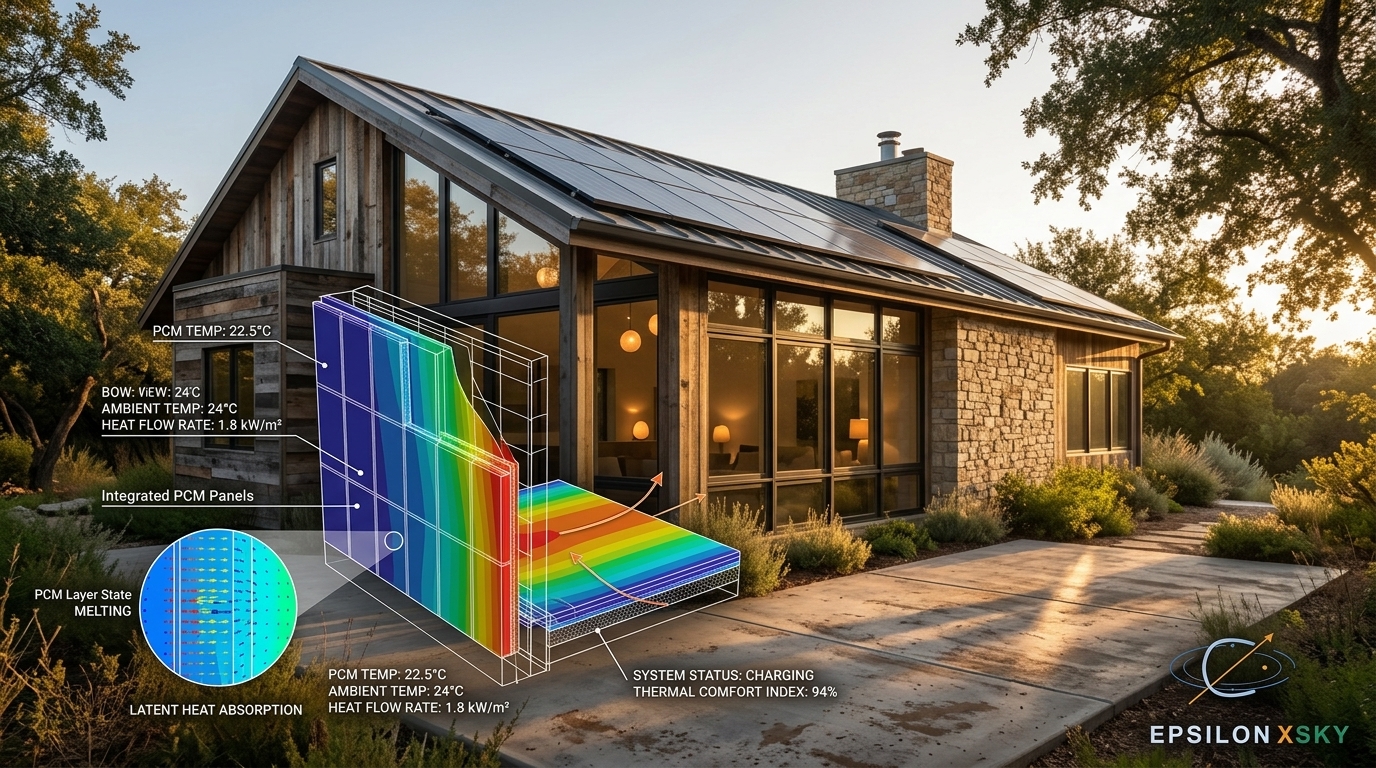
Phase Change Materials solve this problem through latent heat storage. Unlike conventional materials that only store sensible heat by increasing temperature, PCM absorbs large quantities of thermal energy while maintaining nearly constant temperature during melting. Later, when indoor temperatures decrease, the material solidifies and releases the stored heat back into the living space. This unique thermal behavior helps stabilize indoor temperatures without additional energy consumption.
The operating principle of PCM depends on selecting a material with a melting temperature close to the desired indoor comfort range. For residential buildings, many PCM products are designed with melting temperatures between 22°C and 28°C, making them particularly suitable for passive thermal regulation.
When indoor temperatures exceed the melting temperature, the PCM begins absorbing excess heat. Instead of allowing room temperatures to continue increasing, the thermal energy is stored internally as latent heat. As a result, indoor temperature rises much more slowly than in conventional buildings.
During the evening, when outdoor temperatures decrease and indoor temperatures begin to fall, the stored thermal energy is gradually released. This delayed heat release helps maintain comfortable indoor conditions for longer periods without requiring active heating systems.
Several types of PCM are available for building applications. Organic paraffin-based materials offer excellent chemical stability and long service life. Salt hydrates provide higher thermal conductivity and greater energy storage density, while bio-based PCM products offer environmentally friendly alternatives with lower environmental impact.
Modern construction methods allow PCM to be incorporated into numerous building components. Common applications include gypsum wallboards, ceiling panels, floor systems, concrete walls, roof insulation, façade elements, and even ventilation systems. Each installation strategy provides different thermal performance depending on climate conditions and building orientation.
Selecting the appropriate PCM requires careful engineering evaluation. The melting temperature must correspond to local climate conditions, occupancy schedules, HVAC operation, and building usage patterns. A material optimized for one geographical region may perform poorly under different environmental conditions.
At Epsilon X Sky, engineers evaluate these parameters using advanced simulation workflows developed within the ANSYS environment. Rather than relying solely on laboratory measurements, numerical simulations allow designers to investigate multiple PCM configurations before construction begins.

Thermal conductivity also plays an important role in PCM performance. Although many Phase Change Materials possess excellent energy storage capacity, some exhibit relatively low thermal conductivity, slowing heat transfer into and out of the material. Engineers frequently investigate enhanced PCM composites containing graphite, aluminum foams, or conductive additives that improve thermal response.
One major advantage of simulation is the ability to compare multiple PCM thicknesses, installation locations, encapsulation methods, and environmental conditions without expensive physical testing. Engineers can rapidly identify the optimal design that provides maximum energy savings while minimizing material costs.
Another important consideration is climate adaptation. Buildings located in hot climates prioritize cooling load reduction, while colder climates emphasize heating energy storage. Mixed climates require balanced thermal performance throughout both summer and winter seasons.
Using ANSYS Fluent and thermal simulation tools, Epsilon X Sky evaluates hourly temperature variations, solar radiation, indoor airflow, and transient heat transfer to determine exactly how PCM behaves under realistic operating conditions.
Instead of simply adding thermal storage material, simulation allows engineers to understand exactly when, where, and how much energy the PCM stores and releases during daily operation.
By integrating advanced engineering simulation with sustainable building technologies, Epsilon X Sky helps create residential buildings that are more comfortable, more energy efficient, and better prepared for the future of green construction.
Thermal Simulation of Phase Change Materials in Residential Buildings Using ANSYS Fluent
The true performance of a Phase Change Material cannot be evaluated through simple steady-state calculations. PCM continuously absorbs and releases heat depending on solar radiation, outdoor weather conditions, indoor occupancy, and HVAC operation. Because these thermal processes change throughout the day, transient thermal simulation is essential for accurately predicting PCM behavior inside residential buildings.
At Epsilon X Sky, we perform advanced ANSYS Fluent simulations to investigate the complete thermal cycle of Phase Change Materials under realistic environmental conditions. Instead of estimating thermal performance using simplified assumptions, CFD and transient heat transfer simulations provide detailed information about temperature evolution, melting behavior, indoor comfort, and energy savings.

The simulation process begins with creating a three-dimensional model of the residential building. The geometry includes walls, ceilings, roofs, windows, insulation layers, ventilation openings, and PCM-integrated construction materials. Depending on project objectives, PCM may be incorporated into gypsum wallboards, concrete walls, ceiling panels, roofing systems, or floor assemblies.
Material properties are then assigned to every building component. Conventional construction materials such as concrete, brick, gypsum, insulation, and glass are defined alongside the thermal properties of the selected Phase Change Material. PCM requires additional thermophysical data including density, specific heat, thermal conductivity, latent heat of fusion, melting temperature range, and solidification characteristics.
Unlike conventional materials, PCM changes phase during operation. This phase transition is the key mechanism responsible for storing large amounts of thermal energy while maintaining nearly constant temperature. ANSYS Fluent accurately models this process using enthalpy-based formulations that track both sensible and latent heat throughout the simulation.
Solar radiation represents one of the most important boundary conditions. Exterior walls and roofs absorb varying amounts of solar energy throughout the day depending on building orientation, geographical location, and weather conditions. ANSYS Fluent incorporates realistic solar loading models that account for changing sun position, direct radiation, diffuse radiation, and surface absorption properties.
Outdoor environmental conditions are also applied as transient boundary conditions. Ambient temperature, wind velocity, humidity, and atmospheric convection vary continuously over the simulation period. These parameters strongly influence building heat transfer and determine how rapidly PCM absorbs or releases thermal energy.
Indoor conditions depend on occupant activities, lighting, electrical equipment, and HVAC operation. Internal heat gains generated by residents and household appliances are included to produce realistic indoor thermal behavior. Occupancy schedules further improve simulation accuracy by representing varying heat loads throughout the day.
One of the major advantages of ANSYS Fluent is its ability to simulate the complete daily thermal cycle. During the morning, as solar radiation increases, walls and roofs begin absorbing heat. In conventional buildings, this energy quickly transfers indoors, raising room temperature. When PCM is integrated into the building envelope, a significant portion of this thermal energy is absorbed by the Phase Change Material instead.
As the PCM reaches its melting temperature, additional heat no longer produces a rapid temperature increase. Instead, thermal energy is stored as latent heat while the material gradually melts. This phase transition delays indoor temperature rise and significantly improves thermal comfort without consuming electrical energy.
Temperature contour plots generated in ANSYS Fluent clearly illustrate this behavior. Engineers observe lower interior wall temperatures, reduced ceiling temperatures, and more stable room temperatures throughout the hottest periods of the day. These contour maps provide immediate visual confirmation of PCM effectiveness.
Heat flux analysis provides further insight into building performance. Engineers evaluate how much heat enters the building envelope, how much energy is stored within the PCM, and how much eventually reaches indoor living spaces. Reduced inward heat flux directly corresponds to lower cooling requirements.
The liquid fraction model available in ANSYS Fluent enables engineers to visualize the melting process inside the PCM layer. Regions that have completely melted, partially melted, or remained solid are displayed throughout the simulation period. This information allows engineers to determine whether the selected PCM thickness and melting temperature are appropriate for the local climate.
Airflow simulation is frequently coupled with thermal analysis to evaluate indoor air circulation. Natural convection distributes heat throughout residential spaces, affecting occupant comfort and PCM charging behavior. CFD streamlines reveal airflow patterns around walls, windows, and ceilings, allowing designers to optimize natural ventilation strategies alongside PCM integration.
Nighttime operation is equally important. As outdoor temperatures decrease, the PCM begins solidifying while releasing the stored latent heat back into the indoor environment. This controlled heat release slows the nighttime temperature drop, reducing heating requirements and maintaining more consistent indoor comfort.
Transient simulations often span 24 hours, several consecutive days, or even entire seasonal periods. These extended analyses allow engineers to investigate how PCM performance changes under varying weather conditions rather than relying on isolated operating points.
Engineers also perform parametric studies within ANSYS. Different PCM thicknesses, melting temperatures, wall locations, encapsulation methods, and construction materials are evaluated to identify the most efficient configuration. Instead of physically constructing multiple prototypes, numerical simulation allows hundreds of design alternatives to be analyzed rapidly and economically.
At Epsilon X Sky, thermal simulation results include hourly indoor temperature profiles, wall temperature distributions, heat flux maps, latent heat storage capacity, liquid fraction evolution, HVAC energy reduction, and overall building energy performance. These engineering metrics provide quantitative evidence supporting design decisions.
The integration of CFD with transient heat transfer analysis transforms Phase Change Material selection from trial-and-error into a data-driven engineering process. Simulation enables designers to predict building performance before construction begins, reducing uncertainty while maximizing energy efficiency and occupant comfort.
By combining advanced ANSYS Fluent simulation with building physics expertise, Epsilon X Sky helps residential developers design sustainable buildings that maintain comfortable indoor temperatures, reduce HVAC energy consumption, and improve long-term environmental performance.
CFD Airflow, Natural Ventilation, and PCM Optimization in Residential Buildings Using ANSYS

While Phase Change Materials provide exceptional thermal storage capability, their effectiveness depends heavily on the surrounding airflow. Heat must be transferred efficiently between the indoor air and the PCM surfaces for melting and solidification to occur at the right time. This is why Computational Fluid Dynamics (CFD) plays a critical role in designing energy-efficient residential buildings that utilize Phase Change Materials.
At Epsilon X Sky, we combine ANSYS Fluent CFD with transient thermal simulations to study how indoor airflow influences PCM charging and discharging cycles. Instead of analyzing heat transfer alone, our engineers evaluate the interaction between air movement, solar radiation, natural ventilation, thermal storage, and occupant comfort.
Residential buildings experience complex airflow patterns generated by windows, doors, HVAC systems, ceiling fans, temperature gradients, and external wind conditions. These air movements directly influence how rapidly PCM absorbs excess heat during the day and releases stored heat during the evening.
The CFD workflow begins with generating a detailed three-dimensional computational model of the building interior. Living rooms, bedrooms, kitchens, hallways, windows, doors, ventilation openings, and PCM-integrated walls are all represented within the simulation domain. A high-quality computational mesh is then created to accurately capture airflow behavior around critical regions.
Boundary conditions include outdoor wind speed, wind direction, ambient temperature, solar radiation intensity, and indoor heat sources such as occupants, lighting, and household appliances. These conditions allow the simulation to reproduce realistic operating environments throughout different seasons.
Natural ventilation is one of the most important passive cooling strategies in residential buildings. CFD simulations help engineers determine the optimal placement of windows and ventilation openings to maximize fresh air circulation while simultaneously enhancing PCM thermal charging.
During warm afternoons, naturally flowing air transfers excess heat toward PCM-integrated walls and ceilings. Efficient airflow accelerates the melting process, allowing the Phase Change Material to absorb greater amounts of thermal energy before indoor temperatures become uncomfortable.
Velocity contour plots generated by ANSYS Fluent reveal regions of stagnant airflow where thermal energy accumulates. Poor ventilation reduces the effectiveness of PCM because heat cannot reach the thermal storage material efficiently. Engineers modify window sizes, ventilation paths, or architectural layouts to eliminate these low-velocity zones.
Streamline visualizations provide additional insight into airflow pathways throughout residential spaces. Designers can identify short-circuit airflow, dead zones, recirculation regions, and ineffective ventilation patterns that reduce cooling performance.
Temperature contour maps clearly demonstrate the combined effect of airflow and PCM. Buildings equipped with optimized ventilation and properly selected PCM exhibit significantly more uniform indoor temperature distributions compared to conventional buildings.
One major design challenge involves balancing ventilation with thermal storage. Excessive ventilation may remove valuable thermal energy before the PCM has an opportunity to absorb it. Conversely, insufficient airflow reduces PCM utilization and increases cooling loads. CFD enables engineers to find the ideal balance between ventilation efficiency and thermal energy storage.
Solar chimney systems represent another passive design strategy frequently analyzed using CFD. Warm indoor air naturally rises through vertical ventilation shafts, creating pressure differences that draw cooler outdoor air into the building. PCM integrated into surrounding walls can further stabilize indoor temperatures by storing excess thermal energy during peak solar hours.
Cross ventilation is another important application. By strategically positioning windows on opposite building façades, engineers create pressure-driven airflow that improves occupant comfort while maximizing PCM heat absorption. CFD simulations determine the most effective window configurations under varying wind directions.
Mechanical ventilation systems also benefit from CFD optimization. Supply diffusers, exhaust vents, and air conditioning outlets are positioned to improve thermal comfort while ensuring efficient interaction between conditioned air and PCM surfaces. This integrated design approach reduces HVAC operating time and lowers electricity consumption.
Airflow simulations also help engineers evaluate indoor air quality. Ventilation systems designed solely for cooling may inadvertently create regions with poor air circulation. CFD simultaneously optimizes temperature control, contaminant removal, humidity distribution, and occupant comfort.
Occupant comfort is commonly evaluated using internationally recognized indices such as Predicted Mean Vote (PMV) and Predicted Percentage of Dissatisfied (PPD). ANSYS Fluent predicts these comfort indicators throughout occupied spaces, allowing engineers to verify that PCM integration improves not only energy efficiency but also human comfort.

Seasonal simulations provide valuable insight into PCM performance under different climatic conditions. During summer, PCM primarily reduces cooling demand by absorbing excess heat. During winter, stored thermal energy helps maintain comfortable indoor temperatures by releasing heat during colder periods. CFD allows engineers to evaluate both operating modes within a single simulation framework.
Another important engineering consideration involves furniture placement. Large furniture items, interior partitions, and architectural features influence airflow distribution and may reduce PCM effectiveness. CFD identifies these effects early in the design process, enabling architects to optimize interior layouts.
At Epsilon X Sky, simulation reports include airflow velocity fields, temperature distributions, streamlines, heat transfer coefficients, ventilation effectiveness, thermal comfort indices, and PCM charging efficiency. These comprehensive engineering analyses provide designers with practical recommendations for improving residential building performance.
The integration of Computational Fluid Dynamics with Phase Change Material analysis transforms passive building design into a highly optimized engineering solution. Instead of relying on assumptions, engineers make informed decisions based on detailed numerical simulations that accurately represent real operating conditions.
By combining CFD, heat transfer analysis, and advanced building physics, Epsilon X Sky helps architects and developers design residential buildings that consume less energy, maintain superior thermal comfort, and contribute to a more sustainable built environment.
Energy Savings, Building Performance Optimization, and Sustainable Residential Design Using PCM with ANSYS

As energy prices continue to rise and environmental regulations become increasingly stringent, residential buildings are expected to deliver higher levels of efficiency while maintaining exceptional indoor comfort. Heating and cooling systems account for a significant portion of household energy consumption, making thermal management one of the most important engineering challenges in modern construction. Phase Change Materials (PCM), combined with advanced ANSYS simulation, provide an effective solution for reducing energy demand without sacrificing occupant comfort.
At Epsilon X Sky, we use ANSYS Fluent, transient heat transfer analysis, and building performance simulations to quantify the impact of PCM on residential energy consumption. Rather than relying on theoretical estimates, our engineers evaluate actual building behavior under varying weather conditions, occupancy schedules, and operating scenarios to develop highly optimized passive energy-saving solutions.
One of the primary objectives of PCM integration is reducing peak cooling loads. During the hottest hours of the day, conventional buildings rapidly absorb solar heat through walls, roofs, and windows, forcing air-conditioning systems to operate continuously. By incorporating Phase Change Materials into the building envelope, a large portion of this excess heat is absorbed as latent energy instead of immediately entering the indoor space.
This delay in heat transfer significantly reduces indoor temperature fluctuations, allowing HVAC systems to operate less frequently and consume less electricity. Lower peak cooling loads also reduce equipment sizing requirements, resulting in lower installation costs and longer equipment life.
During nighttime operation, PCM releases the stored thermal energy gradually as outdoor temperatures decrease. Instead of experiencing rapid indoor cooling, residential spaces maintain more stable temperatures for longer periods. This passive thermal regulation reduces heating demand during cooler evenings and improves overall occupant comfort.
ANSYS simulations allow engineers to calculate hourly building energy consumption before and after PCM installation. These comparisons clearly demonstrate reductions in cooling loads, heating loads, annual energy use, and peak electricity demand. Such quantitative analysis enables building owners to evaluate the economic benefits of PCM integration with confidence.
Building orientation also has a significant influence on PCM effectiveness. South-facing walls may receive intense solar radiation throughout the day, while east- and west-facing façades experience different heating patterns. Using ANSYS, Epsilon X Sky evaluates solar exposure on every building surface to determine the most effective PCM placement strategy.
Roof systems often represent the largest source of heat gain in residential buildings located in hot climates. Integrating PCM into roof assemblies allows the material to absorb solar energy before it reaches occupied spaces. Simulation results frequently demonstrate substantial reductions in roof surface temperatures and corresponding improvements in indoor thermal conditions.
Wall assemblies containing PCM provide additional thermal buffering. During periods of intense sunlight, wall temperatures increase more slowly because the PCM stores excess thermal energy internally. When solar radiation decreases later in the day, this stored energy is released gradually, reducing temperature swings inside the building.
Window design is another important factor in building energy performance. Although PCM primarily influences opaque building elements, ANSYS simulations evaluate the interaction between glazing systems, solar gains, shading devices, and PCM-enhanced walls to optimize the complete building envelope.
The effectiveness of PCM also depends on insulation quality. Highly insulated buildings retain stored thermal energy more effectively, allowing the Phase Change Material to operate over longer periods. Engineers therefore analyze insulation thickness and material properties alongside PCM selection to achieve the best overall performance.
Economic analysis forms an important part of every engineering study at Epsilon X Sky. Simulation results are combined with construction costs, energy prices, maintenance expenses, and expected service life to estimate return on investment. Rather than viewing PCM as an additional construction expense, simulation demonstrates how improved energy efficiency generates long-term financial savings.
Environmental sustainability is another major advantage. Reduced HVAC operation directly lowers electricity consumption, which in turn decreases greenhouse gas emissions associated with power generation. For developers pursuing green building certifications such as LEED or BREEAM, PCM integration can contribute valuable energy performance credits.
Modern smart buildings can further enhance PCM performance through intelligent HVAC control strategies. Building management systems monitor indoor temperature, weather forecasts, and occupancy schedules to optimize ventilation and cooling based on the thermal storage capacity of the PCM. Simulation helps engineers evaluate these advanced operating strategies before implementation.
Climate-specific optimization is essential because PCM behavior varies significantly between geographical regions. A material selected for hot desert climates may not perform efficiently in temperate or cold environments. ANSYS allows engineers to evaluate building performance using local weather data, ensuring that every PCM solution is optimized for its intended location.
Future residential buildings are increasingly being designed as integrated energy systems rather than isolated architectural structures. Solar panels, high-performance insulation, natural ventilation, smart controls, efficient HVAC systems, and Phase Change Materials work together to minimize energy consumption while maximizing indoor comfort. Engineering simulation provides the platform for integrating these technologies into a single optimized design.
At Epsilon X Sky, our multidisciplinary simulation approach combines CFD, transient heat transfer, building energy analysis, and optimization studies to develop residential buildings that are both energy-efficient and environmentally sustainable. Every engineering decision is supported by detailed numerical analysis rather than assumptions, enabling our clients to construct buildings with predictable performance and long-term value.
By combining Phase Change Materials with advanced ANSYS simulations, residential buildings become more comfortable, consume less energy, reduce operating costs, and contribute to a more sustainable future.
Future Trends, Engineering Best Practices, Conclusion, and FAQs

The future of residential construction is moving toward smart, energy-efficient, and sustainable buildings, where every component contributes to reducing energy consumption while improving occupant comfort. Phase Change Materials (PCM) are expected to become a standard feature in next-generation buildings because they provide passive thermal energy storage without increasing operational energy demand. When combined with advanced engineering simulation, PCM enables buildings to perform more efficiently throughout their entire lifecycle.
At Epsilon X Sky, we believe that simulation-driven engineering is transforming how sustainable buildings are designed. Rather than relying on traditional trial-and-error approaches, architects and engineers can use ANSYS to evaluate hundreds of design alternatives virtually before construction begins. This approach reduces project risk, lowers development costs, and delivers buildings with predictable energy performance.
One of the most promising developments is the integration of Building Information Modeling (BIM) with engineering simulation. BIM models contain detailed architectural and construction information, while ANSYS provides advanced thermal and CFD analysis. Combining these technologies enables engineers to evaluate building performance directly from digital construction models, significantly accelerating project development.
Artificial Intelligence is also beginning to influence PCM optimization. Machine learning algorithms can analyze thousands of simulation results to identify optimal PCM materials, thicknesses, melting temperatures, and installation locations. Instead of manually comparing alternatives, AI-assisted optimization rapidly determines the most efficient building design for specific climate conditions.
Digital Twin technology represents another major advancement. A Digital Twin continuously compares simulation predictions with real building operating data collected from sensors. Indoor temperatures, energy consumption, occupancy, weather conditions, and HVAC performance can all be monitored in real time. This continuous feedback allows engineers to optimize building operation throughout its entire service life rather than only during the design phase.
Future residential buildings will increasingly integrate multiple passive technologies simultaneously. PCM will work alongside high-performance insulation, photovoltaic panels, natural ventilation systems, green roofs, energy-efficient glazing, and smart HVAC controls. Engineering simulation becomes essential for understanding how these technologies interact and ensuring they complement one another rather than compete.
Another growing research area involves nano-enhanced Phase Change Materials. Conventional PCM sometimes suffers from relatively low thermal conductivity, limiting charging and discharging speed. By incorporating nanoparticles, graphite, carbon fibers, or metallic foams, engineers can significantly improve thermal conductivity while maintaining excellent latent heat storage capacity. ANSYS simulations help evaluate these advanced materials before commercial implementation.
Climate resilience is becoming increasingly important as weather patterns become more extreme. Buildings must remain comfortable during prolonged heat waves, cold periods, and fluctuating seasonal conditions. Simulation allows engineers to evaluate building performance under extreme environmental scenarios, ensuring that PCM systems continue functioning effectively throughout changing climate conditions.
At Epsilon X Sky, every PCM project follows a structured engineering workflow based on internationally accepted best practices. The first principle is accurate material characterization. Reliable simulation begins with precise thermophysical properties including latent heat, thermal conductivity, density, and melting temperature range.
The second principle is transient analysis. Because PCM performance depends on continuous melting and solidification, steady-state simulations cannot accurately predict building behavior. Time-dependent simulations capture daily and seasonal thermal cycles, providing realistic performance predictions.
The third principle is mesh independence and numerical verification. High-quality computational meshes ensure simulation accuracy while avoiding unnecessary computational cost. Every engineering study includes convergence verification and sensitivity analysis to guarantee reliable numerical results.
The fourth principle is multidisciplinary engineering. PCM should never be evaluated as an isolated building component. Thermal analysis, CFD, natural ventilation, structural behavior, and occupant comfort must all be considered together to achieve the highest level of building performance.
Economic analysis is equally important. Sustainable engineering must also be financially viable. Engineers at Epsilon X Sky evaluate lifecycle costs, energy savings, return on investment, maintenance requirements, and expected service life to ensure that PCM integration provides long-term value for homeowners and developers.
Environmental sustainability remains at the center of every project. Lower HVAC energy consumption directly reduces greenhouse gas emissions, supports green building certification programs, and contributes to global efforts toward carbon neutrality.
Through advanced simulation technologies, Epsilon X Sky helps architects, developers, and construction companies design residential buildings that consume less energy, maintain superior thermal comfort, and deliver long-term sustainability.
Conclusion
Phase Change Materials are transforming modern residential building design by providing passive thermal energy storage that improves indoor comfort while reducing heating and cooling energy demand. Unlike conventional construction materials, PCM stores and releases large amounts of latent heat, helping stabilize indoor temperatures throughout daily temperature cycles.
Using ANSYS Fluent, engineers can accurately simulate heat transfer, airflow, solar radiation, natural ventilation, and PCM melting and solidification processes. Combined with CFD and transient thermal analysis, these simulations enable engineers to optimize PCM placement, material selection, building orientation, and ventilation strategies before construction begins.
Simulation-driven engineering replaces assumptions with data, allowing smarter design decisions that improve comfort, reduce operational costs, and increase building sustainability.
At Epsilon X Sky, we combine CFD, heat transfer analysis, building performance simulation, and engineering optimization to develop innovative residential solutions that meet the growing demand for sustainable construction. Our ANSYS-based workflow enables clients to build smarter, greener, and more energy-efficient homes with confidence.
Share this article