All Courses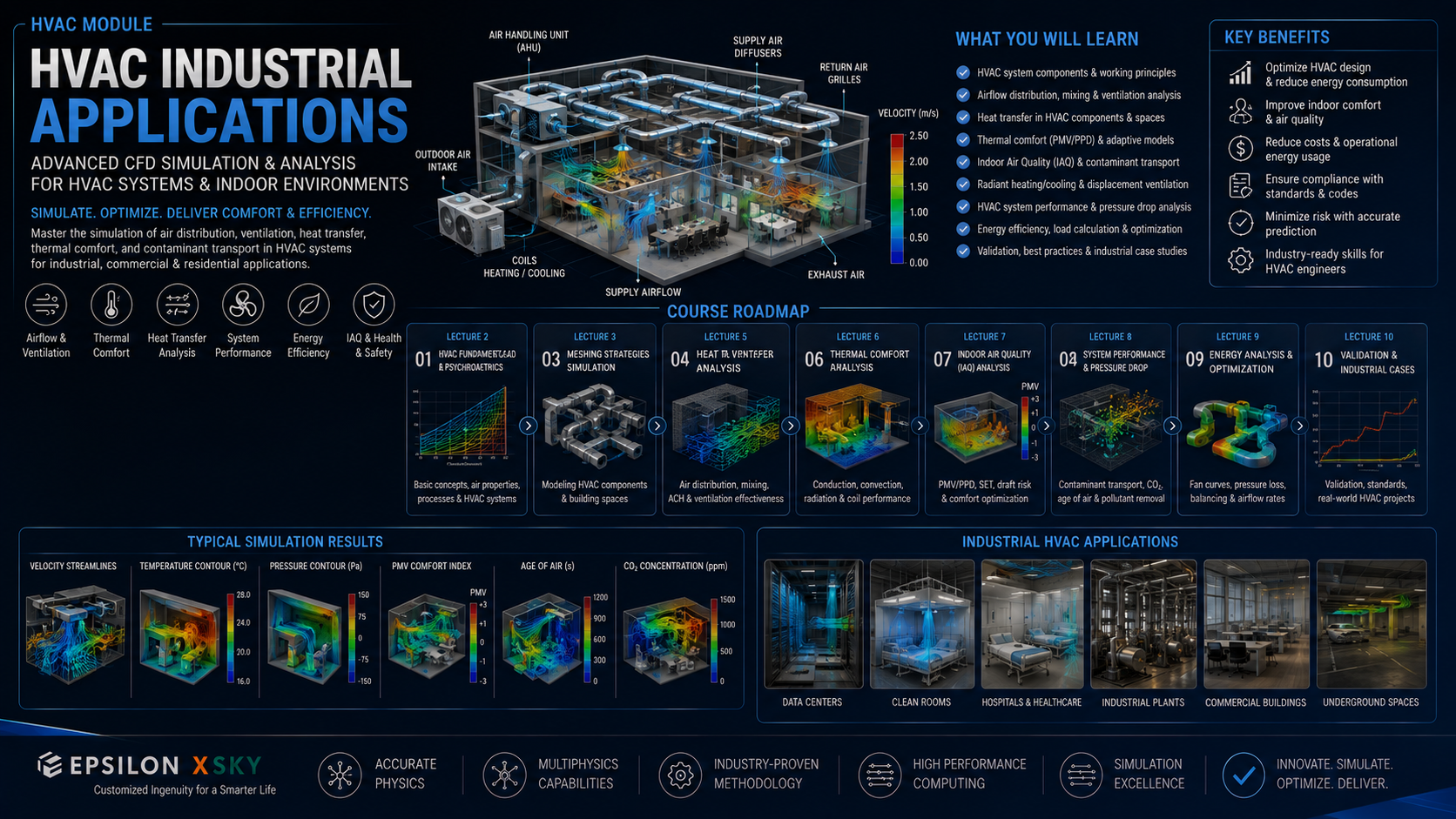
Course
Module 10 : HVAC industrial field case studies
12 sessions
Curriculum
What you'll learn
12 sessions
0160m
H-Vac Industrial application - Lecture One – Shell and Tube Heat Exchanger: Introduction and Fundamentals
0231m
H-Vac Industrial application - Lecture Two– Shell and Tube Heat Exchanger: Introduction and Fundamentals
0325m
H-Vac Industrial application - Lecture Three– Shell and Tube Heat Exchanger: Introduction and Fundamentals
0430m
H-Vac Industrial application - Lecture Four – Ventilation System for Industrial Facilities: Design Principles and Performance
058m
H-Vac Industrial application - Lecture Five– Ventilation System for Industrial Facilities: Design Principles and Performance Basics
0622m
H-Vac Industrial application - Lecture Six – Hull Cooling Air-Conditioning System: Design, Thermal Analysis and CFD Simulation
076m
H-Vac Industrial application - Lecture Seven– Hull Cooling Air-Conditioning System: Design, Thermal Analysis and CFD Simulation
0846m
H-Vac Industrial application - Lecture Eight – Smoke Management Systems: Design Principles, CFD Simulation and Performance Evaluation
0914m
H-Vac Industrial application - Lecture Nine– Smoke Management Systems: Design Principles, CFD Simulation and Performance Evaluation
1028m
H-Vac Industrial application - Lecture Ten– Complete CFD Project Workflow: From Problem Definition to Optimized Solution
118m
H-Vac Industrial application -Lecture Eleven – Complete CFD Project Workflow: From Problem Definition to Optimized Solution
1233m
H-Vac Industrial application - Lecture Twelve – Thermostat Project: Heat Exchanger Design, Thermal Analysis and CFD Simulation
Overview
About this course
Module 10: HVAC & Thermal Management – Industrial Case Studies
Advanced CFD Applications for Heating, Ventilation, Air Conditioning, and Thermal Systems
Heating, Ventilation, and Air Conditioning (HVAC) systems are highly dependent on the movement of air, heat, and energy. Poor airflow distribution can create hot spots, inefficient cooling, uncomfortable indoor environments, excessive energy consumption, and inadequate smoke extraction during emergencies.
Module 10 at Epsilon X Sky focuses on the practical application of Computational Fluid Dynamics (CFD) to HVAC and thermal-management systems, combining fluid flow and heat-transfer analysis with realistic industrial case studies.
Participants learn how to use CFD to predict airflow, temperature distribution, pressure, heat transfer, ventilation effectiveness, smoke movement, and cooling performance, while developing the engineering judgment required to optimize HVAC systems.
Shell & Tube Heat Exchanger – CFD Analysis
The module begins with an industrial Shell & Tube Heat Exchanger CFD project, introducing participants to the simulation of one of the most widely used heat-transfer devices in industry.
Students investigate:
-Fluid flow through the shell and tubes
-Temperature distribution
-Heat transfer between fluids
-Pressure drop
-Velocity distribution
-Thermal performance
-Flow maldistribution
The project demonstrates how CFD can be used to identify inefficient flow regions, evaluate heat-transfer performance, and support heat-exchanger design optimization.
Garage Ventilation – CFD Industrial Project
Adequate ventilation is essential in enclosed garages and industrial parking facilities to control pollutants and maintain safe air quality.
In this case study, participants develop a CFD model to investigate air circulation and contaminant removal within a garage environment.
The analysis focuses on:
-Air inlet and outlet locations
-Air velocity distribution
-Ventilation effectiveness
-Dead zones
-Pollutant distribution
-Flow recirculation
-Ventilation optimization
The project demonstrates how CFD can help engineers determine whether a ventilation system provides sufficient circulation and identify areas requiring improved airflow.
AC Room – Indoor Airflow & Thermal Comfort
The AC Room CFD project introduces participants to the simulation of air-conditioning systems in enclosed spaces.
Students analyze how conditioned air enters the room and interacts with the surrounding environment.
The study investigates:
-Supply-air distribution
-Return-air location
-Room temperature
-Air velocity
-Thermal stratification
-Recirculation zones
-Cooling effectiveness
Participants learn how CFD can be used to optimize air-conditioner positioning and airflow distribution to achieve a more uniform indoor thermal environment.
Smoke Management – CFD Project
Smoke movement during fire events is a critical safety consideration in buildings, tunnels, garages, and industrial facilities.
This case study introduces CFD techniques for smoke transport and ventilation management.
Participants investigate:
-Smoke propagation
-Temperature distribution
-Buoyancy-driven flow
-Smoke accumulation
-Exhaust ventilation
-Air-supply systems
-Visibility-related considerations
-Smoke-control strategies
The project demonstrates how CFD can help engineers understand smoke movement and evaluate ventilation strategies designed to control smoke during emergency scenarios.
Cooling a Heat Source – CFD Thermal Management
Many industrial systems contain concentrated heat sources that require continuous cooling.
This project focuses on CFD analysis of air or fluid cooling around a heat-generating source.
Participants investigate:
-Heat generation
-Temperature distribution
-Cooling flow
-Convective heat transfer
-Hot spots
-Thermal gradients
-Cooling efficiency
The simulation helps engineers determine whether the selected cooling strategy can maintain acceptable operating temperatures and identifies opportunities for improving heat removal.
Applications include:
-Electronics cooling
-Industrial equipment
-Power systems
-Machinery
-Data-centre components
-Thermal management systems
Thermostat & Heat Exchanger CFD Application
The module also introduces a practical CFD application involving a thermostatic heat-transfer system.
Participants investigate the interaction between temperature, fluid flow, and thermal control.
The project provides an opportunity to understand how CFD can be used to evaluate:
-Temperature response
-Fluid circulation
-Heat-transfer performance
-Thermal gradients
-Flow distribution
-Operating conditions
-Thermal control behavior
This case demonstrates how CFD can support the development and optimization of thermal-control equipment.
Advanced HVAC CFD Workflow
Throughout Module 10, participants follow a complete industrial HVAC simulation workflow:
Geometry Preparation → Computational Domain → Meshing → Boundary Conditions → Flow & Thermal Models → Solver Setup → Convergence → Post-Processing → Engineering Evaluation
Students learn how to select appropriate CFD models and interpret the interaction between airflow and heat transfer.
Special attention is given to mesh refinement near walls, inlets, outlets, heat sources, and regions where strong temperature or velocity gradients occur.
CFD for HVAC Optimization
The objective of HVAC CFD is not simply to produce colorful temperature and velocity contours.
Participants learn how simulation results can be converted into meaningful engineering decisions by evaluating:
-Airflow uniformity
-Cooling effectiveness
-Temperature distribution
-Pressure losses
-Ventilation performance
-Heat-transfer rates
-Dead zones
-Hot spots
-Recirculation regions
-Energy-performance considerations
This approach allows engineers to compare alternative HVAC configurations before expensive physical modifications or installations are made.
Industrial Applications
The techniques covered in this module can be applied to a wide range of HVAC and thermal-management systems, including:
-Commercial buildings
-Industrial buildings
-Garages
-Parking facilities
-Data centres
-Manufacturing plants
-Warehouses
-Clean rooms
-HVAC ducts
-Heat exchangers
-Cooling systems
-Industrial thermal equipment
-Smoke-control systems
By the End of Module 10, You Will Be Able To:
-Build CFD models for HVAC and thermal-management applications.
-Analyze airflow distribution inside enclosed spaces.
-Evaluate indoor temperature and thermal stratification.
-Simulate ventilation systems in garages and industrial facilities.
-Analyze smoke movement and ventilation strategies.
-Perform CFD analysis of shell-and-tube heat exchangers.
-Evaluate cooling performance around heat sources.
-Analyze temperature and velocity distributions.
-Identify hot spots, dead zones, and recirculation regions.
-Evaluate heat-transfer and pressure-drop behavior.
-Use CFD results to improve HVAC and cooling-system designs.
-Apply professional CFD workflows to industrial thermal-management problems.
Why This Module Matters
An HVAC system can be correctly designed on paper and still perform poorly in the real world.
Airflow distribution, heat transfer, equipment location, ventilation, and thermal stratification can produce complex three-dimensional behavior that is difficult to predict using conventional calculations alone.
Module 10 at Epsilon X Sky provides engineers with practical CFD experience across heat exchangers, ventilation, indoor air conditioning, smoke management, and industrial cooling applications.
By combining fluid dynamics + heat transfer + HVAC engineering + CFD, participants learn how to move from simply designing a thermal system to understanding, validating, and optimizing its actual performance.
Epsilon X Sky
Simulate the Flow. Understand the Heat. Optimize the System.