All Courses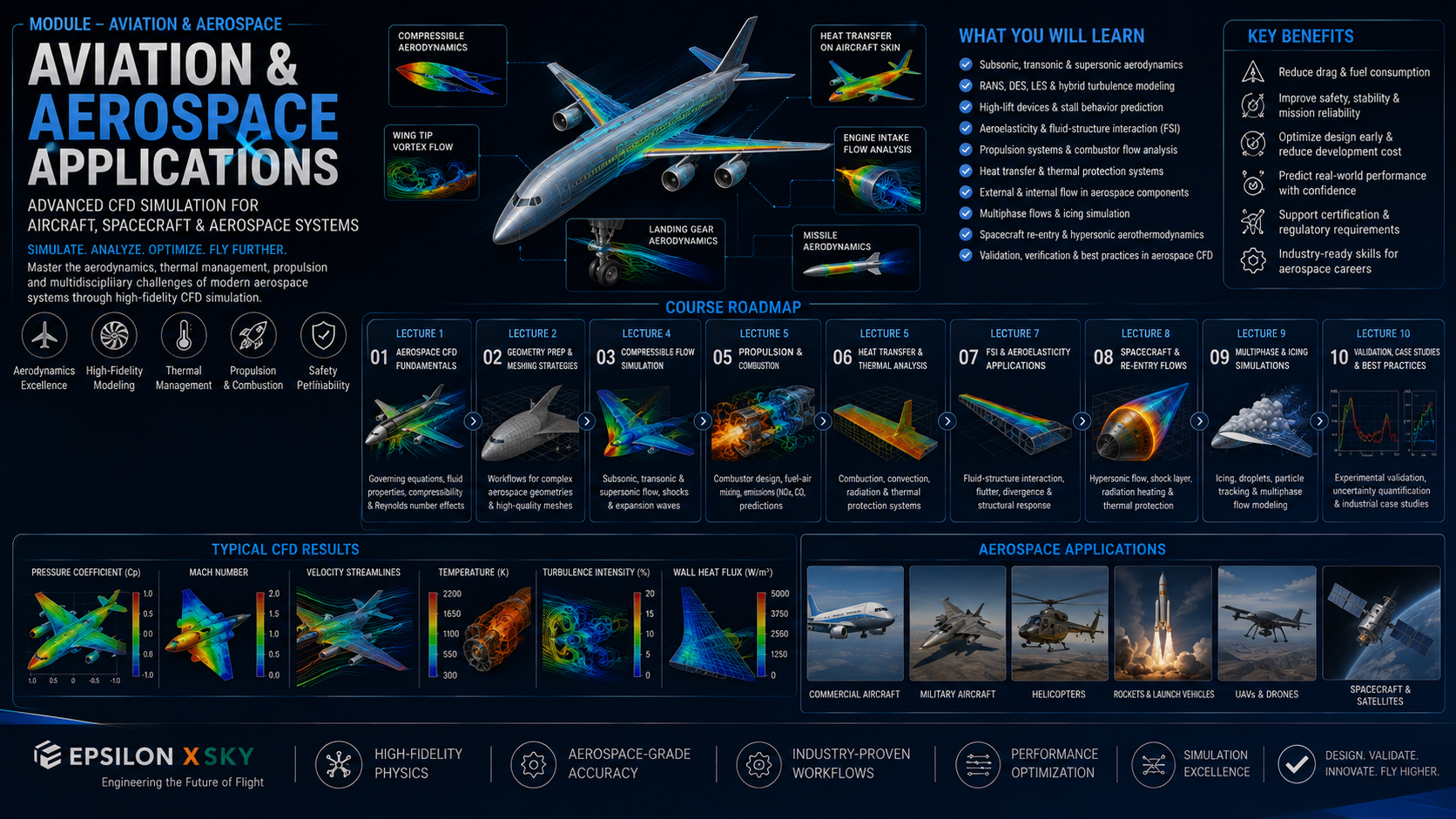
CourseBest Seller
Module 11 :Aviation & Aerospace industrial application
17 sessions
Curriculum
What you'll learn
17 sessions
0134m
Aviation & Aerospace Industrial Application Lecture One – Airfoil Analysis & Validation
0218m
Aviation & Aerospace Industrial Application Lecture Two– Airfoil Analysis & Validation
0358m
Aviation & Aerospace Industrial Application Lecture Three– Airfoil Analysis & Validation
0450m
Aviation & Aerospace Industrial Application Lecture Four– Airfoil Analysis & Validation
057m
Aviation & Aerospace Industrial Application Lecture Five– Airfoil Analysis & Validation
0630m
Aviation & Aerospace Industrial Application Lecture Six– Drone Simulation
0759m
Aviation & Aerospace Industrial Application Lecture Seven– Drone Simulation
0823m
Aviation & Aerospace Industrial Application Lecture eight– Drone Simulation
0960m
Aviation & Aerospace Industrial Application Lecture Nine – Drone Simulation
1030m
Aviation & Aerospace Industrial Application Lecture Ten– Drone Simulation
1128m
Aviation & Aerospace Industrial Application Lecture 11 – Drone Simulation
1240m
Aviation & Aerospace Industrial Application Lecture Twelve – Rocket Simulation Capstone
1322m
Aviation & Aerospace Industrial Application Lecture Thirteen– Rocket Simulation Capstone
1430m
Aviation & Aerospace Industrial Application Lecture Fourteen– Rocket Simulation Capstone
1541m
Aviation & Aerospace Industrial Application Lecture Fifteen– Rocket Simulation Capstone
1645m
Aviation & Aerospace Industrial Application Lecture Sixteen – Compressible Flow Simulation Over Wings
1719m
Aviation & Aerospace Industrial Application Lecture seventeen– Compressible Flow Simulation Over Wings
Overview
About this course
Module 11: Aviation & Aerospace – Industrial Applications
Advanced CFD for Aircraft, UAVs, Rockets, and Compressible Aerodynamics
Aviation and aerospace engineering demand a deep understanding of aerodynamics, compressible flow, turbulence, pressure distribution, and aerodynamic performance. Small changes in geometry or operating conditions can significantly affect lift, drag, stability, fuel consumption, and overall vehicle performance.
Module 11 at Epsilon X Sky provides a practical, industry-oriented introduction to aerospace CFD using ANSYS Fluent, progressing from fundamental airfoil analysis to complete simulations of quadcopters and rocket configurations.
The module is designed to help engineers understand not only how to set up an aerospace CFD simulation, but also how to validate, interpret, and use aerodynamic results for engineering decisions.
CFD Analysis of an Airfoil
The module begins with one of the fundamental building blocks of aerodynamic engineering: the airfoil.
Participants develop a complete CFD model around an airfoil and investigate the interaction between airflow and the aerodynamic surface.
The analysis covers:
-Airflow around the airfoil
-Pressure distribution
-Velocity distribution
-Lift generation
-Drag generation
-Flow separation
-Wake formation
-Boundary-layer behavior
-Surface pressure
Students learn how airfoil geometry and flow conditions influence aerodynamic performance.
Airfoil CFD Results & Aerodynamic Interpretation
Producing an aerodynamic solution is only the first step.
Participants learn how to extract and interpret meaningful engineering results from the CFD simulation, including:
-Lift coefficient
-Drag coefficient
-Pressure coefficient
-Surface pressure distribution
-Velocity contours
-Streamlines
-Wake characteristics
-Wall shear stress
The module emphasizes engineering interpretation, helping participants understand what the CFD results mean physically and how they can be used to improve aerodynamic design.
CFD Airfoil Validation
Validation is a critical part of professional aerospace simulation.
In this section, participants compare CFD predictions against established experimental or reference aerodynamic data.
The validation process focuses on:
-Lift comparison
-Drag comparison
-Pressure-distribution comparison
-Angle-of-attack effects
-Mesh sensitivity
-Numerical uncertainty
-Model assumptions
Students learn how to determine whether an airfoil simulation is sufficiently accurate for engineering use rather than simply accepting a converged CFD solution.
Complete Quadcopter CFD Simulation
The module then moves from a simplified aerodynamic component to a complete quadcopter simulation.
This industrial case study introduces the additional challenges associated with complex UAV geometries and multiple aerodynamic components.
Participants investigate:
-Complete quadcopter geometry
-Airflow around the vehicle
-Rotor-related flow effects
-Pressure distribution
-Velocity fields
-Aerodynamic forces
-Wake development
-Flow interaction between components
The project demonstrates how CFD can support UAV aerodynamic development, performance evaluation, and design optimization.
Rocket Aerodynamic CFD Simulation
A dedicated project focuses on the aerodynamic analysis of a rocket configuration.
Participants investigate airflow around the rocket and analyze the aerodynamic behavior of the vehicle under specified operating conditions.
The study can include:
-Pressure distribution
-Velocity fields
-Flow separation
-Shock-related behavior
-Aerodynamic forces
-Drag
-Surface loads
-Wake development
The project introduces engineers to the challenges of simulating aerospace configurations where high-speed flow and strong pressure gradients can become important.
Compressible Flow Around an Airfoil
At higher Mach numbers, air can no longer always be treated as an incompressible fluid.
This section introduces compressible aerodynamic CFD using an airfoil configuration.
Participants explore:
-Mach number
-Density variation
-Pressure changes
-Temperature changes
-Compressibility effects
-Shock-wave formation
-High-speed aerodynamic behavior
The simulation demonstrates how aerodynamic flow characteristics change as the Mach number increases and why appropriate compressible-flow modeling becomes essential for high-speed aerospace applications.
Aerospace CFD Workflow
Throughout Module 11, participants develop a complete aerospace CFD workflow:
Geometry → Computational Domain → Meshing → Boundary Conditions → Turbulence Model → Solver Setup → Convergence → Validation → Post-Processing → Aerodynamic Evaluation
Special attention is given to the relationship between:
Mesh Quality → Numerical Accuracy → CFD Convergence → Aerodynamic Prediction
This allows participants to understand why aerospace CFD requires carefully controlled computational models.
Aerodynamic Design & Engineering Decision-Making
The ultimate purpose of aerospace CFD is not simply to generate contours.
Participants learn how aerodynamic results can support decisions involving:
-Airfoil selection
-Geometry modification
-Drag reduction
-Lift improvement
-Flow-separation control
-UAV performance
-Rocket aerodynamic design
-High-speed aerodynamic behavior
The module therefore connects CFD simulation with practical aerospace engineering design.
Industrial Applications
The techniques covered in Module 11 can be applied across a broad range of aerospace and aviation systems, including:
-Aircraft
-Airfoils
-Wings
-UAVs
-Quadcopters
-eVTOL aircraft
-Rockets
-Propulsion systems
-High-speed vehicles
-Aerospace components
By the End of Module 11, You Will Be Able To:
-Build aerodynamic CFD models using ANSYS Fluent.
-Perform complete CFD analysis around airfoils.
-Calculate and interpret lift and drag.
-Analyze pressure and velocity distributions.
-Identify flow separation and wake behavior.
-Extract and interpret aerodynamic CFD results.
-Validate airfoil CFD results against reference data.
-Perform CFD analysis of complete quadcopter configurations.
-Analyze rocket aerodynamic behavior.
-Understand the fundamentals of compressible aerodynamic flow.
-Investigate Mach-number effects and high-speed flow.
-Evaluate aerospace designs using CFD from an engineering perspective.
Why This Module Matters
Aerospace engineering demands simulation accuracy.
Whether analyzing a small airfoil, a quadcopter, or a high-speed rocket, engineers need reliable predictions of how air interacts with the vehicle.
Module 11 at Epsilon X Sky takes participants from fundamental airfoil CFD to complete aerospace applications, combining aerodynamic theory, ANSYS Fluent workflows, validation, compressible-flow analysis, and realistic engineering cases.
The result is a practical foundation for engineers who want to work with aerodynamic simulation across aviation, UAV, aerospace, and high-speed-flow applications.
Epsilon X Sky
From Airfoil Aerodynamics to Complete Aerospace CFD.