All Courses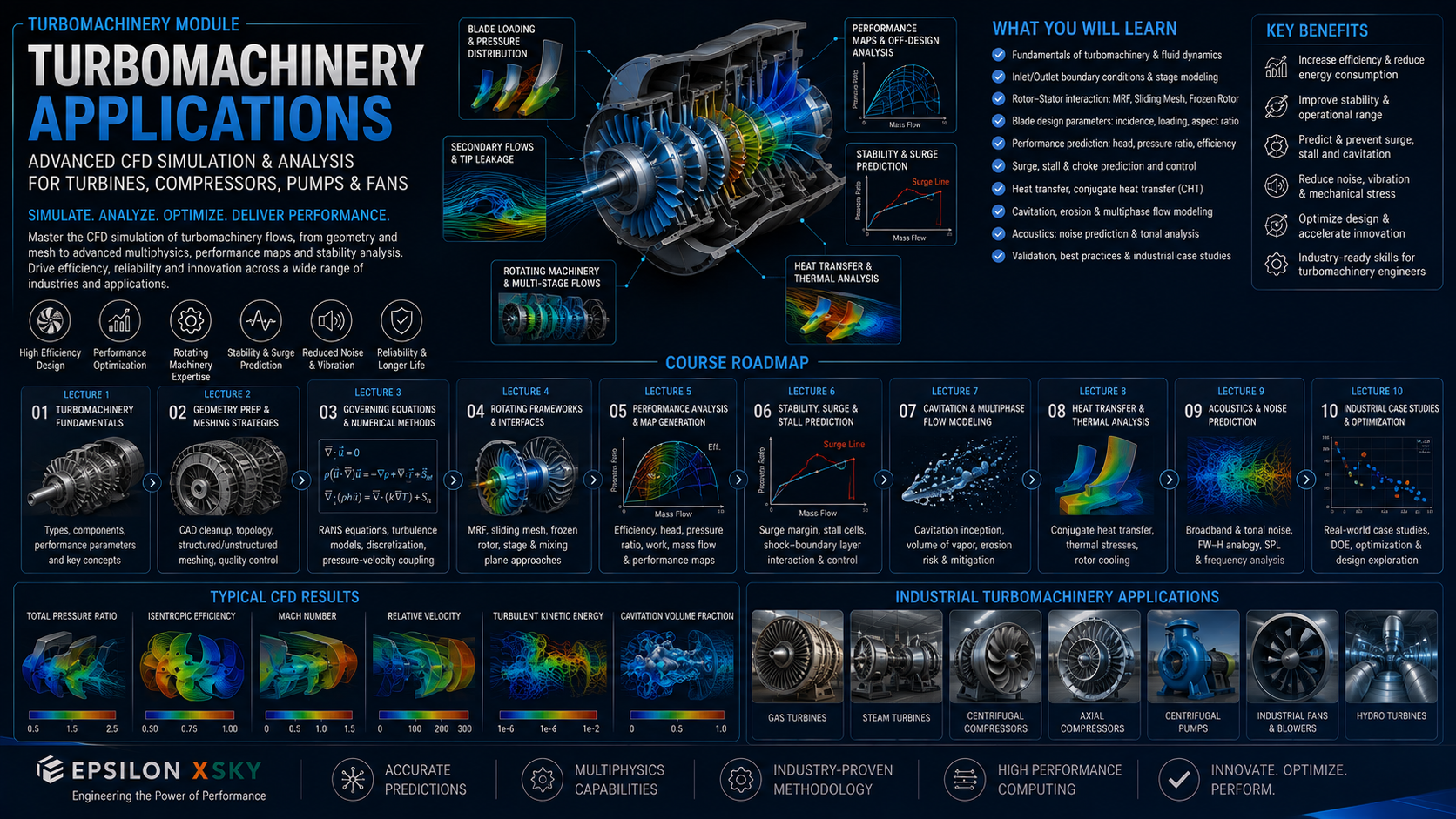
CourseBest Seller
Module 12 :Turbomachinery Field industrial applications
18 sessions1 free preview
Curriculum
What you'll learn
18 sessions · 1 free
0161m
Turbomachinery Industrial Application - Lecture One – 3D Wind Turbine Analysis
0254m
Turbomachinery Industrial Application - Lecture Two– 3D Wind Turbine Analysis
0358m
Turbomachinery Industrial Application - Lecture Three – CFD Analysis of Savonius Wind Turbines
0457m
Turbomachinery Industrial Application - Lecture Four– CFD Analysis of Savonius Wind Turbines
059m
Turbomachinery Industrial Application - Lecture Five– CFD Analysis of Savonius Wind Turbines
0667m
Turbomachinery Industrial Application - Lecture Six – CFD Analysis of Vertical Axis Wind Turbines (VAWT)
0722m
Turbomachinery Industrial Application - Lecture Seven– CFD Analysis of Vertical Axis Wind Turbines (VAWT)
0853m
Turbomachinery Industrial Application - Lecture eight– CFD Analysis of Vertical Axis Wind Turbines (VAWT)
0939m
Turbomachinery Industrial Application - Lecture Nine– CFD Analysis of Vertical Axis Wind Turbines (VAWT)
1059m
Turbomachinery Industrial Application - Lecture Ten– CFD Analysis of Vertical Axis Wind Turbines (VAWT)
1147m
Turbomachinery Industrial Application - Lecture eleven – CFD Analysis of Vertical Axis Wind Turbines (VAWT)
1260m
Turbomachinery Industrial Application - Lecture Twelve – CFD Analysis of Vertical Axis Wind Turbines (VAWT)
1345m
Turbomachinery Industrial Application -Lecture Thirteen – Multi-Stage Compressor CFD Analysis & Performance Optimization
1420m
Turbomachinery Industrial Application - Lecture Fourteen– Multi-Stage Compressor CFD Analysis & Performance Optimization
1536m
Turbomachinery Industrial Application - Lecture Fifteen– Multi-Stage Compressor CFD Analysis & Performance Optimization
1622m
Turbomachinery Industrial Application - Lecture sixteen– Multi-Stage Compressor CFD Analysis & Performance Optimization
1738m
Turbomachinery Industrial Application -Lecture Seventeen – Pelton Wheel Turbine CFD Analysis & Performance Optimization
1810m
Turbomachinery Industrial Application -Lecture eighteen – Pelton Wheel Turbine CFD Analysis & Performance Optimization
Overview
About this course
Module 12: Turbomachinery – Industrial Applications
Advanced CFD Analysis of Wind Turbines, Rotating Machinery & Hydraulic Turbines
Turbomachinery CFD involves some of the most challenging fluid-flow problems in engineering because the flow is strongly influenced by rotation, transient effects, pressure gradients, turbulence, blade geometry, and fluid–machine interaction.
Module 12 at Epsilon X Sky provides a practical, industry-oriented introduction to turbomachinery simulation using CFD, with a particular focus on wind turbines, Vertical Axis Wind Turbines (VAWT), Savonius turbines, and Pelton wheel turbines.
Participants learn how to build rotating-flow simulations, analyze transient aerodynamic and hydrodynamic behavior, extract performance parameters, validate CFD predictions, and interpret complex transient results.
CFD Wind Turbine Analysis
The module begins with the CFD analysis of a wind turbine, introducing the fundamental principles required to simulate energy extraction from airflow.
Participants investigate:
-Airflow around turbine blades
-Pressure distribution
-Velocity fields
-Blade loading
-Torque generation
-Aerodynamic forces
-Wake development
-Turbine performance
The project demonstrates how CFD can be used to understand the interaction between the incoming wind and rotating turbine components and identify opportunities for aerodynamic performance improvement.
Savonius Wind Turbine – CFD Analysis
The Savonius Vertical Axis Wind Turbine provides an excellent case study for understanding complex rotating flows and drag-based energy conversion.
Participants analyze airflow around the rotating turbine and investigate:
-Blade geometry
-Flow separation
-Pressure distribution
-Velocity fields
-Torque generation
-Rotational behavior
-Wake structures
-Energy-extraction performance
The project demonstrates how CFD can be applied to evaluate and optimize alternative wind-turbine configurations.
VAWT CFD Analysis
Vertical Axis Wind Turbines present unique aerodynamic challenges because the blades continuously change their relative position and angle with respect to the incoming wind.
Participants investigate the unsteady aerodynamic behavior of VAWT systems, including:
-Rotating blade motion
-Time-dependent pressure
-Velocity variation
-Dynamic blade loading
-Torque fluctuations
-Wake interaction
-Flow separation
The analysis introduces participants to the challenges associated with transient rotating CFD simulations.
VAWT CFD Validation & Performance Analysis
A professional turbomachinery simulation requires more than a visually attractive CFD result.
This section focuses on validation and engineering interpretation of VAWT simulations.
Participants learn how to compare CFD predictions with available experimental or reference results using parameters such as:
-Torque
-Power
-Power coefficient
-Tip-speed ratio
-Pressure distribution
-Velocity behavior
The validation process helps participants understand the relationship between mesh quality, numerical settings, transient resolution, and predicted turbine performance.
Transient CFD & Post-Processing
Rotating machinery often produces strongly time-dependent flow fields.
This section focuses on the professional post-processing of transient CFD results.
Participants learn how to analyze:
-Time-dependent pressure
-Velocity fluctuations
-Torque variation
-Blade forces
-Moment variation
-Flow structures
-Wake evolution
-Instantaneous and averaged performance
The objective is to transform large amounts of transient simulation data into meaningful engineering information.
Participants learn how to identify performance trends rather than relying only on individual CFD snapshots.
Advanced Turbomachinery CFD
The module introduces the general CFD methodologies used for turbomachinery and rotating-flow systems.
Participants explore concepts such as:
-Rotating reference frames
-Moving meshes
-Transient rotating simulations
-Sliding interfaces
-Rotating zones
-Fluid–machine interaction
-Turbulence modeling
-Transient convergence
-Performance monitoring
These techniques provide a foundation for applications involving fans, pumps, turbines, compressors, propellers, and other rotating machinery.
Pelton Wheel Turbine – CFD Study
The module concludes with an industrial CFD case study involving a Pelton wheel turbine.
Unlike wind turbines, the Pelton wheel converts the energy of a high-speed water jet into mechanical rotation.
Participants investigate:
-Water-jet behavior
-Bucket interaction
-Pressure distribution
-Velocity changes
-Flow direction
-Force on turbine buckets
-Torque generation
-Energy conversion
The project demonstrates how CFD can be used to investigate hydraulic turbomachinery and understand the relationship between fluid momentum and mechanical power generation.
Turbomachinery CFD Workflow
Throughout Module 12, participants develop a structured workflow for rotating-flow simulations:
Geometry → Computational Domain → Mesh → Rotating Region → Boundary Conditions → Solver Setup → Transient Simulation → Convergence → Post-Processing → Performance Evaluation → Validation
Particular attention is given to the additional challenges encountered in rotating CFD, including transient behavior, moving interfaces, periodic flow structures, and time-step selection.
Performance Evaluation & Engineering Optimization
CFD results become valuable when they can be translated into measurable engineering performance.
Participants learn how to evaluate parameters such as:
-Torque
-Power
-Efficiency
-Pressure drop
-Force
-Moment
-Power coefficient
-Tip-speed ratio
-Flow uniformity
These parameters allow engineers to compare different turbine configurations and identify design modifications that can improve performance.
Industrial Applications
The methodologies covered in Module 12 can be applied to a wide range of turbomachinery systems, including:
-Wind Turbines
-VAWT Systems
-Savonius Turbines
-Pelton Turbines
-Hydraulic Turbines
-Pumps
-Fans
-Compressors
-Propellers
-Rotating Machinery
-Renewable Energy Systems
By the End of Module 12, You Will Be Able To:
-Build CFD models for rotating turbomachinery.
-Perform wind-turbine CFD analysis.
-Simulate Savonius wind turbines.
-Analyze VAWT aerodynamic performance.
-Set up transient rotating CFD simulations.
-Interpret time-dependent turbomachinery results.
-Extract torque, power, and performance parameters.
-Perform VAWT CFD validation.
-Understand rotating-reference-frame and moving-mesh concepts.
-Analyze hydraulic turbine flow.
-Perform a CFD study of a Pelton wheel turbine.
-Interpret complex transient flow structures.
-Apply CFD methodologies to industrial turbomachinery problems.
Why This Module Matters
Rotating machinery is at the heart of modern energy systems.
From wind turbines generating renewable electricity to hydraulic turbines converting water energy into mechanical power, turbomachinery performance depends on complex interactions between fluid flow and rotating components.
Module 12 at Epsilon X Sky provides practical experience with these challenges through wind-turbine, VAWT, Savonius, and Pelton-wheel CFD projects.
Participants learn not only how to set up rotating CFD simulations, but also how to validate results, analyze transient behavior, extract performance data, and use simulation to improve turbomachinery designs.
Epsilon X Sky
Simulate the Rotation. Understand the Flow. Optimize the Machine.