All Courses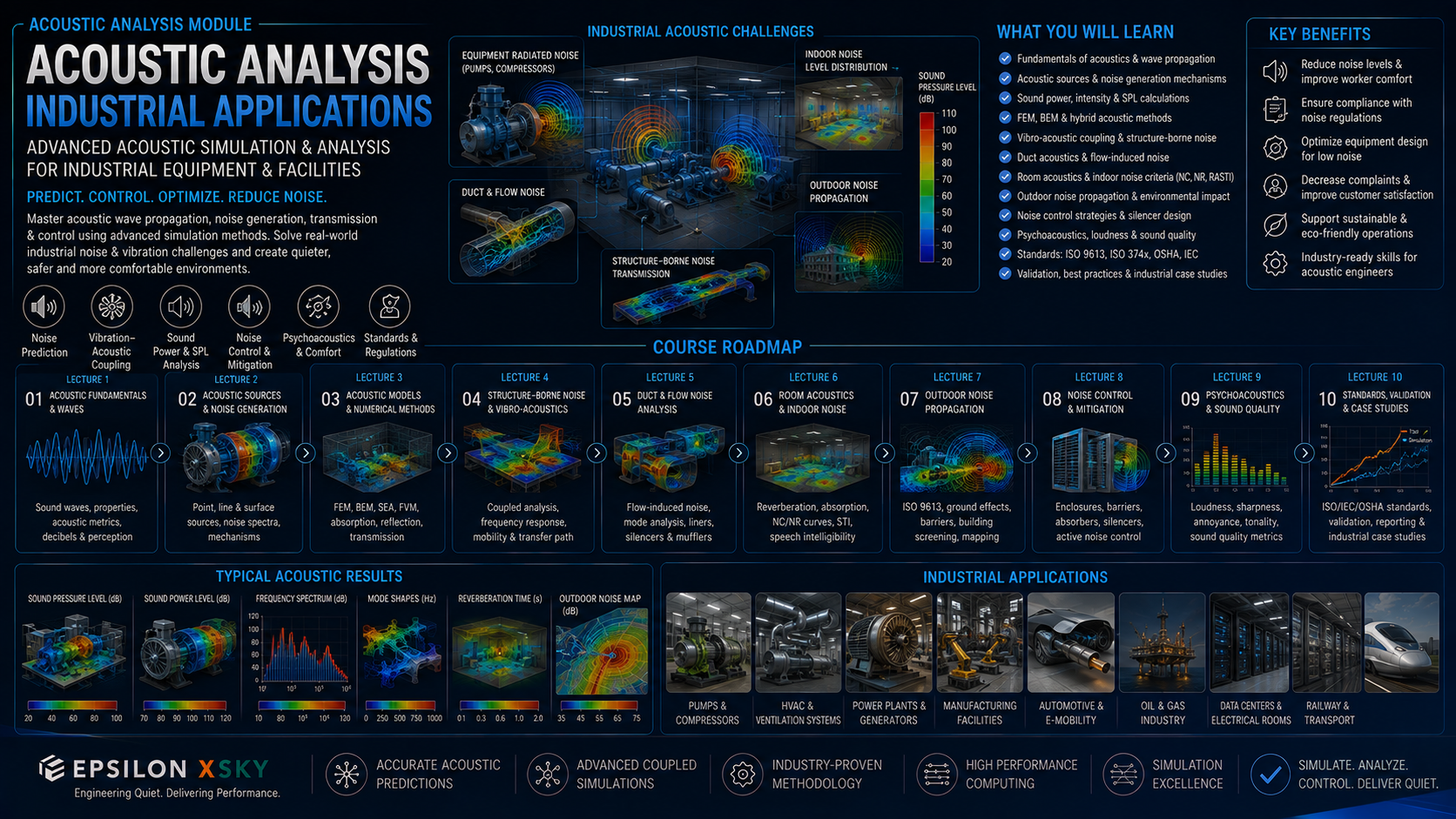
Course
Module 14 :Acoustic Various Analysis for industrial application
0 sessions
Overview
About this course
Module 14: Acoustic Analysis – Industrial Applications
Advanced Acoustic & Aeroacoustic Simulation Using CAE
Noise and vibration are critical engineering challenges across aerospace, automotive, turbomachinery, industrial equipment, and mechanical systems. Predicting where noise originates, how it propagates, and how it can be reduced requires the integration of structural dynamics, fluid mechanics, and acoustic analysis.
Module 14 at Epsilon X Sky introduces participants to advanced acoustic and aeroacoustic simulation, combining FEA-based acoustic analysis with CFD-driven aeroacoustic applications.
The module is designed to help engineers understand how computational methods can be used to identify noise sources, evaluate acoustic response, and support the development of quieter and more efficient engineering systems.
Acoustic Analysis – FEA Industrial Project
The first case study focuses on acoustic analysis using FEA, introducing participants to the numerical simulation of acoustic behavior within an engineering system.
Participants investigate the interaction between structural and acoustic domains and learn how computational analysis can be used to predict acoustic response.
The project covers concepts such as:
-Acoustic pressure
-Sound propagation
-Acoustic modes
-Natural frequencies
-Pressure response
-Acoustic cavities
-Structural-acoustic interaction
-Frequency-domain analysis
Students learn how FEA can be used to identify important acoustic characteristics and evaluate how an engineering system responds to different excitation frequencies.
Understanding Acoustic Modes & Resonance
A key part of industrial acoustic simulation is understanding resonance and modal behavior.
Participants learn how acoustic modes can develop inside enclosed or semi-enclosed domains and how these modes influence the resulting sound pressure levels.
The analysis helps engineers investigate:
-Resonant frequencies
-Acoustic mode shapes
-Pressure nodes
-Pressure antinodes
-Frequency response
-Acoustic amplification
This knowledge is particularly important when designing systems where unwanted noise or vibration must be controlled.
Aeroacoustic CFD – Propeller Analysis
The second major project focuses on aeroacoustic analysis of a propeller, combining CFD and acoustic concepts to investigate noise generated by aerodynamic flow.
Propellers can generate significant noise due to complex interactions between rotating blades, turbulent flow, pressure fluctuations, and wake structures.
Participants analyze:
-Airflow around the propeller
-Blade pressure distribution
-Velocity fields
-Wake development
-Pressure fluctuations
-Aerodynamic loading
-Noise-generation mechanisms
-Aeroacoustic behavior
The project demonstrates how CFD can be used as a foundation for understanding flow-induced noise and aerodynamic noise sources.
Aeroacoustic Engineering Workflow
The propeller case introduces participants to a professional aeroacoustic workflow:
Geometry → Mesh → Flow Simulation → Transient Solution → Pressure Fluctuations → Acoustic Analysis → Noise Evaluation
Students learn why transient CFD information can be important when investigating aerodynamic noise and why steady-state results alone may not capture the complete acoustic behavior of rotating machinery.
CFD & FEA for Acoustic Engineering
A major objective of Module 14 is to demonstrate that acoustic engineering often requires the combination of multiple simulation disciplines.
Depending on the application, engineers may need to combine:
CFD + FEA + Acoustics + Structural Dynamics
This multidisciplinary approach can be applied to systems where fluid flow generates pressure fluctuations that excite structures and subsequently produce or transmit sound.
Participants therefore develop an understanding of how acoustic simulation fits into the wider multiphysics CAE workflow.
Industrial Applications
The methodologies introduced in Module 14 can be extended to numerous engineering fields, including:
-Aerospace
-Automotive
-UAVs and drones
-Propellers
-Fans
-Pumps
-Turbomachinery
-Industrial machinery
-HVAC systems
-Rotating equipment
-Structural-acoustic systems
-Consumer products
By the End of Module 14, You Will Be Able To:
-Understand the fundamentals of engineering acoustic simulation.
-Perform FEA-based acoustic analysis.
-Analyze acoustic modes and resonance.
-Evaluate acoustic pressure distributions.
-Understand structural-acoustic interaction.
-Develop CFD models for aeroacoustic applications.
-Analyze aerodynamic noise generated by propellers.
-Interpret transient CFD data for acoustic applications.
-Identify potential aerodynamic noise sources.
-Understand the relationship between CFD, FEA, and acoustics.
-Apply acoustic simulation methodologies to industrial engineering problems.
Why This Module Matters
Noise is not simply a sound problem—it is often a physics problem.
Unwanted noise can originate from aerodynamic turbulence, structural vibration, rotating machinery, pressure fluctuations, or resonance. Understanding these mechanisms allows engineers to move from simply measuring noise to predicting, identifying, and controlling its sources.
Module 14 at Epsilon X Sky combines FEA acoustic analysis with a practical propeller aeroacoustic CFD case study, giving participants an industry-oriented foundation for tackling complex noise and vibration challenges.
Epsilon X Sky
Simulate the Noise. Identify the Source. Engineer a Quieter System.