All Courses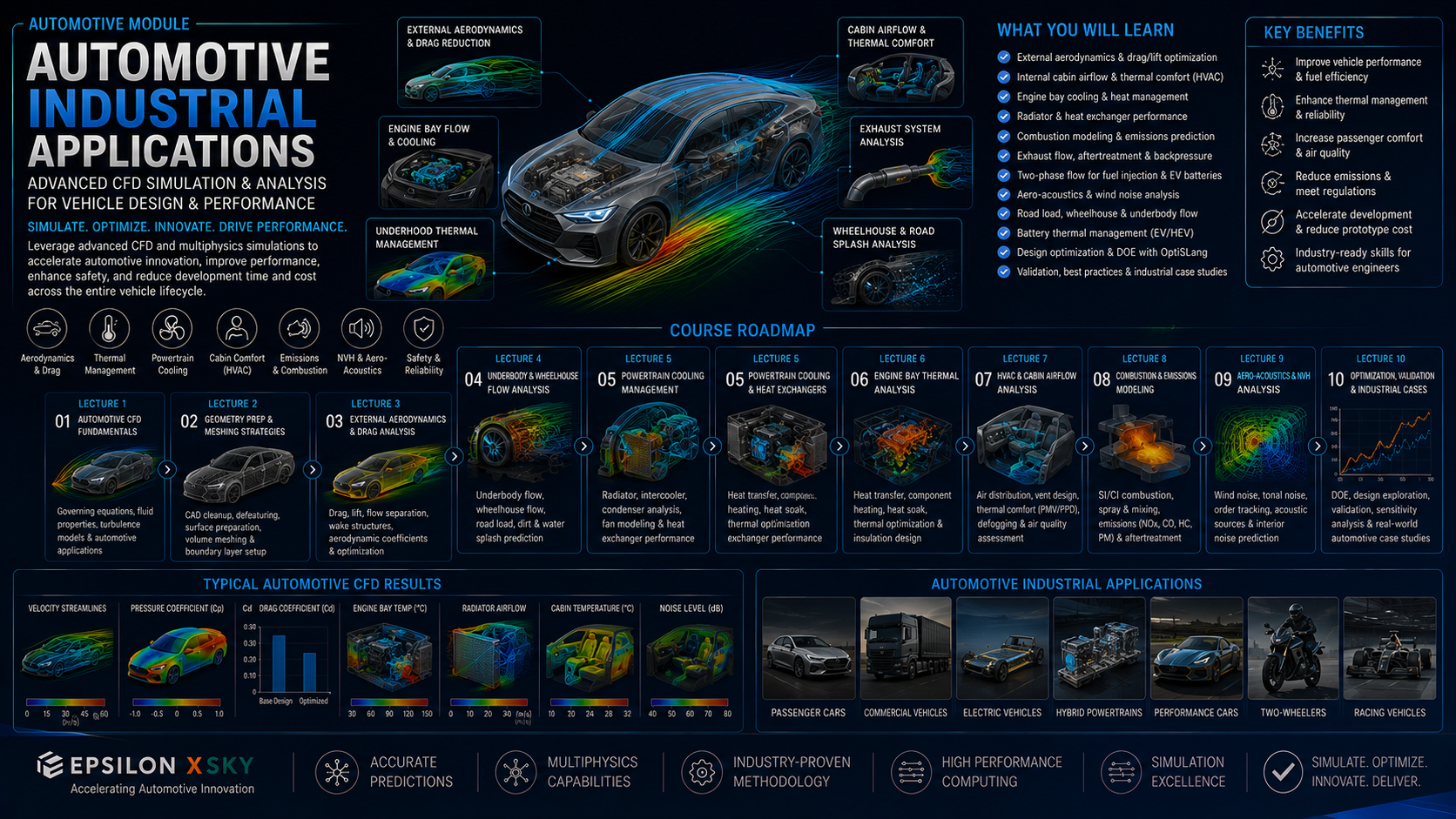
Course
Module 15 :Automotive Field industry application
0 sessions
Overview
About this course
Module 15: Automotive Engineering – Industrial Applications
CFD Around a Formula Car
Automotive engineering is one of the most demanding fields for Computational Fluid Dynamics, where aerodynamic performance directly influences speed, stability, efficiency, cooling, and overall vehicle performance.
Module 15 at Epsilon X Sky focuses on the practical application of CFD to automotive aerodynamics through a dedicated Formula Car CFD project. Participants learn how to develop an external aerodynamic simulation, analyze complex airflow around a race car, and translate CFD results into meaningful engineering decisions.
Formula Car CFD – Complete Aerodynamic Analysis
The main project of this module is a detailed CFD analysis around a Formula-style race car, providing participants with practical experience in simulating airflow around a complex automotive geometry.
The analysis investigates the interaction between the vehicle and surrounding airflow, including:
-External aerodynamic flow
-Pressure distribution
-Velocity distribution
-Flow separation
-Wake formation
-Surface pressure
-Aerodynamic forces
-Downforce
-Drag
Participants learn how different parts of the vehicle influence the surrounding flow field and overall aerodynamic performance.
Aerodynamic Performance of a Formula Car
Formula-style vehicles are designed to generate significant aerodynamic performance while maintaining controlled drag.
Participants investigate the aerodynamic behavior of key vehicle components, including:
-Front wing
-Rear wing
-Bodywork
-Floor
-Diffuser
-Wheels
-Side surfaces
The CFD analysis helps visualize how these components interact with the airflow and contribute to downforce and aerodynamic drag.
Drag & Downforce Analysis
A major objective of the project is understanding the balance between drag and downforce.
Participants learn how to extract and interpret:
-Drag force
-Lift/downforce
-Drag coefficient
-Lift coefficient
-Pressure coefficient
-Surface pressure
-Aerodynamic balance
The analysis demonstrates why increasing downforce does not always result in a better vehicle, as aerodynamic performance must be considered together with the associated drag penalty.
Flow Structures & Wake Analysis
The flow behind a race car can significantly influence its aerodynamic performance and the behavior of vehicles following it.
Participants investigate:
-Wake structures
-Vortices
-Flow separation
-Recirculation zones
-Turbulent regions
-Pressure recovery
-Near-wall flow behavior
This provides practical insight into the complex three-dimensional flow structures generated by a high-performance vehicle.
CFD Post-Processing & Engineering Interpretation
The module emphasizes that professional automotive CFD is not simply about producing velocity or pressure contours.
Participants learn how to convert CFD results into useful engineering information by analyzing:
Pressure → Forces → Coefficients → Flow Structures → Aerodynamic Performance
They learn how to identify aerodynamic weaknesses and determine which vehicle regions may require further optimization.
Automotive CFD Workflow
The Formula Car project follows a complete professional CFD workflow:
CAD Preparation → Computational Domain → Meshing → Boundary Conditions → Turbulence Modeling → Solver Setup → Convergence → Post-Processing → Drag & Downforce Evaluation
Participants also develop an understanding of how mesh quality and numerical settings can influence aerodynamic predictions.
Industrial Automotive Applications
Although the main project focuses on a Formula-style race car, the methodologies developed in this module can be applied to:
-Passenger Cars
-Race Cars
-Formula Cars
-Electric Vehicles
-Sports Cars
-SUVs
-Commercial Vehicles
-Autonomous Vehicles
-Automotive Components
The same aerodynamic principles can be used to improve vehicle efficiency, stability, cooling, and performance.
By the End of Module 15, You Will Be Able To:
-Build an external automotive CFD model.
-Prepare complex vehicle geometry for aerodynamic simulation.
-Generate an appropriate computational mesh.
-Analyze airflow around a Formula car.
-Evaluate pressure and velocity distributions.
-Calculate and interpret drag and downforce.
-Analyze aerodynamic coefficients.
-Identify flow separation and wake structures.
-Investigate vortices and recirculation regions.
-Interpret automotive CFD results from an engineering perspective.
-Use CFD results to identify potential aerodynamic improvements.
Why This Module Matters
In high-performance automotive engineering, milliseconds can depend on aerodynamics.
A small change in airflow around a vehicle can influence drag, downforce, tire loading, stability, and ultimately vehicle performance.
Module 15 at Epsilon X Sky provides a practical Formula Car CFD project that connects aerodynamic theory with professional simulation workflows, giving participants the opportunity to analyze a complex automotive configuration and understand how CFD supports modern vehicle development.
Epsilon X Sky
Simulate the Airflow. Optimize the Aerodynamics. Engineer the Performance.