All Courses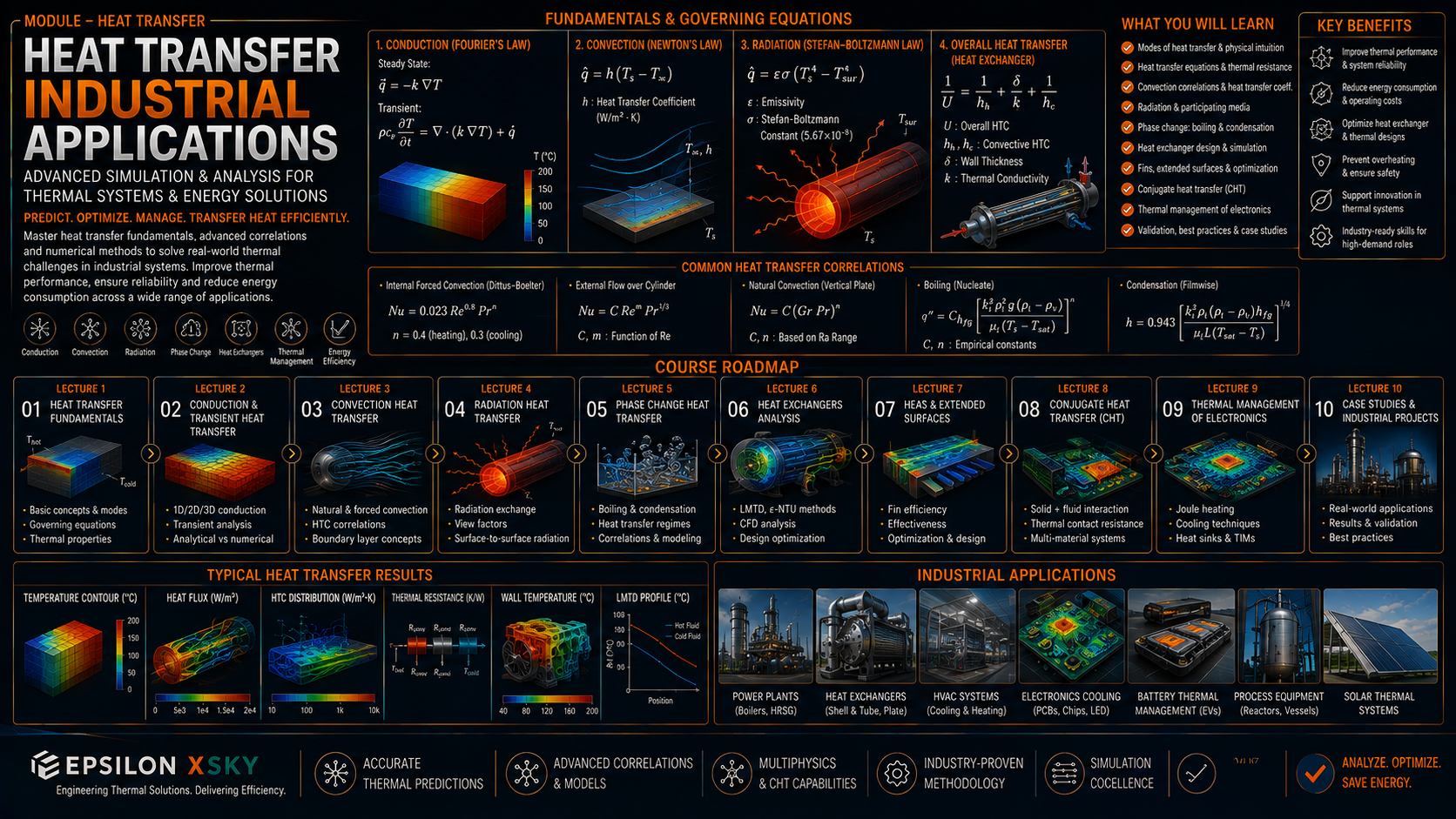
Course
Module 16 :Heat Transfer Various industrial applications
13 sessions
Curriculum
What you'll learn
13 sessions
01120m
Heat Transfer Industrial application Lecture One – Heat Transfer Analysis and Fin Optimization of a Motorcycle Engine
0228m
Heat Transfer Industrial application Lecture Two– Heat Transfer Analysis and Fin Optimization of a Motorcycle Engine
03165m
Heat Transfer Industrial application Lecture Three – Heat Transfer Equations and Numerical Data
0413m
Heat Transfer Industrial application Lecture Four – Natural Convection Heat Transfer in Electronic Devices
0518m
Heat Transfer Industrial application Lecture Five– Natural Convection Heat Transfer in Electronic Devices
068m
Heat Transfer Industrial application Lecture Six– Natural Convection Heat Transfer in Electronic Devices
0740m
Heat Transfer Industrial application Lecture Seven – LED Light Generation and Convection Heat Transfer
0823m
Heat Transfer Industrial application Lecture eight – LED Light Generation and Convection Heat Transfer
0928m
Heat Transfer Industrial application Lecture Nine– LED Light Generation and Convection Heat Transfer
108m
Heat Transfer Industrial application Lecture Ten– LED Light Generation and Convection Heat Transfer
1159m
Heat Transfer Industrial application Lecture Eleven – Shell and Tube Heat Exchanger CFD Analysis & Optimization
1231m
Heat Transfer Industrial application Lecture twelve – Shell and Tube Heat Exchanger CFD Analysis & Optimization
1325m
Heat Transfer Industrial application Lecture thirteen – Shell and Tube Heat Exchanger CFD Analysis & Optimization
Overview
About this course
Module 16: Heat Transfer – Industrial Applications
Advanced CFD Analysis of Conduction, Convection & Thermal Management
Heat transfer is a fundamental engineering discipline that influences the performance, reliability, and efficiency of countless industrial systems. From engine cooling and electronic equipment to thermal-management systems and natural-convection applications, engineers must understand how heat moves through solids, fluids, and their interfaces.
Module 16 at Epsilon X Sky focuses on the practical application of CFD-based heat-transfer analysis, providing engineers with industry-oriented experience in convection modeling, thermal management, engine-fin optimization, and natural-convection problems.
The module demonstrates how CFD can be used not only to predict temperature fields, but also to identify thermal limitations and optimize engineering designs for improved heat dissipation.
CFD Modeling of Heat Generation & Convection
The module begins with a practical CFD approach to systems involving heat generation and convective heat transfer.
Participants learn how to model a heat-generating component and investigate how thermal energy is transferred from the solid into the surrounding fluid.
The analysis covers:
-Volumetric heat generation
-Surface heat flux
-Temperature distribution
-Convective heat transfer
-Fluid temperature
-Velocity distribution
-Thermal gradients
-Heat-transfer rates
Students learn how heat sources can be represented numerically and how the surrounding flow influences the resulting temperature field.
Engine Fins Optimization – CFD
One of the key industrial applications in this module is the CFD analysis and optimization of engine cooling fins.
Engine fins are designed to increase the available surface area and improve heat dissipation to the surrounding environment. Their geometry can have a significant impact on thermal performance.
Participants investigate:
-Fin geometry
-Temperature distribution
-Heat-transfer rate
-Surface temperature
-Airflow around fins
-Thermal gradients
-Cooling effectiveness
The project demonstrates how CFD can be used to compare different fin configurations and determine which design provides improved thermal performance.
Heat Transfer Design Optimization
Participants learn that improving heat transfer is not simply a matter of increasing the surface area.
CFD can be used to investigate the interaction between:
Geometry + Flow + Temperature + Material + Heat Transfer
Students analyze how changes in geometry can influence:
-Heat-transfer coefficient
-Temperature distribution
-Pressure drop
-Flow distribution
-Thermal efficiency
-Cooling performance
This provides a practical foundation for thermal design optimization across different industrial applications.
Advanced Heat Transfer CFD
The module progresses toward more advanced heat-transfer problems where fluid flow and thermal behavior are strongly coupled.
Participants investigate the interaction between:
-Fluid dynamics
-Conduction
-Convection
-Heat generation
-Temperature gradients
-Turbulence
-Thermal boundary layers
The objective is to develop a deeper understanding of how CFD solvers combine the governing equations of fluid flow and energy to predict realistic thermal behavior.
Natural Convection – Industrial Case Study
Natural convection represents an important class of thermal problems where fluid motion is generated primarily by buoyancy forces caused by temperature differences.
In this case study, participants analyze a natural-convection system and investigate how temperature differences generate fluid motion.
The analysis focuses on:
-Buoyancy-driven flow
-Temperature distribution
-Natural convection currents
-Thermal stratification
-Velocity distribution
-Heat-transfer behavior
-Hot and cold regions
The project demonstrates why natural-convection simulations require careful consideration of gravity, density variation, thermal properties, mesh quality, and numerical convergence.
Conjugate Heat Transfer Concepts
The module also introduces the concept of conjugate heat transfer, where heat conduction through a solid interacts with convection within a surrounding fluid.
This approach is particularly important for engineering components such as:
-Engine components
-Heat sinks
-Cooling systems
-Heat exchangers
-Electronic components
-Thermal-management systems
Participants learn how the solid and fluid domains can be solved together to obtain a more complete representation of the thermal system.
Thermal CFD Workflow
Throughout Module 16, participants follow a professional heat-transfer CFD workflow:
Geometry → Material Properties → Heat Source → Mesh → Thermal & Flow Boundary Conditions → Energy Model → Solver → Convergence → Temperature & Heat-Transfer Analysis → Optimization
Students learn how to monitor both fluid-flow and thermal convergence, rather than relying on a single residual value.
Post-Processing & Thermal Performance Evaluation
Professional thermal simulation requires more than displaying temperature contours.
Participants learn how to extract and interpret:
-Maximum temperature
-Minimum temperature
-Temperature gradients
-Heat-transfer rate
-Surface heat flux
-Convective heat-transfer behavior
-Flow velocity
-Pressure drop
-Thermal performance
These parameters allow engineers to evaluate whether a cooling system is actually meeting its design requirements.
Industrial Applications
The techniques covered in Module 16 can be applied to a wide range of thermal engineering systems, including:
-Engine Cooling
-Cooling Fins
-Heat Exchangers
-Electronics Cooling
-Heat Sinks
-Industrial Equipment
-Thermal Management Systems
-HVAC Components
-Energy Systems
-Natural-Convection Systems
-Industrial Cooling Systems
By the End of Module 16, You Will Be Able To:
-Build CFD models for heat-transfer applications.
-Model heat generation and convection.
-Analyze temperature and velocity distributions.
-Perform thermal analysis of engine cooling fins.
-Compare and optimize fin geometries.
-Understand advanced heat-transfer mechanisms.
-Analyze natural-convection systems.
-Understand buoyancy-driven thermal flows.
-Apply conjugate heat-transfer concepts.
-Evaluate heat-transfer rates and surface heat flux.
-Identify thermal hot spots and inefficient cooling regions.
-Use CFD to support thermal-system design optimization.
Why This Module Matters
Managing heat is often the difference between a system that works and a system that fails.
Excessive temperatures can reduce efficiency, accelerate material degradation, damage components, and shorten equipment life. CFD allows engineers to visualize thermal behavior and test design alternatives before manufacturing physical prototypes.
Module 16 at Epsilon X Sky provides practical experience in advanced heat-transfer CFD, combining heat generation, convection, engine-fin optimization, conjugate thermal behavior, and natural-convection analysis.
Participants learn how to transform thermal CFD results into engineering decisions that improve cooling performance, efficiency, and system reliability.
Epsilon X Sky
Understand the Heat. Optimize the Cooling. Improve the Performance.