All Courses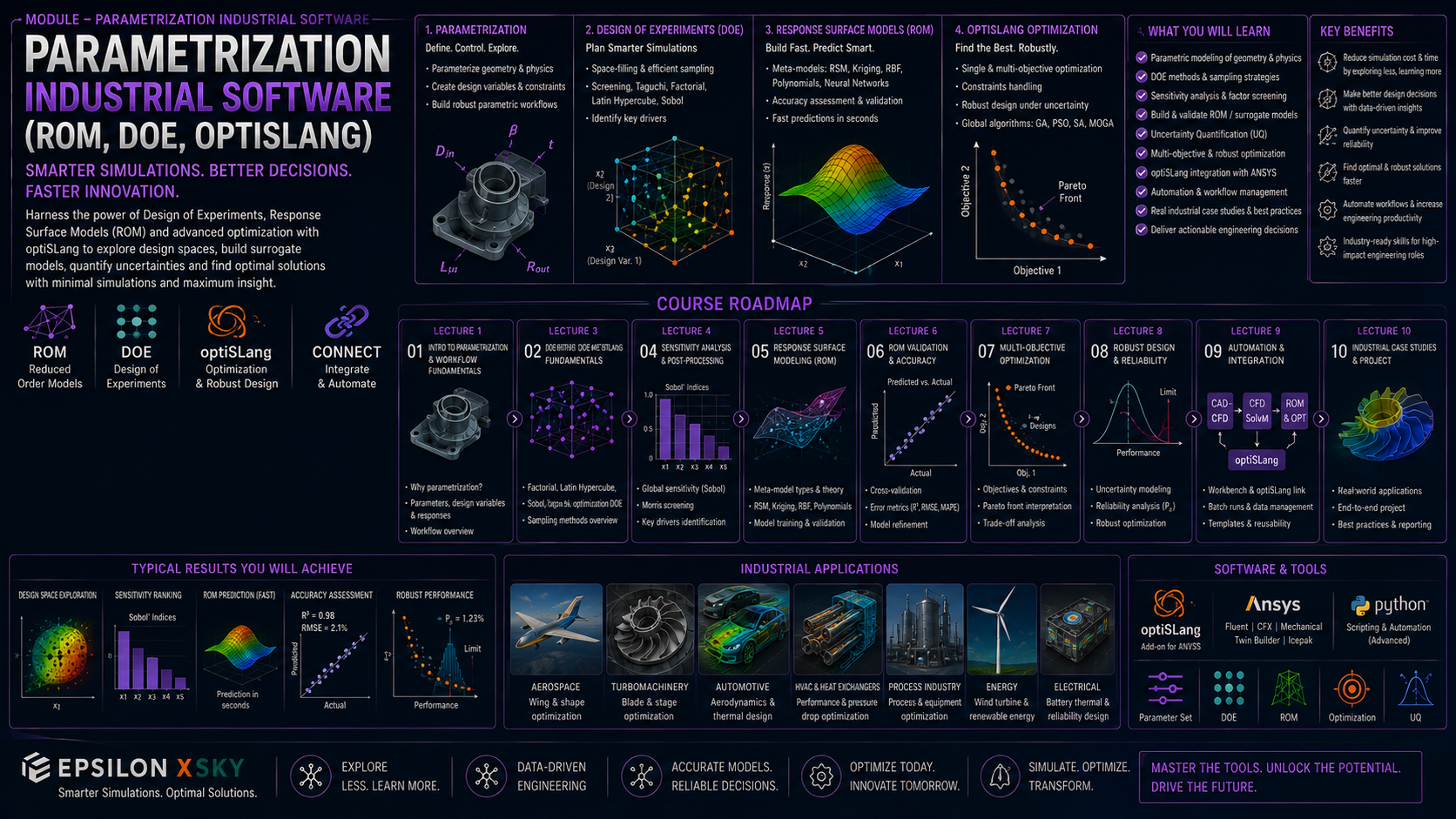
Course
Module 17 :Parametrization industrial Software (ROM,DOE,OPTISLANG)
0 sessions
Overview
About this course
Module 17: Parametrization & Design Optimization – Industrial Applications
ROM, DOE & optiSLang for Advanced Engineering Optimization
Modern engineering simulation is no longer limited to analyzing a single design. In real industrial projects, engineers often need to evaluate hundreds or thousands of design variations, identify the most influential parameters, reduce computational cost, and determine the optimal configuration.
Module 17 at Epsilon X Sky introduces advanced simulation parametrization, Design of Experiments (DOE), Reduced Order Modeling (ROM), and optimization using ANSYS optiSLang.
The module focuses on transforming conventional CAE simulations into automated, parameter-driven engineering workflows that can support faster design exploration and more efficient decision-making.
Understanding Simulation Parametrization
The module begins with the fundamentals of parametric engineering simulation.
Participants learn how important design and simulation parameters can be identified and controlled to investigate their influence on engineering performance.
Typical parameters may include:
-Geometry dimensions
-Material properties
-Boundary conditions
-Operating conditions
-Flow rates
-Temperatures
-Pressure
-Design angles
-Thicknesses
-Mesh-independent design variables
Students learn how parametrization allows engineers to move from analyzing one configuration to systematically exploring an entire design space.
Design of Experiments – DOE
Design of Experiments (DOE) provides a structured methodology for understanding how different input parameters influence simulation outputs.
Participants learn how DOE can be used to investigate:
-Parameter sensitivity
-Design-variable influence
-Interaction between parameters
-Response behavior
-Design-space exploration
-Performance trends
Instead of testing design variables randomly, DOE provides a systematic approach for selecting simulation points and extracting maximum information from a limited number of expensive CAE simulations.
Reduced Order Modeling – ROM
High-fidelity CFD and FEA simulations can require significant computational resources.
This section introduces Reduced Order Modeling (ROM) as a methodology for developing computationally efficient representations of complex engineering systems.
Participants explore how ROM can help:
-Reduce computational time
-Approximate expensive simulations
-Perform rapid design exploration
-Support optimization
-Enable faster engineering predictions
The module demonstrates how high-fidelity simulation data can be used to create faster predictive models while maintaining an appropriate level of engineering accuracy for the intended application.
ANSYS optiSLang
A major focus of Module 17 is ANSYS optiSLang, which provides advanced capabilities for process integration, sensitivity analysis, robust design, optimization, and uncertainty quantification.
Participants learn how optiSLang can connect simulation tools and automate the evaluation of multiple design configurations.
The workflow can integrate:
Geometry → Meshing → Solver → Post-Processing → Parameter Extraction → Optimization
This allows engineers to create automated simulation processes rather than manually repeating the same analysis for every design variation.
Complete optiSLang Industrial Project
The core of Module 17 is a complete optiSLang project, taking participants through the optimization workflow from initial simulation setup to final engineering recommendations.
The project demonstrates how to:
-Define input parameters.
-Identify relevant output responses.
-Connect the simulation workflow.
-Automate multiple simulation runs.
-Perform DOE.
-Evaluate parameter sensitivity.
-Build response surfaces or surrogate models.
-Perform design optimization.
-Compare candidate designs.
-Identify an optimized configuration.
-Evaluate the optimized design using the original high-fidelity simulation.
This complete workflow provides practical experience with the methodology used in modern simulation-driven product development.
Sensitivity Analysis
Understanding which parameters actually control system performance is an important part of engineering optimization.
Participants learn how sensitivity analysis can identify:
-Most influential parameters
-Low-impact parameters
-Parameter interactions
-Critical design variables
-Performance-driving mechanisms
This information allows engineers to focus optimization efforts where they can produce the greatest engineering benefit.
Multi-Objective Optimization
Real engineering problems rarely have a single objective.
For example, an engineer may want to:
Increase efficiency + reduce pressure drop + reduce temperature + minimize material usage
These objectives can conflict with each other.
The module introduces optimization concepts that allow engineers to evaluate competing design objectives and identify suitable design solutions based on the required engineering priorities.
Robust Engineering Design
An optimized design should not only perform well under one ideal operating condition.
Participants are introduced to the importance of evaluating how design performance changes when operating conditions or input parameters vary.
This provides a foundation for developing more robust engineering designs that can maintain acceptable performance despite uncertainty and variation.
Industrial Applications
The parametrization and optimization methodologies covered in Module 17 can be applied to a wide range of engineering problems, including:
-CFD Optimization
-FEA Optimization
-Heat-Transfer Systems
-Aerospace Design
-Automotive Aerodynamics
-Turbomachinery
-HVAC Systems
-Structural Design
-Thermal Management
-Manufacturing Processes
-Energy Systems
-Mechanical Components
By the End of Module 17, You Will Be Able To:
-Understand the fundamentals of simulation parametrization.
-Define meaningful input and output parameters.
-Perform structured Design of Experiments.
-Analyze parameter sensitivity.
-Understand the purpose of Reduced Order Models.
-Automate simulation workflows using optiSLang.
-Connect CAE simulations to optimization processes.
-Develop response surfaces and surrogate models.
-Perform engineering design exploration.
-Evaluate competing design objectives.
-Identify optimized design configurations.
-Validate optimized designs using high-fidelity simulations.
-Build complete simulation-driven optimization workflows.
Why This Module Matters
Running more simulations does not automatically produce a better design. Knowing which simulations to run is what creates engineering value.
Module 17 teaches engineers how to turn individual CFD and FEA simulations into automated, parameterized, data-driven optimization workflows.
Through the complete ANSYS optiSLang project, participants experience the full process:
Parametrization → DOE → Sensitivity Analysis → ROM/Surrogate Modeling → Optimization → Validation
This enables engineers to move beyond traditional trial-and-error design and adopt a more advanced approach to simulation-driven engineering and product optimization.
Epsilon X Sky
Automate the Simulation. Explore the Design Space. Optimize the Engineering Solution.