All Courses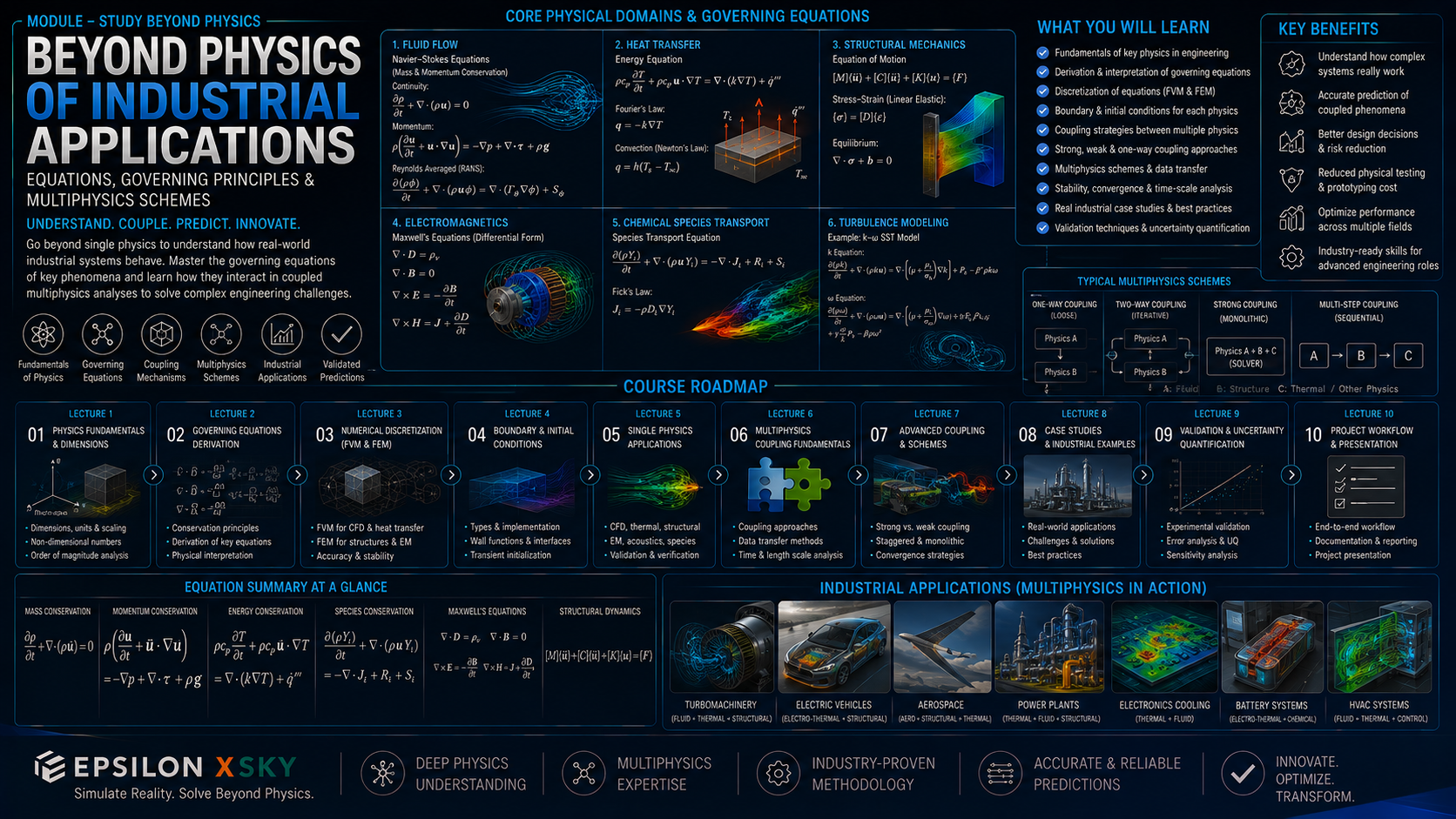
Course
Module 18 :Beyond Physics
0 sessions
Overview
About this course
Module 18: Beyond Physics – Numerical Methods & Computational Foundations
Understanding the Mathematics Behind FEA & CFD Solvers
Advanced CAE engineers should not only know how to operate ANSYS, but also understand what happens inside the solver.
Module 18 at Epsilon X Sky takes participants beyond conventional simulation workflows and into the mathematical and numerical foundations behind Finite Element Analysis (FEA) and Computational Fluid Dynamics (CFD).
The objective is to help engineers understand how governing equations are transformed into numerical systems, how those systems are solved, and how numerical choices influence the accuracy, stability, and reliability of simulation results.
FEA General Equation & Solution Sequence
The module begins by exploring the general mathematical framework behind Finite Element Analysis.
Participants learn how a physical structural problem is transformed into a numerical system that can be solved computationally.
The section covers:
-Governing equations in structural mechanics
-Finite-element discretization
-Element formulation
-Degrees of freedom
-Element matrices
-Global matrix assembly
-Boundary conditions
-Load vectors
-Solution of the resulting system
-Post-processing of numerical results
Participants develop a conceptual understanding of the FEA solution sequence:
Physical Problem → Discretization → Element Formulation → Global Assembly → Boundary Conditions → Numerical Solution → Results
This provides the mathematical foundation needed to understand what commercial FEA solvers are actually calculating.
CFD Governing Equations
The module then moves into the mathematical foundation of CFD.
Participants study the fundamental conservation equations governing fluid flow, including:
-Conservation of mass
-Conservation of momentum
-Conservation of energy
-Species transport concepts
-Pressure-velocity relationships
-Turbulence modeling concepts
The objective is not simply to memorize equations, but to understand how the governing physics are represented numerically inside a CFD solver.
This helps engineers make better decisions when selecting models, boundary conditions, numerical schemes, and solver settings.
Reynolds Decomposition & Turbulence Modeling
Turbulent flow contains fluctuations across a wide range of spatial and temporal scales, making direct resolution of every turbulent structure computationally expensive for most industrial applications.
This section introduces Reynolds decomposition and its role in the development of turbulence models.
Participants explore the conceptual separation between:
Mean Flow + Fluctuating Flow
and investigate how averaging the governing equations introduces additional terms associated with turbulent momentum transport.
This provides the foundation for understanding why turbulence models are required in many industrial CFD simulations.
Eddy Viscosity Models in CFD
The module introduces the concept of eddy viscosity and explains how turbulence models approximate the additional momentum transport generated by turbulent fluctuations.
Participants explore the engineering principles behind commonly used turbulence-modeling approaches and understand how turbulence assumptions influence CFD predictions.
The discussion focuses on:
-Turbulent viscosity
-Reynolds stresses
-Turbulent momentum transport
-Closure problem
-Eddy-viscosity concept
-Turbulence-model selection
-Practical industrial implications
This section helps engineers understand why selecting a turbulence model should be based on the physics of the problem, rather than simply using the default solver settings.
Finite Volume Method – CFD
A major part of the module focuses on the Finite Volume Method (FVM), one of the fundamental numerical approaches used in industrial CFD.
Participants learn how conservation equations are transformed from their differential form into equations that can be solved over discrete computational cells.
The workflow is explored conceptually as:
Governing Equation → Control Volume → Integration → Surface Fluxes → Discretization → Algebraic Equation → Numerical Solution
Participants gain an understanding of how quantities such as mass, momentum, and energy are transported between neighboring control volumes.
Gauss-Seidel Method – Numerical Solution
Once the governing equations have been discretized, CFD produces a large system of algebraic equations that must be solved numerically.
This section introduces the Gauss-Seidel iterative method and its role in understanding iterative numerical solution procedures.
Participants learn how iterative methods:
-Start from an initial solution
-Update unknown variables
-Use neighboring information
-Reduce numerical error
-Iterate toward convergence
The objective is to help engineers understand the connection between discretization, numerical iteration, residuals, and convergence.
Aspect Ratio & Mesh Quality
Mesh quality has a direct impact on numerical accuracy and solver performance.
This section examines aspect ratio and its relationship to computational mesh quality.
Participants learn how element and cell geometry can influence:
-Numerical diffusion
-Gradient calculation
-Convergence
-Stability
-Accuracy
-Solver robustness
The module emphasizes that mesh quality should always be considered in relation to the physics and flow direction, rather than relying on a single mesh-quality number.
Numerical Accuracy & Solver Behavior
The final objective of Module 18 is to connect the mathematical foundations with the practical behavior engineers observe inside ANSYS.
Participants develop a deeper understanding of how:
Physics → Governing Equations → Discretization → Mesh → Numerical Scheme → Iterative Solver → Convergence → Engineering Results
are connected.
This helps engineers diagnose simulation problems more effectively and distinguish between:
-Physical modeling errors
-Mesh-related errors
-Boundary-condition problems
-Numerical instability
-Poor convergence
-Inappropriate solver settings
Beyond Software Operation
Module 18 is designed to move engineers beyond the mindset of simply “setting up ANSYS.”
Instead, participants learn to ask:
-What equation is being solved?
-How was the equation discretized?
-What does each computational cell represent?
-How is the numerical system solved?
-Why does the solution converge—or fail to converge?
-How can numerical errors influence the engineering result?
These questions are essential for engineers who want to develop genuine expertise in computational engineering.
By the End of Module 18, You Will Be Able To:
-Understand the general mathematical foundation of FEA.
-Explain the fundamental CFD governing equations.
-Understand the FEA solution sequence.
-Understand the principles of Reynolds decomposition.
-Explain the concept of eddy viscosity.
-Understand the fundamentals of turbulence modeling.
-Explain the Finite Volume Method.
-Understand control-volume discretization.
-Understand the role of iterative numerical methods.
-Explain the basic principle of the Gauss-Seidel method.
-Understand the importance of mesh aspect ratio.
-Connect mesh quality with numerical accuracy.
-Understand the relationship between discretization and solver convergence.
-Diagnose numerical issues from a more fundamental engineering perspective.
Why This Module Matters
Knowing where to click in ANSYS makes you a software user. Understanding why the solver works makes you a CAE engineer.
Module 18 provides the theoretical foundation required to understand what happens behind commercial FEA and CFD software.
By studying FEA equations, CFD governing equations, Reynolds decomposition, eddy-viscosity models, the Finite Volume Method, iterative numerical methods, and mesh-quality concepts, participants develop a deeper understanding of the numerical machinery behind engineering simulation.
At Epsilon X Sky, this module represents the transition from using simulation software to understanding computational engineering itself.
Epsilon X Sky
Beyond the Software. Beyond the Physics. Into the Mathematics of Simulation.