All Courses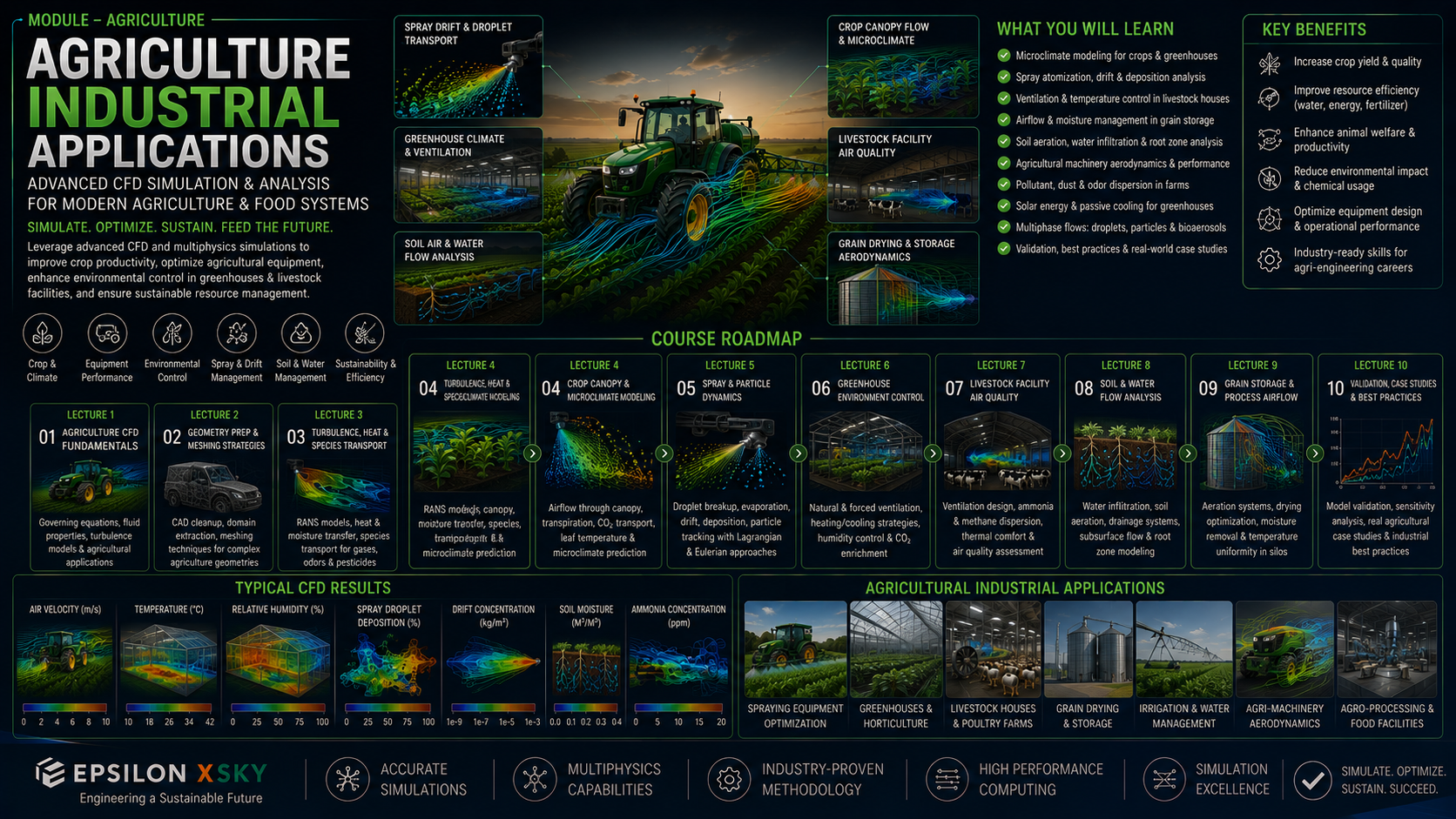
Course
Module 19 :Agriculture field industrial application
0 sessions
Overview
About this course
Module 19: Agriculture – Industrial Applications
CFD Analysis of Agricultural Spray Nozzles – DU & CU
Computational Fluid Dynamics is increasingly becoming a powerful tool for improving the efficiency and precision of modern agricultural systems. From spray distribution and irrigation to pesticide and fertilizer application, understanding how fluids leave agricultural equipment and interact with the surrounding environment is essential for achieving uniform and efficient coverage.
Module 19 at Epsilon X Sky introduces the application of CFD to agricultural engineering, with a dedicated industrial case study focused on the CFD analysis of an agricultural spray nozzle.
The module demonstrates how CFD can be used to investigate nozzle flow behavior, spray characteristics, and distribution uniformity, helping engineers improve agricultural spraying systems through simulation-driven design.
Agricultural Nozzle CFD – Industrial Case Study
The main project focuses on developing a CFD model of an agricultural spray nozzle and analyzing the flow behavior inside and around the nozzle.
Participants investigate how operating conditions and nozzle geometry influence the resulting spray behavior.
The study can include:
-Fluid flow through the nozzle
-Pressure distribution
-Velocity distribution
-Flow acceleration
-Nozzle outlet behavior
-Spray distribution
-Flow uniformity
-Pressure losses
-Flow patterns
The project provides participants with practical experience in applying CFD to an agricultural engineering problem where fluid distribution directly affects real-world performance.
Distribution Uniformity (DU)
A major focus of the agricultural nozzle project is Distribution Uniformity (DU).
Uniform application is essential in agricultural spraying because uneven distribution can result in:
-Over-application in some regions
-Under-application in other regions
-Uneven crop treatment
-Increased chemical consumption
-Reduced agricultural efficiency
Participants learn how CFD results can be used to evaluate the uniformity of fluid distribution and identify areas where the nozzle design may require improvement.
The analysis connects CFD flow-field results with practical agricultural performance indicators.
Coefficient of Uniformity (CU)
The module also introduces the concept of Coefficient of Uniformity (CU) as a performance indicator for fluid-distribution systems.
Participants learn how uniformity metrics can be used alongside CFD results to compare different nozzle configurations and operating conditions.
The objective is to move beyond simply examining velocity contours and instead develop a quantitative approach to evaluating agricultural nozzle performance.
This provides a practical connection between:
CFD Results → Distribution Pattern → DU/CU Evaluation → Design Improvement
Nozzle Geometry & Flow Optimization
Small changes in nozzle geometry can significantly influence the resulting flow distribution.
Participants investigate how design parameters may affect:
-Outlet velocity
-Pressure distribution
-Flow rate
-Spray pattern
-Distribution uniformity
-Hydraulic performance
CFD provides a virtual environment in which alternative designs can be evaluated before physical manufacturing and field testing.
This introduces participants to the concept of simulation-driven optimization in agricultural engineering.
CFD Workflow for Agricultural Applications
The project follows a complete industrial CFD workflow:
Geometry Preparation → Computational Domain → Meshing → Material Properties → Boundary Conditions → Solver Setup → Convergence → Flow Analysis → DU/CU Evaluation → Design Assessment
Participants learn how to connect the numerical CFD solution with measurable engineering performance.
Special attention is given to mesh quality, boundary conditions, convergence, and appropriate post-processing to ensure that the simulation provides meaningful engineering information.
Industrial Applications
The methodologies introduced in Module 19 can be extended beyond agricultural spray nozzles to other agricultural-fluid applications, including:
-Agricultural Sprayers
-Irrigation Systems
-Spray Nozzles
-Fertilizer Distribution
-Pesticide Application Systems
-Water Distribution Systems
-Precision Agriculture
-Agricultural Machinery
-Fluid-Delivery Systems
The same CFD principles can be used to improve flow distribution, efficiency, and resource utilization across agricultural engineering systems.
By the End of Module 19, You Will Be Able To:
-Understand the application of CFD in agricultural engineering.
-Build CFD models for agricultural nozzle systems.
-Analyze pressure and velocity distributions.
-Investigate flow behavior through nozzle geometries.
-Evaluate fluid-distribution patterns.
-Understand Distribution Uniformity (DU).
-Understand Coefficient of Uniformity (CU).
-Connect CFD results with agricultural performance metrics.
-Compare different nozzle configurations.
-Identify regions of non-uniform distribution.
-Use CFD as a tool for agricultural-system optimization.
-Apply simulation-driven engineering principles to agricultural applications.
Why This Module Matters
Precision agriculture depends on precision fluid distribution.
An agricultural nozzle that produces an uneven spray can waste water, fertilizer, or chemicals while producing inconsistent crop treatment. CFD provides engineers with the ability to investigate the underlying flow behavior and evaluate alternative designs before expensive physical testing.
Module 19 at Epsilon X Sky demonstrates how advanced CFD methodologies can be transferred into agricultural engineering through an industrial agricultural-nozzle case study, combining flow analysis with Distribution Uniformity (DU) and Coefficient of Uniformity (CU) evaluation.
The module demonstrates how simulation can contribute to more efficient, consistent, and resource-conscious agricultural systems.
Epsilon X Sky
Simulate the Spray. Measure the Uniformity. Optimize the Agriculture.