All Courses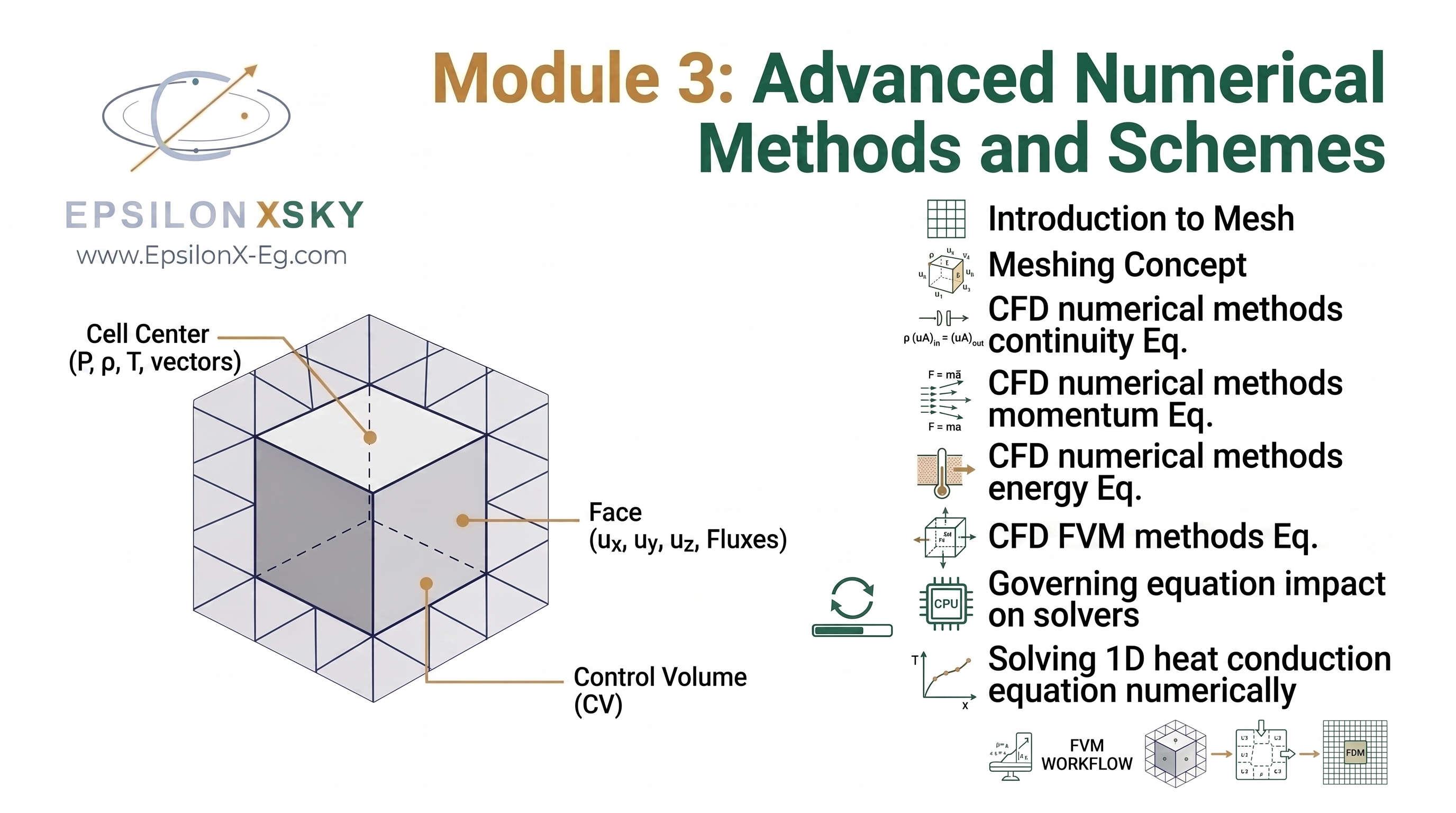
Course
Module 3: Advanced Numerical Methods and Schemes
21 sessions
Curriculum
What you'll learn
21 sessions
0148m
Numerical science Lecture One ( Y plus)
0230m
Numerical science Lecture Two ( Y plus)
0351m
Numerical science Lecture Three ( Mesh Concept )
0422m
Numerical science Lecture Three Part Two ( Mesh Concept )
0532m
Numerical science Lecture Three Part Three ( Heat Transfer )
0626m
Numerical science Lecture FOUR ( FEA Formulation)
0745m
Numerical science Lecture Five ( Solving PDEs & Solution Schemes Illustration )
0859m
Numerical science Lecture Five part two ( Solving PDEs & Solution Schemes Illustration )
0945m
Numerical science Lecture Six – Finite Volume Method (FVM) & Numerical Schemes in CFD
1058m
Numerical science Lecture Six part two – Finite Volume Method (FVM) & Numerical Schemes in CFD
1141m
Numerical science Lecture Six part three – Finite Volume Method (FVM) & Numerical Schemes in CFD
1258m
Numerical science Lecture Seven – Governing Equations & Their Impact on CFD Solvers
1355m
Numerical science Lecture Eight – Solving the Heat Conduction Equation Numerically
14110m
Numerical science - Lecture Nine – Fluid Basics and Fundamentals of Fluid Mechanics
1540m
Numerical science - Lecture Ten – FEA General Equation and Solution Sequence
1645m
Numerical science - Lecture eleven – CFD Governing equations
1769m
Numerical science - Lecture Twelve – Eddy Viscosity Models for Turbulent CFD Simulations
1848m
Numerical science -Lecture Thirteen – Finite Volume Method (FVM) for CFD
1953m
Numerical science - Lecture Fourteen – Gauss–Seidel Method for Linear System Solvers
2040m
Numerical science - Lecture Fifteen – Aspect Ratio and Courant Number in CFD Simulations
2120m
Numerical science - Lecture Fifteen (2)– Aspect Ratio and Courant Number in CFD Simulations
Overview
About this course
Module 3: Advanced Numerical Methods and Schemes
Numerical Methods for CFD & FEA – Professional Engineering Module
The Numerical Methods for CFD & FEA module provides a comprehensive foundation in the mathematical, numerical, and computational principles that govern modern engineering simulation. The module is designed to move participants beyond simply operating commercial software and develop a deeper understanding of how CFD and FEA solvers formulate, discretize, assemble, and solve engineering problems numerically.
Throughout the module, participants progress from the fundamentals of differential equations, numerical discretization, computational meshes, and solution schemes to the practical implementation of numerical methods using Python. The training connects the underlying mathematics directly to real engineering applications, demonstrating how governing equations are transformed into algebraic systems and ultimately converted into meaningful engineering results.
Module Scope
The module begins with the fundamentals of numerical science and computational mesh concepts, explaining how continuous physical domains are divided into computational elements or control volumes and how mesh quality affects numerical accuracy, stability, and convergence. Particular attention is given to boundary-layer resolution and y⁺, including its physical meaning, calculation, first-layer-height selection, inflation-layer design, turbulence-model requirements, and practical monitoring in CFD simulations.
Participants then develop a strong understanding of partial differential equations (PDEs) and their role in describing fluid flow and heat-transfer phenomena. The training covers the continuity, momentum, energy, diffusion, and convection–diffusion equations, explaining their physical meaning and how they are transformed from differential form into discrete numerical equations.
A major component of the module is the study of numerical discretization and solution schemes, including the Finite Difference Method (FDM) and Finite Volume Method (FVM). Participants learn how derivatives, convection, diffusion, source terms, and fluxes are represented numerically and how different schemes influence accuracy, numerical diffusion, stability, convergence, and computational cost. Practical comparison of first-order, second-order, central-difference, hybrid, QUICK, and bounded/TVD approaches provides a clear understanding of how numerical scheme selection affects CFD results.
The module also explains the complete CFD solver sequence, from governing-equation formulation and mesh generation to discretization, algebraic equation formation, matrix assembly, iterative solution, residual monitoring, convergence, and validation. Participants gain insight into the internal operation of CFD solvers and understand why activating additional physics—such as energy, species transport, turbulence, multiphase models, or combustion—increases equation coupling and computational complexity.
Numerical Programming with Python
To reinforce the theoretical concepts, participants learn how to implement simplified numerical solvers using Python. Rather than treating commercial CFD software as a black box, the training demonstrates how engineering equations can be translated into computational algorithms.
Practical Python exercises include:
Computational grid generation
Numerical differentiation
PDE discretization
Matrix and algebraic-system assembly
Iterative solution techniques
Residual and convergence monitoring
Boundary and initial-condition implementation
Temperature and flow-field visualization
Mesh-refinement studies
Numerical-error evaluation
Comparison with analytical or benchmark solutions
This approach enables participants to understand the relationship between mathematical formulation, numerical algorithms, programming, and engineering simulation software.
FEA Numerical Fundamentals
The module also extends numerical concepts into Finite Element Analysis (FEA), introducing the principles behind structural finite-element solvers. Participants learn how continuous structures are converted into finite-element models and how element formulations, shape functions, degrees of freedom, stiffness matrices, boundary conditions, and loads contribute to the final solution.
The FEA section explains the solver sequence:
Geometry → Mesh → Element Formulation → Degrees of Freedom → Element Matrices → Global Matrix Assembly → Boundary Conditions → Solution → Convergence → Post-Processing
Participants also gain an understanding of linear and nonlinear solution procedures, including material nonlinearity, geometric nonlinearity, contact, substeps, iterations, convergence criteria, and solver controls.
Heat-Transfer Numerical Methods
The module concludes with a practical numerical treatment of the heat-conduction equation, covering steady-state and transient conduction, one-, two-, and three-dimensional formulations, boundary and initial conditions, discretization, matrix assembly, and iterative solution techniques.
Using Python-based examples, participants solve engineering heat-transfer problems and investigate the influence of grid resolution, time-step size, numerical error, convergence, and solution verification.
Complete Numerical Simulation Workflow
The module establishes a complete understanding of the engineering numerical workflow:
Physical Problem → Governing Equations → Mathematical Model → Computational Domain → Mesh → Discretization → Numerical Scheme → Algebraic System → Solver → Iteration → Convergence → Verification → Validation → Engineering Results
Learning Outcomes
By completing this module, participants will be able to:
Understand the mathematical foundation of CFD and FEA solvers.
Interpret and formulate fundamental engineering PDEs.
Understand how computational meshes represent continuous physical domains.
Evaluate mesh quality and understand its impact on numerical accuracy.
Calculate and control y⁺ for appropriate near-wall CFD resolution.
Understand and compare major FDM and FVM discretization approaches.
Select appropriate numerical schemes based on accuracy, stability, and physics.
Understand how CFD solvers assemble and solve algebraic systems.
Understand the interaction between different governing equations and physical models.
Analyze solver convergence and identify potential numerical problems.
Understand the fundamental numerical sequence used in FEA solvers.
Implement simplified CFD and heat-transfer algorithms using Python.
Perform numerical verification, mesh refinement, and solution validation.
Develop the ability to troubleshoot simulation problems from a numerical and physical perspective, rather than relying only on software settings.
Professional Value
This module is designed for engineers and researchers who want to develop a strong numerical foundation for advanced engineering simulation. It provides the knowledge required to move from being a software user to becoming an engineer who understands why the solver behaves the way it does, how numerical decisions affect the solution, and how to judge whether simulation results are physically and numerically reliable.
The combination of mathematical theory, numerical methods, Python programming, CFD, FEA, and practical solver interpretation makes this module a fundamental component for anyone seeking to work professionally in Computational Fluid Dynamics, Finite Element Analysis, Heat Transfer, Multiphysics, and Engineering Simulation.