All Courses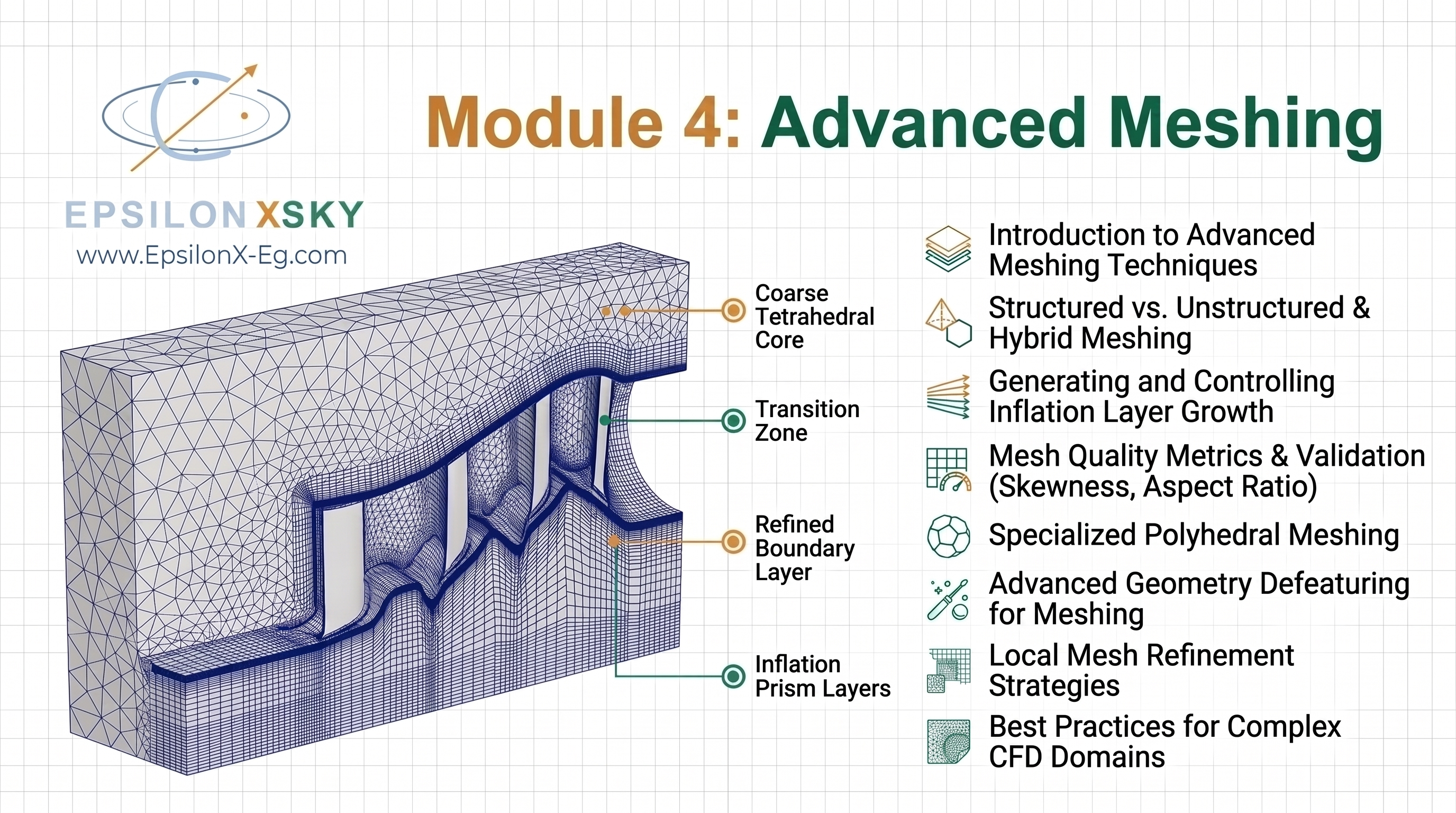
Course
Module 4: Advanced Meshing
14 sessions
Curriculum
What you'll learn
14 sessions
0158m
Advanced Meshing Lecture One – The Importance of Global Size Functions in Mesh Generation
0258m
Advanced Meshing Lecture One part two – The Importance of Global Size Functions in Mesh Generation
0359m
Advanced Meshing Lecture Two– Meshing Methods & Local Sizing Techniques
0454m
Advanced Meshing Lecture Two part two – Meshing Methods & Local Sizing Techniques
0560m
Advanced Meshing Lecture Two part Three– Meshing Methods & Local Sizing Techniques
0625m
Advanced Meshing Lecture Three – Airfoil Meshing for CFD
0712m
Advanced Meshing Lecture Three part two – Airfoil Meshing for CFD
0858m
Advanced Meshing Lecture Four – Effect of Inflation Layers, First Layer Height & Turbulence Modelling
0972m
Advanced Meshing Lecture Four part two – Effect of Inflation Layers, First Layer Height & Turbulence Modelling
1025m
Advanced Meshing Lecture Four Part Three – Effect of Inflation Layers, First Layer Height & Turbulence Modelling
1126m
Advanced Meshing Lecture Four Part four– Effect of Inflation Layers, First Layer Height & Turbulence Modelling
1228m
Advanced Meshing - Lecture Five – FSI & Watertight Mesh
1359m
Advanced Meshing - Lecture Five Part Two – Watertight Mesh
1459m
Advanced Meshing - Lecture six– Watertight Mesh Car
Overview
About this course
Module 4: Advanced Meshing
Generate High-Quality Computational Meshes for Accurate and Reliable Engineering Simulations
A simulation is only as accurate as the mesh it is built upon. Even with the most advanced physics models and powerful ANSYS solvers, poor mesh quality can lead to inaccurate results, convergence problems, excessive computational time, or complete simulation failure. Module 4 is dedicated to one of the most critical skills in engineering simulation—creating high-quality meshes that deliver reliable, efficient, and industry-standard numerical solutions.
This module provides a comprehensive understanding of ANSYS Meshing and Fluent Meshing, teaching engineers how to generate robust computational grids for CFD, FEA, thermal, structural, and multiphysics simulations. Rather than simply learning which buttons to click, participants will understand the mathematical principles behind mesh generation, how mesh quality affects numerical accuracy, and how to select the most appropriate meshing strategy for different engineering applications.
Throughout the course, you will learn the same professional meshing techniques used by simulation engineers in aerospace, automotive, oil & gas, energy, manufacturing, HVAC, biomedical, civil engineering, electronics, and process industries.
Understanding the Role of Meshing in Numerical Simulation
Every numerical simulation begins by dividing a continuous geometry into thousands—or even millions—of smaller computational elements. These elements form the computational mesh where the governing equations of fluid flow, heat transfer, structural mechanics, or electromagnetics are solved.
This module begins by explaining why mesh generation is the foundation of numerical simulation. You will understand how mesh quality influences:
-Numerical accuracy
-Solver convergence
-Computational stability
-Memory consumption
-Solution time
-Post-processing quality
-Engineering reliability
By understanding these relationships, you will develop the engineering judgment required to balance accuracy and computational efficiency for real industrial projects.
Mastering ANSYS Meshing and Fluent Meshing
The course introduces both ANSYS Meshing and the modern Fluent Meshing environment, enabling engineers to work confidently with different preprocessing workflows depending on project requirements.
You will gain hands-on experience with:
-Traditional ANSYS Meshing
-Fluent Watertight Geometry Workflow
-Fluent Fault-Tolerant Meshing Workflow
-Fluent Native Meshing Environment
Each workflow is explained in detail, including when to use it, its advantages, and its limitations in practical engineering applications.
The Watertight Geometry Workflow focuses on clean CAD models where high-quality structured and unstructured meshes can be generated efficiently.
The Fault-Tolerant Meshing Workflow prepares engineers to handle complex industrial geometries that contain gaps, overlaps, missing surfaces, or imperfect imported CAD models—an extremely common situation in industrial engineering.
Understanding Computational Element Types
Different engineering problems require different element types.
Rather than relying on default mesh settings, this module explains the advantages, disadvantages, computational cost, and engineering applications of every major mesh element.
Participants will master:
-Tetrahedral Elements
-Hexahedral Elements
-Polyhedral Elements
-Prism Layers
-Pyramid Transition Elements
-Line Elements
-Shell Elements
-Solid Elements
You will learn how each element influences numerical stability, convergence rate, computational efficiency, and solution accuracy in both CFD and FEA analyses.
Special attention is given to selecting the appropriate element type based on geometry complexity and physical behavior.
Advanced Mesh Sizing Strategies
Professional simulation engineers rarely rely on uniform mesh sizes.
Instead, they strategically refine the mesh only where engineering accuracy requires higher resolution while keeping the remaining computational domain relatively coarse.
This module teaches advanced mesh refinement techniques including:
-Global Sizing
-Local Sizing
-Face Sizing
-Edge Sizing
-Body of Influence
-Curvature-Based Sizing
-Proximity-Based Sizing
-Advanced Size Functions
You will understand how these tools capture:
-Boundary layer development
-Flow separation
-Sharp geometric features
-High stress gradients
-Thermal gradients
-Contact regions
-Small geometric details
This targeted refinement dramatically improves solution accuracy while minimizing unnecessary computational cost.
Boundary Layer Meshing and Inflation Layers
For CFD simulations, accurately resolving the boundary layer is essential.
The module provides a detailed explanation of Inflation Layer generation, including:
-Boundary layer theory
-First layer thickness calculation
-Growth rate selection
-Number of inflation layers
-Wall treatment
-y+ requirements
-Prism layer generation
Participants will learn how to generate high-quality near-wall meshes suitable for turbulence models such as:
-Standard k-ε
-Realizable k-ε
-RNG k-ε
-SST k-ω
-Transition SST
-Reynolds Stress Models
Proper boundary layer meshing is one of the most important factors influencing CFD accuracy.
Professional Mesh Generation Methods
Different geometries require different meshing approaches.
This module provides an in-depth understanding of the major ANSYS mesh generation methods, including:
-Sweep Meshing
-MultiZone Meshing
-Hex Dominant Meshing
-Patch Conforming Meshing
-Patch Independent Meshing
Rather than memorizing workflows, participants will understand:
-When each method should be used
-Which geometries are best suited for each approach
-Advantages and disadvantages
-Computational efficiency
-Typical industrial applications
Real engineering examples demonstrate how experienced analysts select the optimal meshing strategy for each project.
Mesh Quality Evaluation
Creating a mesh is only the first step.
Professional engineers must verify that the mesh satisfies strict numerical quality criteria before beginning any simulation.
This module explains the most important mesh quality metrics used throughout the engineering industry, including:
-Skewness
-Orthogonal Quality
-Aspect Ratio
-Jacobian
-Element Quality
-Smoothness
-Transition Quality
You will learn acceptable industrial limits for each metric and understand how poor-quality elements affect solver convergence and solution accuracy.
The course also demonstrates practical techniques for repairing poor-quality meshes without rebuilding the entire computational model.
Numerical Foundations Behind Meshing
Unlike many software-focused training programs, Module 4 also explains the mathematical principles behind numerical simulation.
Participants are introduced to:
-Degrees of Freedom (DOF)
-Number of Nodes
-Element Formulations
-Gaussian Integration Points
-Numerical Interpolation
-Discretization Concepts
-Finite Volume Cell Representation
-Finite Element Integration
These topics help engineers understand why mesh refinement improves accuracy, rather than simply accepting software recommendations.
This mathematical understanding distinguishes professional simulation engineers from software operators.
Mesh Independence Study
One of the defining characteristics of a reliable simulation is mesh independence.
A properly validated engineering model should produce nearly identical results even when the mesh is further refined.
This module teaches the complete workflow for performing professional mesh independence studies, including:
-Baseline mesh generation
-Systematic mesh refinement
-Solution comparison
-Convergence evaluation
-Error estimation
-Computational cost analysis
-Engineering documentation
Participants will learn how to determine the minimum mesh density required to achieve accurate results while minimizing computational resources.
This process is essential for producing simulation results suitable for industrial decision-making and research publications.
Mesh Optimization for Industrial Applications
Industrial simulations often involve millions of computational cells.
Poor mesh design can increase simulation time by several days without improving engineering accuracy.
The course demonstrates advanced mesh optimization techniques that reduce computational cost while maintaining solution quality.
Topics include:
-Adaptive refinement strategies
-Local mesh optimization
-Transition control
-Element reduction
-Solver efficiency improvements
-Memory optimization
-Parallel computing considerations
These techniques are widely used in large industrial CFD and FEA projects where computational efficiency directly impacts project cost.
Best Practices for CFD and FEA Meshing
Because CFD and FEA require different meshing philosophies, the module concludes by comparing best practices for each discipline.
You will understand how mesh strategies differ between:
-Structural Analysis
-Thermal Analysis
-Fluid Flow
-Heat Transfer
-Fatigue Analysis
-Dynamic Simulation
-Contact Problems
-Multiphysics Applications
This practical comparison enables engineers to confidently prepare computational meshes for virtually any engineering simulation.
By the End of Module 4, You Will Be Able To:
-Generate high-quality meshes using ANSYS Meshing and Fluent Meshing.
-Apply both Watertight and Fault-Tolerant Meshing workflows.
-Select the appropriate mesh type for CFD, FEA, and multiphysics analyses.
-Create structured, unstructured, hybrid, and polyhedral meshes.
-Build high-quality inflation layers for advanced CFD simulations.
-Apply professional mesh sizing and refinement strategies.
-Evaluate and improve mesh quality using industrial standards.
-Understand mesh metrics and their influence on numerical accuracy.
-Perform mesh independence studies with confidence.
-Optimize meshes to reduce computational cost while maintaining solution quality.
-Apply industry best practices for simulation-ready mesh generation.
Why This Module Matters
Meshing is where engineering judgment meets numerical accuracy. A well-designed mesh improves convergence, reduces computational cost, enhances simulation reliability, and provides results that engineers can trust.
At Epsilon X Sky, Module 4 equips you with the advanced meshing skills used by professional simulation engineers worldwide. By mastering ANSYS Meshing and Fluent Meshing, you will be able to prepare robust computational models for CFD, FEA, thermal, and multiphysics simulations, ensuring that every analysis is built on a foundation of accuracy, efficiency, and engineering excellence.