All Courses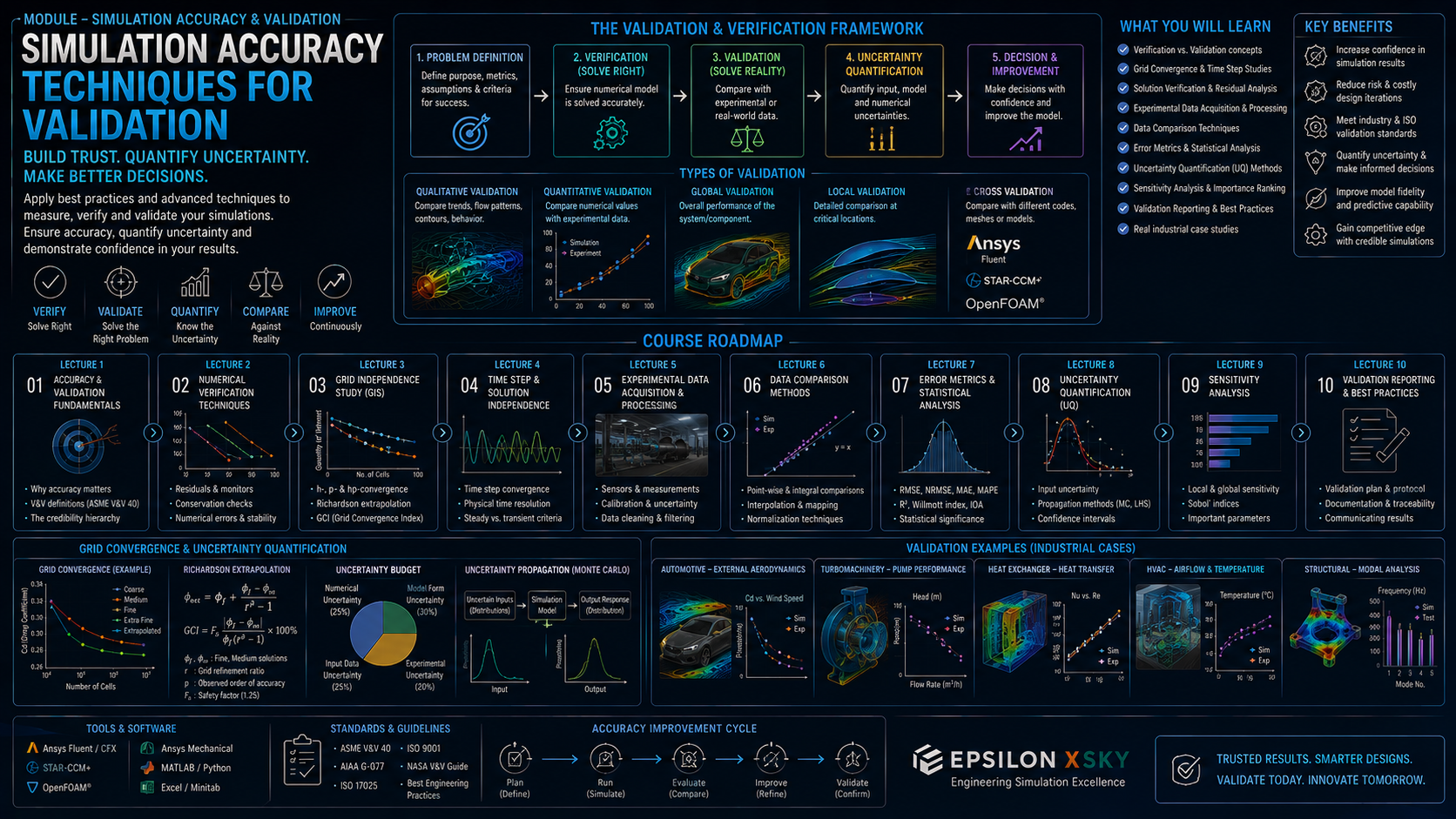
CourseBest Seller
Module 5 : Simulation accuracy Technique for Validation
12 sessions
Curriculum
What you'll learn
12 sessions
0158m
Accuracy Techniques - Lecture One – Simulation Validation in CFD and FEA
0245m
Accuracy Techniques - Lecture Two– Mesh Optimization & Parametric Studies in CFD and FEA
0322m
Accuracy Techniques - Lecture Three – Parametric Studies, Singularity Identification & Engineering Result
0458m
Accuracy Techniques - Lecture Four: Solving Singularity – The Seventh Law
0541m
Accuracy Techniques -Lecture Five: Parametric Study for Mesh Independence Testing in CFD
0658m
Accuracy Techniques -Lecture Five part two: Parametric Study for Mesh Independence Testing in CFD
0758m
Accuracy Techniques - Lecture Six: Averaged and Unaveraged Results in FEA
0816m
Accuracy Techniques -Lecture six part two: Averaged and Unaveraged Results in FEA
0960m
Accuracy Techniques -Lecture Seven: FEA Submodelling – Industrial Applications
1058m
Accuracy Techniques -Lecture Seven Part Two : FEA Submodelling – Industrial Applications
1160m
Accuracy Techniques -Lecture Seven Part Three: FEA Submodelling – Industrial Applications
12100m
Accuracy Techniques Lecture 8: CFD Sensitivity Study
Overview
About this course
Module 5: Simulation Accuracy Techniques for Validation
Validate, Verify, and Trust Your Simulation Results
Running a simulation is only the beginning. The true value of engineering simulation lies in proving that the results are accurate, reliable, and suitable for real engineering decisions. Module 5 is dedicated to one of the most important—and often overlooked—aspects of computational engineering: simulation validation and accuracy assessment.
Many engineers know how to build a model and obtain results, but very few understand how to determine whether those results can actually be trusted. This module teaches the professional verification and validation (V&V) techniques used by simulation engineers across aerospace, automotive, energy, oil & gas, manufacturing, civil engineering, and research industries to ensure that numerical results accurately represent physical reality.
At Epsilon X Sky, we believe that a simulation without validation is simply a colorful picture. This module transforms simulation users into engineering analysts who can confidently defend, verify, and improve their computational results.
Understanding Simulation Accuracy
Simulation accuracy is influenced by numerous factors including geometry preparation, boundary conditions, mesh quality, numerical schemes, solver settings, material properties, and post-processing methods.
Throughout this module, participants learn how each stage of the simulation workflow contributes to overall solution accuracy and how numerical errors can accumulate if engineering best practices are not followed.
Rather than treating validation as the final step of a project, students learn to integrate verification techniques throughout the entire simulation process.
Watertight Geometry and Singularity Concepts
Accurate simulations begin with robust geometry.
This module explains the importance of watertight computational models, where all surfaces form a continuous computational domain without gaps, overlaps, or missing faces.
Participants learn how non-watertight geometry affects:
-CFD domain generation
-Mesh quality
-Solver convergence
-Numerical stability
-Physical accuracy
The course also introduces one of the most misunderstood concepts in engineering analysis—stress and numerical singularities.
Students learn to distinguish between:
-Physical singularities
-Mathematical singularities
-Numerical singularities
-Geometric singularities
-Boundary-condition singularities
Understanding these concepts enables engineers to correctly interpret extremely high stress values, avoid false engineering conclusions, and recognize when localized results should not be used for design decisions.
Parametric Studies for Engineering Validation
Professional engineers rarely trust the result of a single simulation.
Instead, they perform parametric studies to understand how design variables influence engineering performance.
This module teaches systematic parameter variation techniques used to validate simulation behavior and improve engineering designs.
Participants will learn how to:
-Create parametric models
-Modify geometry automatically
-Evaluate multiple design configurations
-Perform sensitivity analysis
-Compare simulation responses
-Identify optimal engineering solutions
Rather than guessing how a design behaves, engineers learn to quantify performance trends using structured simulation studies.
The Seventh Law of Simulation Engineering
One of the fundamental principles taught in this module is what we refer to as the Seventh Law of Engineering Simulation:
"Never trust a simulation result until it has been challenged."
Students learn why every engineering result should be questioned through:
-Parameter variation
-Boundary condition modification
-Mesh refinement
-Solver comparison
-Experimental validation
-Engineering reasoning
This mindset develops critical engineering thinking rather than blind confidence in software output.
Parametric Validation for FEA
Finite Element Analysis requires rigorous validation before structural decisions can be made.
This module demonstrates how parametric studies improve FEA reliability by evaluating the influence of:
-Material properties
-Applied loads
-Boundary conditions
-Contact definitions
-Geometric dimensions
-Mesh density
Students learn how structural responses evolve as parameters change and how to determine whether predicted stresses, strains, and deformations remain physically realistic.
Special emphasis is placed on identifying numerical artifacts caused by poor modeling assumptions.
Parametric Validation for CFD
Computational Fluid Dynamics presents its own unique validation challenges.
Participants learn how CFD results are verified through systematic variation of:
-Mesh density
-Turbulence models
-Boundary conditions
-Operating conditions
-Physical properties
-Numerical schemes
-Convergence criteria
Engineers learn how to evaluate:
-Pressure distribution
-Velocity fields
-Temperature profiles
-Flow separation
-Turbulence behavior
-Species transport
-Heat transfer performance
By comparing multiple simulation scenarios, students develop confidence in the stability and consistency of CFD predictions.
Averaging and Un-Averaging Techniques
Industrial simulations often generate enormous quantities of numerical data.
Proper interpretation requires understanding when results should be averaged and when local values must be preserved.
This module explains:
-Area averaging
-Volume averaging
-Mass-weighted averaging
-Time averaging
-Surface averaging
-Instantaneous values
-Local peak values
Participants also learn un-averaging techniques, which reveal localized phenomena that may be hidden by global averages.
These concepts are especially important for:
-Turbulent CFD
-Heat transfer
-Pressure analysis
-Structural stress evaluation
-Fatigue assessment
Understanding the difference between averaged and local results prevents incorrect engineering conclusions.
Sub-Modelling Techniques for Industrial FEA
Large industrial structures often contain small regions requiring extremely high numerical accuracy.
Instead of refining the entire model, engineers use FEA Sub-Modelling to analyze critical regions independently.
Participants learn:
-Global model creation
-Boundary displacement transfer
-Local refinement
-High-resolution stress analysis
-Weld assessment
-Fillet analysis
-Crack initiation regions
This technique dramatically reduces computational cost while improving local solution accuracy.
Sub-Modelling Techniques for Industrial CFD
The same concept applies to Computational Fluid Dynamics.
Rather than refining an entire flow domain, engineers create local CFD sub-models to investigate regions requiring higher resolution.
Applications include:
-Valve analysis
-Injector nozzles
-Heat exchanger channels
-Turbine blades
-Pipe junctions
-Mixing chambers
-Electronic cooling
Students learn how global solutions provide boundary conditions for detailed local simulations, enabling highly accurate engineering analysis with significantly reduced computational expense.
Achieving Accurate Results in ANSYS Fluent
One of the most practical sections of this module focuses on obtaining reliable results from ANSYS Fluent.
Participants learn professional techniques for improving solution accuracy, including:
-Solver selection
-Pressure–velocity coupling
-Spatial discretization schemes
-Initialization methods
-Residual monitoring
-Physical convergence assessment
-Mass balance verification
-Energy balance validation
-Mesh independence confirmation
-Turbulence model verification
Rather than stopping a simulation when residuals appear low, students learn how experienced CFD engineers determine whether a solution has truly converged.
Engineering Validation Workflow
The module concludes by integrating all validation techniques into a complete industrial verification workflow.
Students learn how professional engineers validate simulation results through:
-Geometry verification
-Mesh verification
-Boundary condition validation
-Numerical verification
-Parameter sensitivity analysis
-Mesh independence studies
-Solver comparison
-Experimental correlation
-Engineering judgment
This structured workflow ensures simulation results are suitable for design optimization, certification studies, research publications, and industrial decision-making.
By the End of Module 5, You Will Be Able To:
-Evaluate the reliability of engineering simulation results.
-Identify numerical errors before they influence engineering decisions.
-Understand watertight geometry requirements.
-Recognize and correctly interpret singularities.
-Perform professional parametric studies for CFD and FEA.
-Validate structural and fluid simulations using engineering best practices.
-Apply averaging and un-averaging techniques appropriately.
-Build and analyze industrial sub-models for FEA and CFD.
-Improve ANSYS Fluent solution accuracy using advanced numerical techniques.
-Develop a complete verification and validation workflow for industrial simulations.
-Produce simulation results that can be confidently used for engineering design and optimization.
Why This Module Matters
Engineering decisions are only as reliable as the simulations supporting them. Module 5 equips engineers with the validation techniques, numerical verification methods, and professional workflows required to ensure that every simulation is accurate, defensible, and ready for real-world industrial applications.
At Epsilon X Sky, we train engineers not just to produce simulation results—but to prove that those results are correct. This module develops the analytical mindset and validation skills required to deliver high-confidence engineering solutions across CFD, FEA, heat transfer, and multiphysics applications.