All Courses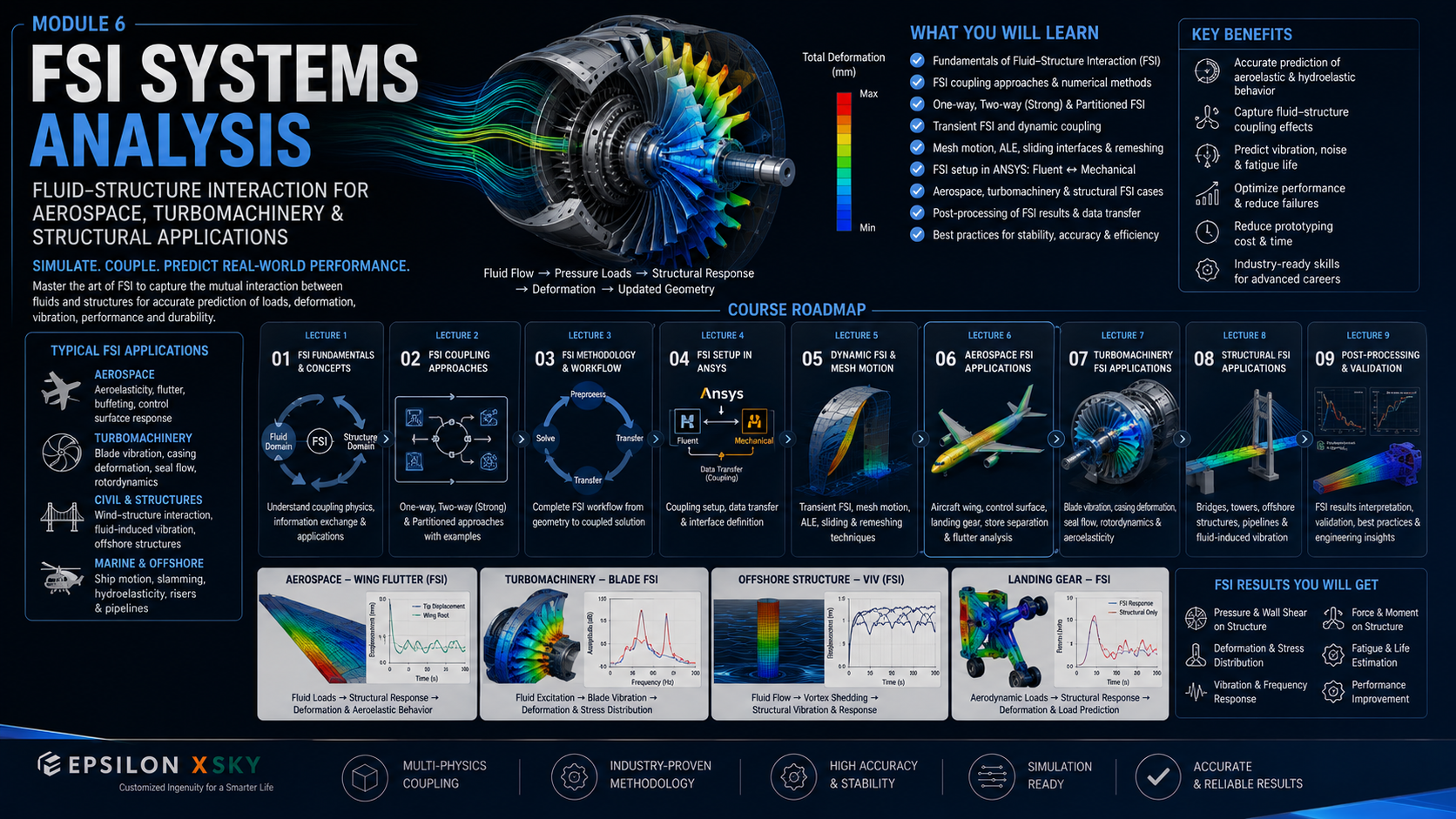
Course
Module 6 : FSI Fluid Solid interaction Industrial Cases
8 sessions
Curriculum
What you'll learn
8 sessions
0116m
FSI Analysis - Lecture One: FSI Analysis of an Industrial Petroleum Tank
0240m
FSI Analysis - Lecture two : FSI Analysis of an Industrial Petroleum Tank
0361m
FSI Analysis - Lecture three: FSI Analysis of an Industrial Petroleum Tank
0477m
FSI Analysis - Lecture Four: FSI Analysis of an Industrial Petroleum Tank
0538m
FSI Analysis - Lecture Five :System Coupling – Fluid Transient Analysis of a Real Bridge
0624m
FSI Analysis - Lecture six :System Coupling – Fluid Transient Analysis of a Real Bridge
0719m
FSI Analysis - Lecture six Part Two :System Coupling – Fluid Transient Analysis of a Real Bridge
0861m
FSI Analysis - Lecture Seven
Overview
About this course
Module 6: Fluid-Structure Interaction (FSI) – Industrial Applications
Master the Integration of Fluid Dynamics and Structural Mechanics for Real-World Engineering Systems
Many engineering systems cannot be accurately analyzed using CFD or FEA alone. In real industrial applications, fluids continuously interact with structures, transferring pressure, forces, vibrations, and deformation back and forth. Ignoring this interaction can lead to inaccurate predictions, unexpected failures, excessive vibration, fatigue damage, or even catastrophic structural collapse.
Module 6 introduces one of the most advanced simulation disciplines in ANSYS: Fluid-Structure Interaction (FSI). This module teaches engineers how to couple Computational Fluid Dynamics (CFD) with Finite Element Analysis (FEA) using ANSYS Fluent, ANSYS Mechanical, and System Coupling, allowing them to simulate the real behavior of engineering systems where fluids and structures influence one another simultaneously.
At Epsilon X Sky, this module emphasizes practical industrial applications rather than theoretical demonstrations. Participants will learn professional workflows used in aerospace, civil engineering, marine engineering, oil & gas, energy, automotive, and heavy industrial sectors.
Understanding Fluid-Structure Interaction
Fluid-Structure Interaction is a multiphysics simulation technique that combines the governing equations of fluid flow with structural mechanics to predict how fluids and solids behave together during operation.
Rather than solving the fluid and structure independently, FSI allows both domains to exchange information throughout the simulation.
Students begin by understanding:
-One-way coupling
-Two-way coupling
-Strong coupling
-Weak coupling
-Partitioned solvers
-Coupled multiphysics workflows
Special attention is given to understanding when each approach is appropriate for industrial engineering applications.
Industrial External Flow over Storage Tanks
The first industrial project focuses on external aerodynamic flow around large storage tanks.
Participants learn how wind loading influences:
-Pressure distribution
-Drag forces
-Lift forces
-Flow separation
-Wake formation
-Structural loading
Using ANSYS Fluent, engineers build a complete external flow model and investigate how aerodynamic forces develop around industrial storage tanks under different operating conditions.
The resulting pressure fields are then transferred to the structural model for further analysis.
Fluid-Structure Interaction Analysis Using CFD
Once the fluid solution has been completed, students begin the FSI workflow by coupling the CFD solution with structural analysis.
This section explains how pressure generated by the fluid solver becomes structural loading within ANSYS Mechanical.
Participants learn:
-Pressure transfer
-Load mapping
-Data interpolation
-Interface creation
-Coupling regions
-Data consistency
Rather than treating fluid forces as simple static loads, engineers learn how changing fluid behavior continuously affects structural response.
Structural Response of Industrial Tanks
The structural component of the module focuses on analyzing how industrial tanks respond to aerodynamic loading.
Using ANSYS Mechanical, participants investigate:
-Total deformation
-Equivalent stress
-Principal stresses
-Elastic strain
-Support reactions
-Structural safety
Students learn how fluid pressure changes structural behavior and how structural deformation, in turn, can influence surrounding fluid flow in fully coupled simulations.
Transient Fluid-Structure Interaction
Many industrial systems experience continuously changing loads.
Unlike static simulations, transient FSI considers time-dependent interaction between the fluid and the structure.
Participants learn:
-Time stepping
-Transient loading
-Dynamic structural response
-Pressure fluctuations
-Flow-induced vibration
-Time-dependent deformation
These concepts are essential for analyzing systems exposed to wind gusts, waves, pulsating flows, moving fluids, and dynamic operating conditions.
System Coupling in ANSYS
One of the most powerful features of ANSYS is System Coupling, which enables multiple physics solvers to exchange data automatically during every time step.
This module provides a complete understanding of System Coupling, including:
-Coupling architecture
-Data transfer procedures
-Force transfer
-Displacement transfer
-Convergence control
-Time synchronization
-Coupling iterations
Participants learn how Fluent and Mechanical communicate during each iteration, allowing the fluid and structural solutions to evolve together until convergence is achieved.
Industrial Bridge Fluid-Structure Interaction
A major industrial case study within this module involves the transient interaction between wind and bridge structures.
Participants simulate realistic aerodynamic loading on a bridge and investigate:
-Wind pressure
-Structural displacement
-Dynamic response
-Stress development
-Flow separation
-Vortex formation
-Structural vibration
This project demonstrates how modern infrastructure is evaluated using advanced multiphysics simulations before construction.
The workflow closely resembles the methodologies used by consulting companies and engineering firms responsible for long-span bridges, towers, and large civil structures.
ANSYS Fluent Setup for FSI Simulations
Successful FSI simulations require careful CFD setup before coupling begins.
This module teaches professional Fluent workflows including:
-Boundary condition selection
-Dynamic interfaces
-Pressure coupling
-Turbulence model selection
-Transient solver configuration
-Time-step selection
-Convergence monitoring
-Data export for System Coupling
Participants learn how poor CFD setup directly affects structural accuracy and how to prepare fluid models suitable for industrial FSI analyses.
Engineering Challenges in FSI
Real industrial FSI projects present numerous numerical challenges.
The course discusses practical solutions for:
-Coupling instability
-Divergence problems
-Large structural deformation
-Mesh motion
-Interface distortion
-Computational cost
-Time-step sensitivity
-Numerical convergence
Students develop the engineering judgment required to build stable and reliable multiphysics simulations.
Industrial Applications of Fluid-Structure Interaction
The techniques covered in this module are directly applicable to a wide range of engineering industries, including:
-Wind loading on storage tanks
-Bridges and civil infrastructure
-Offshore platforms
-Marine structures
-Pipelines
-Pressure vessels
-Heat exchangers
-Aircraft wings
-Turbomachinery
-Cooling systems
-Industrial chimneys
-Renewable energy systems
-Hydrogen infrastructure
-Process equipment
Participants gain experience with workflows that mirror those used in major engineering consulting firms and industrial simulation departments.
By the End of Module 6, You Will Be Able To:
-Understand the principles of Fluid-Structure Interaction (FSI).
-Distinguish between one-way and two-way coupling strategies.
-Build complete FSI workflows using ANSYS Fluent and Mechanical.
-Configure ANSYS System Coupling for transient multiphysics simulations.
-Simulate external aerodynamic loading on industrial storage tanks.
-Transfer fluid pressure fields accurately to structural models.
-Analyze structural deformation caused by fluid forces.
-Configure transient FSI simulations for dynamic engineering problems.
-Understand data transfer between CFD and FEA solvers.
-Diagnose convergence and stability issues in coupled simulations.
-Apply industrial FSI methodologies to real engineering projects.
Why This Module Matters
Many of today's most complex engineering challenges involve the interaction between fluids and structures. Whether designing bridges, storage tanks, aircraft, offshore platforms, or energy systems, engineers must understand how aerodynamic and hydrodynamic forces influence structural behavior over time.
Module 6 equips you with the advanced Fluid-Structure Interaction skills required for modern multiphysics engineering. By mastering ANSYS Fluent, ANSYS Mechanical, and System Coupling, you will learn to build accurate, industrial-grade FSI simulations capable of solving some of the most demanding engineering problems across aerospace, civil, mechanical, energy, and process industries.
At Epsilon X Sky, we prepare engineers to go beyond standalone CFD or FEA analyses by mastering the integrated multiphysics workflows that define the future of engineering simulation.