All Courses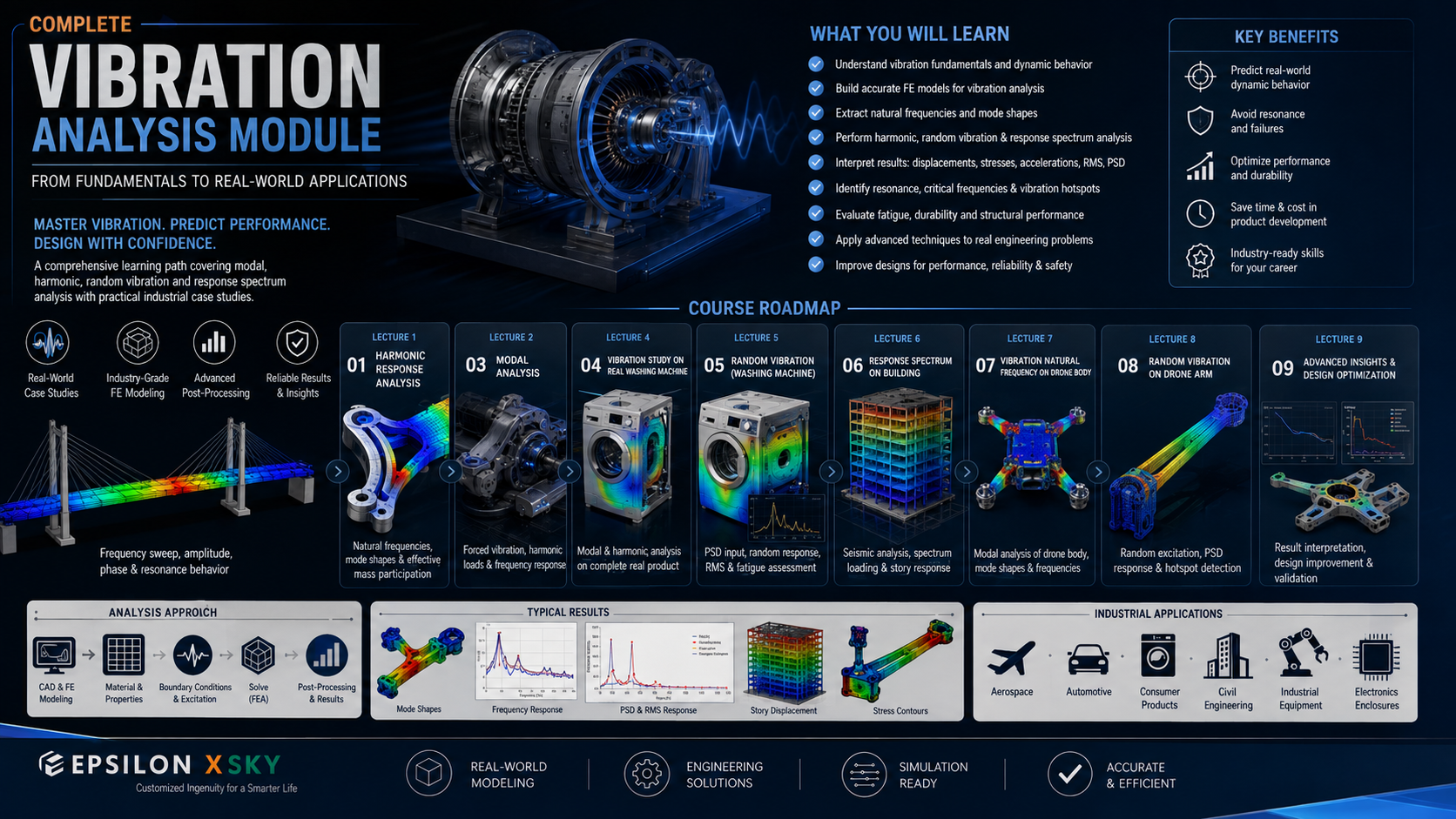
CourseBest Seller
Module 7 : Vibration analysis industrial cases
12 sessions
Curriculum
What you'll learn
12 sessions
0160m
Vibration Module - Lecture One: Introduction to Modal Analysis
0258m
Vibration Module - Lecture Two – Vibration on Bridge
0341m
Vibration Module - Lecture Three – Prestress Modal & Stress Stiffening
0428m
Vibration Module - Lecture Four – Harmonic Response Analysis
0551m
Vibration Module - Lecture Four part Two – Harmonic Response Analysis
0627m
Vibration Module - Lecture Five – Vibration Study on a Real Washing Machine
0727m
Vibration Module - Lecture Six – Random Vibration Analysis
0826m
Vibration Module -Lecture Six part two – Random Vibration Analysis
0961m
Vibration Module - Lecture Seven – Response Spectrum Analysis on Buildings
1038m
Vibration Module -Lecture Seven Part two – Response Spectrum Analysis on Buildings
1130m
Vibration Module -Lecture Eight – Vibration Natural Frequency on a Drone Body
1240m
Vibration Module - Lecture Nine – Random Vibration Analysis on a Drone Arm
Overview
About this course
Module 7: Vibration Analysis – Industrial Applications
Design Structures That Perform Reliably Under Real Dynamic Operating Conditions
In engineering, many failures occur not because structures are too weak, but because they vibrate at the wrong frequency. From drones and automotive components to household appliances, bridges, turbines, and industrial machinery, vibration plays a critical role in product performance, durability, comfort, and safety.
Module 7 introduces the complete field of structural vibration analysis using ANSYS Mechanical, enabling engineers to predict, analyze, and eliminate vibration-related problems before physical prototypes are manufactured. Participants will learn how dynamic loads affect structural behavior, how resonance develops, and how engineers design systems to avoid catastrophic vibration failures.
At Epsilon X Sky, this module combines the theoretical principles of structural dynamics with hands-on industrial projects, allowing participants to master the same vibration analysis workflows used in aerospace, automotive, manufacturing, civil, robotics, electronics, and energy industries.
Understanding Structural Dynamics
Unlike static analysis, where loads remain constant, dynamic analysis considers loads that change with time.
This module begins by introducing the fundamentals of structural dynamics, including:
-Natural Frequency
-Mode Shapes
-Resonance
-Damping
-Dynamic Loading
-Forced Vibration
-Free Vibration
-Transient Excitation
Participants develop an intuitive understanding of how structures respond to vibration and why resonance is one of the most critical considerations in engineering design.
Modal Analysis (FEA)
Modal Analysis is the foundation of all vibration studies.
Participants learn how to determine:
-Natural frequencies
-Mode shapes
-Structural stiffness effects
-Mass participation
-Frequency separation
-Dynamic behavior
The course explains how every structure possesses its own natural vibration characteristics and how these frequencies influence product reliability.
Students learn how engineers use Modal Analysis to prevent resonance before it occurs.
Applications include:
-Mechanical components
-Industrial equipment
-Aerospace structures
-Automotive systems
-Electronic devices
-Civil engineering structures
Prestressed Modal Analysis
Many engineering components operate under significant preloads before vibration begins.
Examples include:
-Bolted assemblies
-Pressure vessels
-Pipelines
-Rotating machinery
-Suspension systems
-Mechanical joints
Participants learn how static loading changes structural stiffness and therefore shifts natural frequencies.
Using Prestressed Modal Analysis, engineers evaluate vibration behavior under realistic operating conditions, producing much more accurate predictions than conventional modal analysis.
Harmonic Response Analysis
Industrial machinery is often subjected to continuous periodic excitation.
Rather than studying only natural frequencies, Harmonic Response Analysis predicts structural response under sinusoidal loading across a specified frequency range.
Students learn how to calculate:
-Frequency response
-Dynamic displacement
-Velocity response
-Acceleration response
-Dynamic stress
-Phase angle
-Resonance amplification
The module explains how engineers identify dangerous operating frequencies and redesign structures to avoid excessive vibration.
Drone Modal Analysis
One of the industrial case studies focuses on drone structural dynamics.
Participants investigate how lightweight drone frames respond to motor-induced vibration.
Topics include:
-Frame stiffness
-Motor excitation frequencies
-Arm flexibility
-Natural frequencies
-Mode shape visualization
-Structural optimization
Students learn how poor vibration characteristics influence:
-Flight stability
-Sensor accuracy
-Camera vibration
-Navigation systems
-Fatigue life
This project demonstrates the importance of vibration analysis in modern UAV development.
Complete Harmonic Analysis of a Washing Machine
Household appliances provide an excellent example of real industrial vibration problems.
Participants perform a complete harmonic response analysis of a washing machine subjected to rotating imbalance loads.
The project investigates:
-Drum excitation
-Structural resonance
-Cabinet vibration
-Noise generation
-Dynamic stress
-Support reactions
Students learn how engineers reduce vibration levels to improve:
-Product durability
-User comfort
-Noise reduction
-Reliability
The project closely resembles industrial product development workflows used by appliance manufacturers.
Random Vibration Analysis
Many engineering systems experience unpredictable loading rather than simple harmonic excitation.
Aircraft, satellites, vehicles, electronics, and industrial machinery are continuously exposed to random vibration environments.
Participants learn:
-Random excitation
-Power Spectral Density (PSD)
-Statistical loading
-RMS response
-Fatigue effects
-Broadband vibration
Rather than analyzing a single excitation frequency, engineers learn how structures behave under continuously changing vibration environments.
Response Spectrum Analysis
Earthquakes, explosions, impacts, and shock events require specialized vibration techniques.
This module introduces Response Spectrum Analysis, allowing engineers to predict structural response to severe transient dynamic events.
Topics include:
-Response spectrum generation
-Modal superposition
-Earthquake loading
-Shock response
-Maximum dynamic displacement
-Structural safety evaluation
Students understand why response spectrum methods are widely used in civil engineering, nuclear facilities, aerospace, and industrial safety design.
Random Vibration Analysis of a Drone Arm
The module concludes with a detailed industrial project involving Random Vibration Analysis of a Drone Arm.
Participants evaluate how random motor excitation influences:
-Structural fatigue
-Resonance behavior
-Sensor stability
-Flight performance
-Structural durability
The project integrates concepts from:
-Modal Analysis
-Harmonic Response
-Random Vibration
-Structural Optimization
This case study demonstrates how professional engineers validate lightweight aerospace structures under realistic operating conditions.
Engineering Interpretation of Dynamic Results
Generating vibration results is only part of the engineering process.
This module teaches participants how to interpret:
-Mode shapes
-Frequency response curves
-Harmonic response plots
-PSD curves
-RMS stress
-Dynamic amplification
-Resonance regions
-Structural damping effects
Students learn how experienced engineers transform numerical results into practical design improvements.
Industrial Applications of Vibration Analysis
The techniques covered in this module are widely used across numerous engineering sectors, including:
-Aerospace Structures
-UAV & Drone Design
-Automotive Components
-Rotating Machinery
-Household Appliances
-Industrial Equipment
-Bridges and Buildings
-Offshore Structures
-Wind Turbines
-Pumps and Compressors
-Electric Motors
-Railway Systems
-Electronic Equipment
-Defense Applications
Participants gain practical skills directly applicable to modern industrial product development and structural design.
By the End of Module 7, You Will Be Able To:
-Understand the fundamentals of structural dynamics and vibration.
-Perform Modal Analysis using ANSYS Mechanical.
-Conduct Prestressed Modal Analysis for loaded structures.
-Analyze harmonic response under periodic excitation.
-Predict resonance and avoid dangerous operating frequencies.
-Perform Random Vibration Analysis using PSD loading.
-Conduct Response Spectrum Analysis for shock and seismic events.
-Interpret frequency response functions and mode shapes.
-Analyze industrial products such as drones and washing machines.
-Optimize structures to improve vibration performance and durability.
-Apply professional vibration analysis techniques used across multiple engineering industries.
Why This Module Matters
Every engineered product vibrates—but only well-designed products vibrate safely. Whether developing aircraft, drones, machinery, industrial equipment, or consumer products, engineers must understand how structures behave under dynamic loading to prevent resonance, reduce noise, extend fatigue life, and improve reliability.
Module 7 provides the advanced vibration analysis expertise required by today's engineering industries. By mastering Modal Analysis, Prestressed Modal Analysis, Harmonic Response, Random Vibration, and Response Spectrum Analysis, participants gain the ability to solve complex dynamic engineering problems with confidence.
At Epsilon X Sky, we prepare engineers to move beyond static structural analysis and develop the dynamic simulation skills required to design safer, quieter, more durable, and higher-performing products for the modern engineering world.