All Courses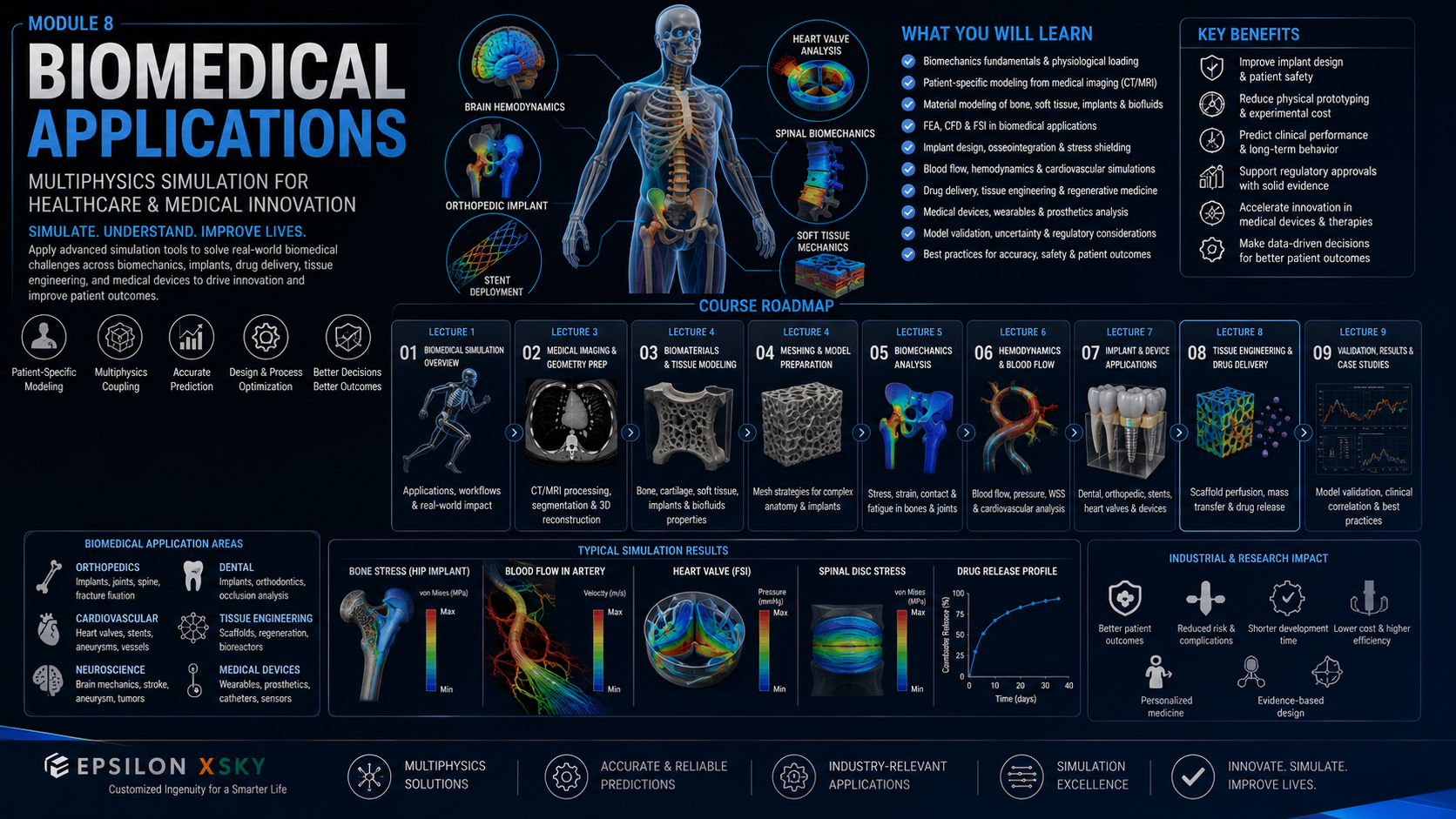
Course
Module 8 :Biomedical field industrial cases
0 sessions
Overview
About this course
Module 8: Biomedical Engineering – Industrial Applications
CFD for Biomedical Flow and Blood-Flow Analysis
Biomedical engineering represents one of the most challenging applications of computational simulation because it requires engineers to combine fluid mechanics, biological systems, complex geometries, and physiological operating conditions.
Module 8 introduces participants to the application of Computational Fluid Dynamics (CFD) in biomedical engineering, using blood-flow simulation as a practical industrial case study. The module demonstrates how advanced CFD methodologies can be applied to investigate fluid behavior inside biological systems and develop a deeper understanding of flow-related biomedical problems.
At Epsilon X Sky, the objective is to demonstrate how engineering simulation principles can be transferred beyond traditional mechanical applications into the rapidly growing field of biomedical CAE.
Blood Flow CFD Case Study
The central project of this module focuses on the CFD analysis of blood flow through a biomedical geometry.
Participants learn how to prepare a biological flow domain and develop a computational model capable of representing important characteristics of blood-flow behavior.
The case study introduces:
-Blood-flow domain preparation
-Biomedical geometry preparation
-Boundary-condition definition
-Blood-flow velocity analysis
-Pressure distribution
-Flow patterns
-Wall shear stress
-Flow recirculation
-Velocity gradients
-Transient blood-flow behavior
The objective is to demonstrate how CFD can provide detailed information that may be difficult or impossible to obtain directly through conventional experimental techniques.
Understanding Blood as a Flowing Fluid
Blood presents unique challenges compared with conventional engineering fluids.
Depending on the application and flow conditions, engineers may need to consider properties such as:
-Density
-Dynamic viscosity
-Non-Newtonian behavior
-Flow rate
-Pulsatile flow
-Physiological pressure
-Vessel geometry
Participants learn how these physical properties influence the CFD model and why selecting appropriate assumptions is critical when developing biomedical simulations.
Biomedical Geometry and Meshing
Biological geometries can contain highly curved surfaces, narrow passages, branches, and complex anatomical structures.
This module demonstrates how engineers can prepare these geometries for CFD analysis and develop appropriate computational meshes.
Particular attention is given to:
-Geometry cleanup
-Fluid-domain extraction
-Local mesh refinement
-Boundary-layer resolution
-Mesh quality
-Near-wall flow resolution
Students learn how computational resolution can influence predicted velocity, pressure, and wall shear-stress distributions.
Hemodynamic Analysis
A major objective of blood-flow CFD is understanding hemodynamic behavior.
Participants learn how to interpret important flow parameters including:
-Velocity distribution
-Pressure variation
-Wall shear stress
-Flow separation
-Recirculation regions
-Vortical structures
-Pressure losses
These parameters can provide valuable engineering insight into the behavior of blood within complex biological flow environments.
Transient and Pulsatile Blood Flow
Blood flow is not necessarily steady.
The cardiovascular system produces time-dependent and pulsatile flow conditions, which can significantly influence the resulting flow field.
The module introduces transient CFD concepts relevant to biomedical applications, including:
-Time-dependent boundary conditions
-Pulsatile velocity profiles
-Transient pressure response
-Time-step selection
-Convergence monitoring
-Flow evolution throughout the cardiac cycle
This provides participants with an introduction to the challenges associated with simulating physiological flow rather than simplified steady-state conditions.
Industrial Applications of Biomedical CFD
The techniques introduced in this module can be extended to a wide range of biomedical engineering applications, including:
-Blood vessels
-Arteries
-Veins
-Aneurysm analysis
-Stenosis studies
-Cardiovascular devices
-Medical implants
-Artificial valves
-Blood pumps
-Medical tubing
-Drug-delivery systems
The module demonstrates how CFD can support the engineering development and analysis of biomedical systems.
From Engineering CFD to Biomedical Simulation
One of the key objectives of Module 8 is to demonstrate that the fundamentals of CFD remain powerful even when the application changes dramatically.
The same principles of:
Geometry → Meshing → Governing Equations → Boundary Conditions → Numerical Solution → Convergence → Validation → Post-Processing
can be applied to biomedical flow problems—with additional consideration for physiological conditions and biological fluid behavior.
This allows engineers with a traditional CFD background to expand their capabilities into the growing field of Biomedical CAE and Computational Biomechanics.
By the End of Module 8, You Will Be Able To:
-Understand the fundamentals of CFD in biomedical engineering.
-Build a computational model for blood-flow analysis.
-Prepare complex biomedical flow geometries.
-Develop suitable meshes for biomedical CFD.
-Define appropriate blood-flow boundary conditions.
-Analyze velocity and pressure distributions.
-Investigate wall shear stress and flow patterns.
-Understand the challenges of pulsatile blood-flow simulation.
-Interpret biomedical CFD results from an engineering perspective.
-Apply CFD methodologies to broader biomedical engineering applications.
Why This Module Matters
Biomedical engineering is one of the fastest-growing frontiers for computational simulation.
The ability to predict blood flow, pressure, wall shear stress, and complex physiological flow behavior opens new opportunities for engineers working alongside biomedical researchers, medical-device developers, and healthcare technology companies.
Module 8 provides engineers with a practical introduction to Biomedical CFD through a dedicated blood-flow case study, demonstrating how the numerical and simulation principles learned throughout the MasterClass can be transferred to one of the most challenging and impactful fields of modern engineering.
At Epsilon X Sky, we believe that the future of CAE extends beyond traditional engineering boundaries—from machines and structures to the complex physics of the human body.