All Courses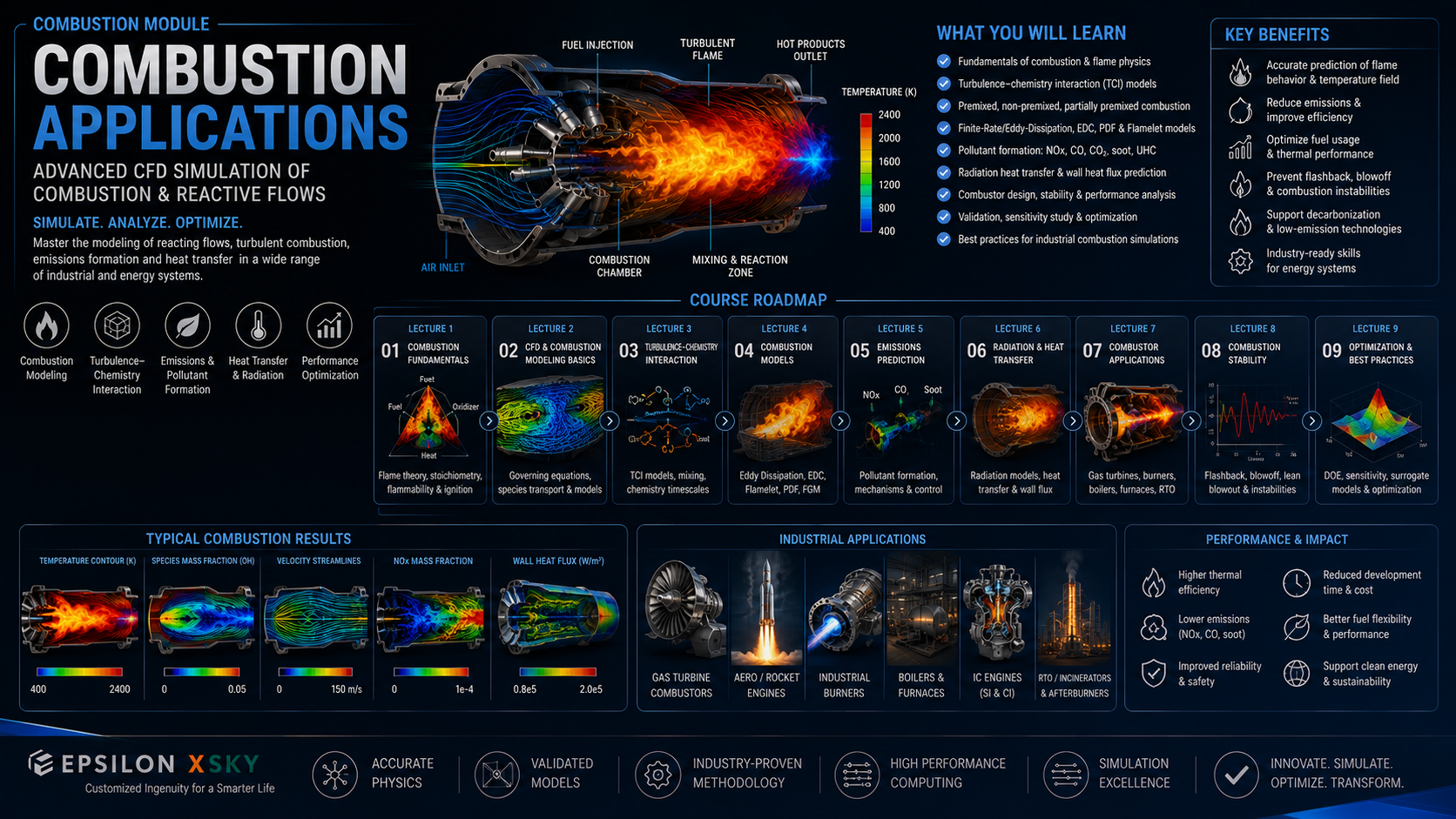
Course
Module 9 : Combustion Simulation Various industrial field
0 sessions
Overview
About this course
Module 9: Combustion Simulation – Industrial Applications
Advanced CFD Analysis of Combustion, Reacting Flows, and Industrial Energy Systems
Combustion is one of the most challenging areas of Computational Fluid Dynamics because it combines fluid flow, heat transfer, turbulence, chemical reactions, and species transport within a single simulation.
Module 9 at Epsilon X Sky introduces engineers to the practical application of CFD for industrial combustion systems. Participants learn how to build, solve, and interpret combustion models using ANSYS Fluent, with a strong focus on reacting flows, fuel combustion, species transport, particle behavior, and industrial burner systems.
The module moves from fundamental combustion concepts to practical industrial case studies, enabling participants to understand how CFD can be used to improve combustion efficiency, temperature distribution, fuel utilization, and overall system performance.
Understanding Combustion CFD
The module begins by establishing the numerical and physical foundations required to simulate reacting flows.
Participants explore the interaction between:
-Fluid flow
-Turbulence
-Chemical reactions
-Species transport
-Heat transfer
-Temperature
-Fuel and oxidizer mixing
Students learn how combustion models represent these physical phenomena and how modeling assumptions influence the final CFD solution.
The goal is to develop an understanding of what is happening inside the combustion solver, rather than treating combustion CFD as a simple software setup.
Combustion Project: CH₄ Burning & Species Transport
A dedicated industrial case study focuses on methane (CH₄) combustion using CFD.
Participants build a reacting-flow model to investigate the behavior of methane and its combustion products.
The project covers:
-CH₄ species transport
-Fuel and oxidizer mixing
-Combustion reaction
-Temperature distribution
-Species concentration
-Velocity field
-Pressure distribution
-Reaction regions
-Heat-release behavior
Students learn how to visualize and interpret the evolution of fuel and combustion products throughout the computational domain.
This project provides a practical foundation for understanding gas-phase combustion simulation in ANSYS Fluent.
Industrial Boiler & Burner CFD
The second major case study focuses on combustion inside an industrial boiler burner system.
Boilers and industrial burners require careful control of fuel-air mixing and combustion conditions to achieve efficient energy conversion while maintaining acceptable temperature distributions and emissions.
Participants investigate:
-Burner flow behavior
-Fuel injection
-Air distribution
-Mixing characteristics
-Flame development
-Temperature fields
-Combustion zones
-Pressure losses
-Thermal performance
The project demonstrates how CFD can support the design, troubleshooting, and optimization of industrial combustion equipment.
DPM Coal Combustion – Industrial CFD
Coal-fired combustion introduces an additional level of complexity because the fuel is represented by discrete particles transported through the continuous gas phase.
This project introduces the Discrete Phase Model (DPM) for industrial coal-combustion applications.
Participants investigate concepts such as:
-Particle injection
-Particle trajectories
-Particle-gas interaction
-Coal particle transport
-Particle heating
-Volatile release
-Combustion behavior
-Temperature distribution
-Residence time
The case study demonstrates how Eulerian fluid flow and Lagrangian particle tracking can be combined to model complex industrial combustion systems.
This provides valuable experience for engineers working with coal boilers, furnaces, burners, particle processing, and thermal-energy systems.
2D Industrial Combustion Approach
Before moving into highly complex three-dimensional combustion models, engineers can benefit from understanding simplified 2D combustion approaches.
This module demonstrates how two-dimensional models can be used to:
-Understand combustion physics
-Reduce computational requirements
-Test modeling assumptions
-Compare combustion configurations
-Investigate temperature distribution
-Study species transport
-Develop initial engineering designs
Participants learn when a 2D model is appropriate and when a full 3D simulation is required.
The approach provides an efficient methodology for developing and testing combustion models before applying them to more computationally demanding industrial geometries.
Combustion Modeling in ANSYS Fluent
Throughout the module, participants develop practical experience with the key components required for combustion CFD in ANSYS Fluent.
The workflow includes:
Geometry → Mesh → Materials → Species → Reactions → Boundary Conditions → Combustion Model → Solver → Convergence → Post-Processing
Students learn how each component affects the final combustion solution and how to diagnose common problems such as poor convergence, unrealistic temperatures, incorrect species behavior, and unstable reacting-flow solutions.
Analyzing Industrial Combustion Results
Obtaining a converged solution is only the beginning.
Participants learn how to interpret important combustion results, including:
-Temperature distribution
-Fuel concentration
-Oxygen concentration
-Combustion products
-Velocity fields
-Pressure distribution
-Reaction zones
-Heat-release regions
-Particle trajectories
-Residence time
These results allow engineers to evaluate whether a combustion system is operating efficiently and identify opportunities for design improvement.
Industrial Applications
The combustion methodologies covered in Module 9 can be applied to numerous industries, including:
-Power Generation
-Boilers
-Industrial Furnaces
-Gas Turbines
-Process Heating
-Oil & Gas
-Petrochemical Systems
-Cement Industry
-Steel Industry
-Coal-Fired Energy Systems
-Waste-to-Energy
-Industrial Burners
-Thermal Processing
The module therefore provides a foundation for applying CFD combustion techniques across a broad range of industrial energy and process-engineering applications.
By the End of Module 9, You Will Be Able To:
-Understand the fundamentals of combustion CFD.
-Set up reacting-flow simulations in ANSYS Fluent.
-Model CH₄ combustion and species transport.
-Analyze fuel-air mixing and combustion behavior.
-Evaluate temperature and species distributions.
-Develop CFD models for industrial boiler burners.
-Apply DPM concepts to coal-combustion simulations.
-Analyze particle trajectories and particle behavior.
-Develop simplified 2D industrial combustion models.
-Interpret combustion CFD results from an engineering perspective.
-Identify numerical and physical issues affecting combustion simulations.
-Apply combustion CFD methodologies to real industrial engineering problems.
Why This Module Matters
Combustion efficiency is directly connected to energy consumption, thermal performance, operating cost, and environmental impact.
CFD provides engineers with the ability to visualize and analyze combustion processes that are extremely difficult to observe experimentally inside operating industrial equipment.
Module 9 gives participants practical experience with combustion CFD through CH₄ combustion, industrial boiler burner analysis, DPM coal combustion, and 2D industrial combustion modeling.
At Epsilon X Sky, the objective is to move engineers beyond basic CFD and into advanced reacting-flow simulation, where fluid mechanics, chemistry, heat transfer, and particle dynamics come together to solve complex industrial combustion problems.